
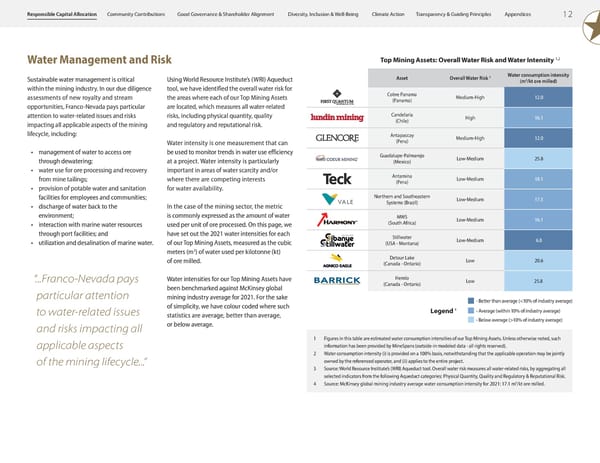
1 2 Appendices Transparency & Guiding Principles Climate Action Diversity, Inclusion & Well-Being Good Governance & Shareholder Alignment Community Contributions Responsible Capital Allocation Water Management and Risk Sustainable water management is critical within the mining industry. In our due diligence assessments of new royalty and stream opportunities, Franco-Nevada pays particular attention to water-related issues and risks impacting all applicable aspects of the mining lifecycle, including: • management of water to access ore through dewatering; • water use for ore processing and recovery from mine tailings; • provision of potable water and sanitation facilities for employees and communities; • discharge of water back to the environment; • interaction with marine water resources through port facilities; and • utilization and desalination of marine water. Using World Resource Institute’s (WRI) Aqueduct tool, we have identified the overall water risk for the areas where each of our Top Mining Assets are located, which measures all water-related risks, including physical quantity, quality and regulatory and reputational risk. Water intensity is one measurement that can be used to monitor trends in water use efficiency at a project. Water intensity is particularly important in areas of water scarcity and/or where there are competing interests for water availability. In the case of the mining sector, the metric is commonly expressed as the amount of water used per unit of ore processed. On this page, we have set out the 2021 water intensities for each of our Top Mining Assets, measured as the cubic meters (m 3 ) of water used per kilotonne (kt) of ore milled. Water intensities for our Top Mining Assets have been benchmarked against McKinsey global mining industry average for 2021. For the sake of simplicity, we have colour coded where such statistics are average, better than average, or below average. Top Mining Assets: Overall Water Risk and Water Intensity 1,2 Asset Overall Water Risk 3 Water consumption intensity (m 3 /kt ore milled) Cobre Panama (Panama) Medium-High 12.0 Candelaria (Chile) High 16.1 Antapaccay (Peru) Medium-High 12.0 Guadalupe-Palmarejo (Mexico) Low-Medium 25.8 Antamina (Peru) Low-Medium 18.1 Northern and Southeastern Systems (Brazil) Low-Medium 17.5 MWS (South Africa) Low-Medium 16.1 Stillwater (USA - Montana) Low-Medium 6.8 Detour Lake (Canada - Ontario) Low 20.6 Hemlo (Canada - Ontario) Low 25.8 “...Franco-Nevada pays particular attention to water-related issues and risks impacting all applicable aspects of the mining lifecycle...” 1 Figures in this table are estimated water consumption intensities of our Top Mining Assets. Unless otherwise noted, such information has been provided by MineSpans (outside-in modeled data - all rights reserved). 2 Water consumption intensity (i) is provided on a 100% basis, notwithstanding that the applicable operation may be jointly owned by the referenced operator, and (ii) applies to the entire project. 3 Source: World Resource Institute’s (WRI) Aqueduct tool. Overall water risk measures all water-related risks, by aggregating all selected indicators from the following Aqueduct categories: Physical Quantity, Quality and Regulatory & Reputational Risk. 4 Source: McKinsey global mining industry average water consumption intensity for 2021: 17.1 m 3 /kt ore milled. Legend 4 - Better than average (<10% of industry average) - Average (within 10% of industry average) - Below average (>10% of industry average)
 ESG Report 2023 Page 13 Page 15