
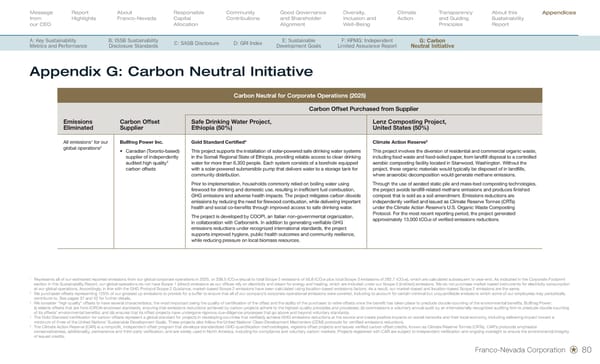
Appendix G: Carbon Neutral Initiative 1 Represents all of our estimated reported emissions from our global corporate operations in 2025, or 338.5 tCO 2 e (equal to total Scope 2 emissions of 55.8 tCO 2 e plus total Scope 3 emissions of 282.7 tCO 2 e), which are calculated subsequent to year-end. As indicated in the Corporate Footprint section in this Sustainability Report, our global operations do not have Scope 1 (direct) emissions as our offices rely on electricity and steam for energy and heating, which are included under our Scope 2 (indirect) emissions. We do not purchase market - based instruments for electricity consumption at our global operations. Accordingly, in line with the GHG Protocol Scope 2 Guidance, market - based Scope 2 emissions have been calculated using location - based emissions factors. As a result, our market - based and location - based Scope 2 emissions are the same. 2 We purchased offsets representing 125% of our grossed up emissions to provide for a buffer to ensure that all of our company’s corporate operational emissions were covered, including to account for certain minimal but unquantifiable emissions which some of our employees may periodically contribute to. See pages 37 and 42 for further details. 3 We consider "high quality" offsets to have several characteristics, the most important being the quality of certification of the offset and the ability of the purchaser to retire offsets once the benefit has taken place to preclude double-counting of the environmental benefits. Bullfrog Power: (i) selects offsets that are from ICROA-endorsed standards, ensuring that emissions reductions achieved by carbon projects adhere to the highest-quality principles and processes; (ii) commissions a voluntary annual audit by an internationally recognized auditing firm to preclude double counting of its offsets’ environmental benefits; and (iii) ensures that its offset projects have undergone rigorous due-diligence processes that go above and beyond voluntary standards. 4 The Gold Standard certification for carbon offsets represent a global standard for projects in developing countries that verifiably achieve GHG emissions reductions at the source and create positive impacts on social networks and their local economy, including delivering impact toward a minimum of three of the United Nations' Sustainable Development Goals. These projects also follow the United Nations’ Clean Development Mechanism (CDM) protocols for certified emissions reductions. 5 The Climate Action Reserve (CAR) is a nonprofit, independent offset program that develops standardized GHG quantification methodologies, registers offset projects and issues verified carbon offset credits, known as Climate Reserve Tonnes (CRTs). CAR’s protocols emphasize conservativeness, additionality, permanence and third - party verification, and are widely used in North America, including for compliance and voluntary carbon markets. Projects registered with CAR are subject to independent verification and ongoing oversight to ensure the environmental integrity of issued credits. Carbon Neutral for Corporate Operations (2025) Carbon Offset Purchased from Supplier Emissions Eliminated Carbon Offset Supplier Safe Drinking Water Project, Ethiopia (50%) Lenz Composting Project, United States (50%) All emissions 1 for our global operations 2 Bullfrog Power Inc. • Canadian (Toronto-based) supplier of independently audited high quality 3 carbon offsets Gold Standard Certified 4 This project supports the installation of solar - powered safe drinking water systems in the Somali Regional State of Ethiopia, providing reliable access to clean drinking water for more than 6,300 people. Each system consists of a borehole equipped with a solar - powered submersible pump that delivers water to a storage tank for community distribution. Prior to implementation, households commonly relied on boiling water using firewood for drinking and domestic use, resulting in inefficient fuel combustion, GHG emissions and adverse health impacts. The project mitigates carbon dioxide emissions by reducing the need for firewood combustion, while delivering important health and social co - benefits through improved access to safe drinking water. The project is developed by COOPI, an Italian non - governmental organization, in collaboration with Carbonsink. In addition to generating verifiable GHG emissions reductions under recognized international standards, the project supports improved hygiene, public health outcomes and community resilience, while reducing pressure on local biomass resources. Climate Action Reserve 5 This project involves the diversion of residential and commercial organic waste, including food waste and food - soiled paper, from landfill disposal to a controlled aerobic composting facility located in Stanwood, Washington. Without the project, these organic materials would typically be disposed of in landfills, where anaerobic decomposition would generate methane emissions. Through the use of aerated static pile and mass - bed composting technologies, the project avoids landfill - related methane emissions and produces finished compost that is sold as a soil amendment. Emissions reductions are independently verified and issued as Climate Reserve Tonnes (CRTs) under the Climate Action Reserve’s U.S. Organic Waste Composting Protocol. For the most recent reporting period, the project generated approximately 13,000 tCO 2 e of verified emissions reductions. Franco-Nevada Corporation 80
 Sustainability Report 2026 Page 81 Page 83