
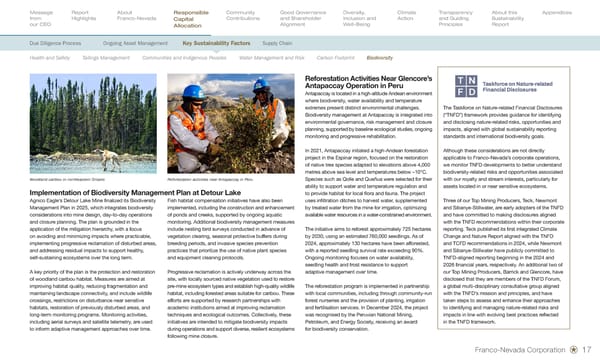
Woodland caribou in northeastern Ontario Reforestation activities near Antapaccay in Peru Implementation of Biodiversity Management Plan at Detour Lake Agnico Eagle’s Detour Lake Mine finalized its Biodiversity Management Plan in 2025, which integrates biodiversity considerations into mine design, day - to - day operations and closure planning. The plan is grounded in the application of the mitigation hierarchy, with a focus on avoiding and minimizing impacts where practicable, implementing progressive reclamation of disturbed areas, and addressing residual impacts to support healthy, self - sustaining ecosystems over the long term. A key priority of the plan is the protection and restoration of woodland caribou habitat. Measures are aimed at improving habitat quality, reducing fragmentation and maintaining landscape connectivity, and include wildlife crossings, restrictions on disturbance near sensitive habitats, restoration of previously disturbed areas, and long - term monitoring programs. Monitoring activities, including aerial surveys and satellite telemetry, are used to inform adaptive management approaches over time. Fish habitat compensation initiatives have also been implemented, including the construction and enhancement of ponds and creeks, supported by ongoing aquatic monitoring. Additional biodiversity management measures include nesting bird surveys conducted in advance of vegetation clearing, seasonal protective buffers during breeding periods, and invasive species prevention practices that prioritize the use of native plant species and equipment cleaning protocols. Progressive reclamation is actively underway across the site, with locally sourced native vegetation used to restore pre - mine ecosystem types and establish high - quality wildlife habitat, including forested areas suitable for caribou. These efforts are supported by research partnerships with academic institutions aimed at improving reclamation techniques and ecological outcomes. Collectively, these initiatives are intended to mitigate biodiversity impacts during operations and support diverse, resilient ecosystems following mine closure. Reforestation Activities Near Glencore’s Antapaccay Operation in Peru Antapaccay is located in a high - altitude Andean environment where biodiversity, water availability and temperature extremes present distinct environmental challenges. Biodiversity management at Antapaccay is integrated into environmental governance, risk management and closure planning, supported by baseline ecological studies, ongoing monitoring and progressive rehabilitation. In 2021, Antapaccay initiated a high - Andean forestation project in the Espinar region, focused on the restoration of native tree species adapted to elevations above 4,000 metres above sea level and temperatures below –10°C. Species such as Qolle and Queñua were selected for their ability to support water and temperature regulation and to provide habitat for local flora and fauna. The project uses infiltration ditches to harvest water, supplemented by treated water from the mine for irrigation, optimizing available water resources in a water - constrained environment. The initiative aims to reforest approximately 725 hectares by 2030, using an estimated 760,000 seedlings. As of 2024, approximately 130 hectares have been afforested, with a reported seedling survival rate exceeding 90%. Ongoing monitoring focuses on water availability, seedling health and frost resistance to support adaptive management over time. The reforestation program is implemented in partnership with local communities, including through community - run forest nurseries and the provision of planting, irrigation and fertilisation services. In December 2024, the project was recognised by the Peruvian National Mining, Petroleum, and Energy Society, receiving an award for biodiversity conservation. The Taskforce on Nature - related Financial Disclosures (“TNFD”) framework provides guidance for identifying and disclosing nature - related risks, opportunities and impacts, aligned with global sustainability reporting standards and international biodiversity goals. Although these considerations are not directly applicable to Franco - Nevada’s corporate operations, we monitor TNFD developments to better understand biodiversity - related risks and opportunities associated with our royalty and stream interests, particularly for assets located in or near sensitive ecosystems. Three of our Top Mining Producers, Teck, Newmont and Sibanye - Stillwater, are early adopters of the TNFD and have committed to making disclosures aligned with the TNFD recommendations within their corporate reporting. Teck published its first integrated Climate Change and Nature Report aligned with the TNFD and TCFD recommendations in 2024, while Newmont and Sibanye - Stillwater have publicly committed to TNFD - aligned reporting beginning in the 2024 and 2026 financial years, respectively. An additional two of our Top Mining Producers, Barrick and Glencore, have disclosed that they are members of the TNFD Forum, a global multi - disciplinary consultative group aligned with the TNFD’s mission and principles, and have taken steps to assess and enhance their approaches to identifying and managing nature - related risks and impacts in line with evolving best practices reflected in the TNFD framework. Franco-Nevada Corporation 17
 Sustainability Report 2026 Page 18 Page 20