
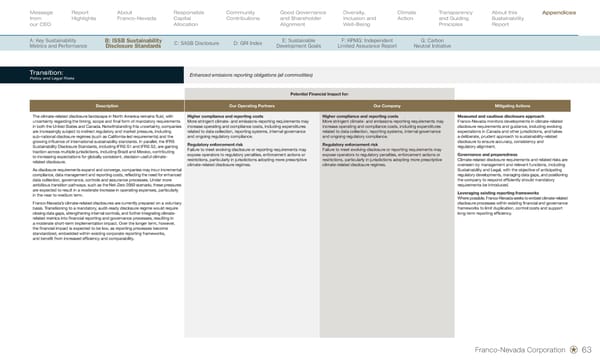
Transition: Policy and Legal Risks Potential Financial Impact for: Description Our Operating Partners Our Company Mitigating Actions The climate - related disclosure landscape in North America remains fluid, with uncertainty regarding the timing, scope and final form of mandatory requirements in both the United States and Canada. Notwithstanding this uncertainty, companies are increasingly subject to indirect regulatory and market pressure, including sub - national disclosure regimes (such as California - led requirements) and the growing influence of international sustainability standards. In parallel, the IFRS Sustainability Disclosure Standards, including IFRS S1 and IFRS S2, are gaining traction across multiple jurisdictions, including Brazil and Mexico, contributing to increasing expectations for globally consistent, decision - useful climate - related disclosure. As disclosure requirements expand and converge, companies may incur incremental compliance, data management and reporting costs, reflecting the need for enhanced data collection, governance, controls and assurance processes. Under more ambitious transition pathways, such as the Net-Zero 2050 scenario, these pressures are expected to result in a moderate increase in operating expenses, particularly in the near to medium term. Franco - Nevada’s climate - related disclosures are currently prepared on a voluntary basis. Transitioning to a mandatory, audit - ready disclosure regime would require closing data gaps, strengthening internal controls, and further integrating climate - related metrics into financial reporting and governance processes, resulting in a moderate short - term implementation impact. Over the longer term, however, the financial impact is expected to be low, as reporting processes become standardized, embedded within existing corporate reporting frameworks, and benefit from increased efficiency and comparability. Higher compliance and reporting costs More stringent climate - and emissions - reporting requirements may increase operating and compliance costs, including expenditures related to data collection, reporting systems, internal governance and ongoing regulatory compliance. Regulatory enforcement risk Failure to meet evolving disclosure or reporting requirements may expose operators to regulatory penalties, enforcement actions or restrictions, particularly in jurisdictions adopting more prescriptive climate - related disclosure regimes. Higher compliance and reporting costs More stringent climate - and emissions - reporting requirements may increase operating and compliance costs, including expenditures related to data collection, reporting systems, internal governance and ongoing regulatory compliance. Regulatory enforcement risk Failure to meet evolving disclosure or reporting requirements may expose operators to regulatory penalties, enforcement actions or restrictions, particularly in jurisdictions adopting more prescriptive climate - related disclosure regimes. Measured and cautious disclosure approach Franco - Nevada monitors developments in climate - related disclosure requirements and guidance, including evolving expectations in Canada and other jurisdictions, and takes a deliberate, prudent approach to sustainability-related disclosure to ensure accuracy, consistency and regulatory alignment. Governance and preparedness Climate - related disclosure requirements and related risks are overseen by management and relevant functions, including Sustainability and Legal, with the objective of anticipating regulatory developments, managing data gaps, and positioning the company to respond efficiently should mandatory requirements be introduced. Leveraging existing reporting frameworks Where possible, Franco - Nevada seeks to embed climate - related disclosure processes within existing financial and governance frameworks to limit duplication, control costs and support long - term reporting efficiency. Enhanced emissions reporting obligations (all commodities) Franco-Nevada Corporation 63
 Sustainability Report 2026 Page 64 Page 66