
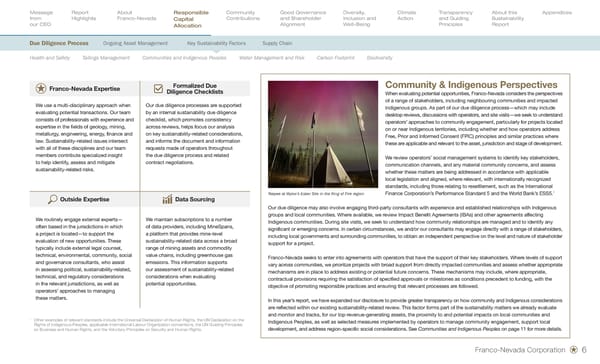
Community & Indigenous Perspectives When evaluating potential opportunities, Franco - Nevada considers the perspectives of a range of stakeholders, including neighbouring communities and impacted Indigenous groups. As part of our due diligence process—which may include desktop reviews, discussions with operators, and site visits—we seek to understand operators’ approaches to community engagement, particularly for projects located on or near Indigenous territories, including whether and how operators address Free, Prior and Informed Consent (FPIC) principles and similar practices where these are applicable and relevant to the asset, jurisdiction and stage of development. We review operators’ social management systems to identify key stakeholders, communication channels, and any material community concerns, and assess whether these matters are being addressed in accordance with applicable local legislation and aligned, where relevant, with internationally recognized standards, including those relating to resettlement, such as the International Finance Corporation’s Performance Standard 5 and the World Bank’s ESS5. 1 Our due diligence may also involve engaging third - party consultants with experience and established relationships with Indigenous groups and local communities. Where available, we review Impact Benefit Agreements (IBAs) and other agreements affecting Indigenous communities. During site visits, we seek to understand how community relationships are managed and to identify any significant or emerging concerns. In certain circumstances, we and/or our consultants may engage directly with a range of stakeholders, including local governments and surrounding communities, to obtain an independent perspective on the level and nature of stakeholder support for a project. Franco - Nevada seeks to enter into agreements with operators that have the support of their key stakeholders. Where levels of support vary across communities, we prioritize projects with broad support from directly impacted communities and assess whether appropriate mechanisms are in place to address existing or potential future concerns. These mechanisms may include, where appropriate, contractual provisions requiring the satisfaction of specified approvals or milestones as conditions precedent to funding, with the objective of promoting responsible practices and ensuring that relevant processes are followed. In this year’s report, we have expanded our disclosure to provide greater transparency on how community and Indigenous considerations are reflected within our existing sustainability - related review. This factor forms part of the sustainability matters we already evaluate and monitor and tracks, for our top revenue - generating assets, the proximity to and potential impacts on local communities and Indigenous Peoples, as well as selected measures implemented by operators to manage community engagement, support local development, and address region - specific social considerations. See Communities and Indigenous Peoples on page 11 for more details. Franco-Nevada Expertise Formalized Due Diligence Checklists We use a multi-disciplinary approach when evaluating potential transactions. Our team consists of professionals with experience and expertise in the fields of geology, mining, metallurgy, engineering, energy, finance and law. Sustainability-related issues intersect with all of these disciplines and our team members contribute specialized insight to help identify, assess and mitigate sustainability - related risks. Our due diligence processes are supported by an internal sustainability due diligence checklist, which promotes consistency across reviews, helps focus our analysis on key sustainability - related considerations, and informs the document and information requests made of operators throughout the due diligence process and related contract negotiations. Outside Expertise Data Sourcing We routinely engage external experts— often based in the jurisdictions in which a project is located—to support the evaluation of new opportunities. These typically include external legal counsel, technical, environmental, community, social and governance consultants, who assist in assessing political, sustainability - related, technical, and regulatory considerations in the relevant jurisdictions, as well as operators’ approaches to managing these matters. We maintain subscriptions to a number of data providers, including MineSpans, a platform that provides mine - level sustainability - related data across a broad range of mining assets and commodity value chains, including greenhouse gas emissions. This information supports our assessment of sustainability - related considerations when evaluating potential opportunities. Teepee at Wyloo's Esker Site in the Ring of Fire region 1 Other examples of relevant standards include the Universal Declaration of Human Rights, the UN Declaration on the Rights of Indigenous Peoples, applicable International Labour Organization conventions, the UN Guiding Principles on Business and Human Rights, and the Voluntary Principles on Security and Human Rights. Franco-Nevada Corporation 6
 Sustainability Report 2026 Page 7 Page 9