
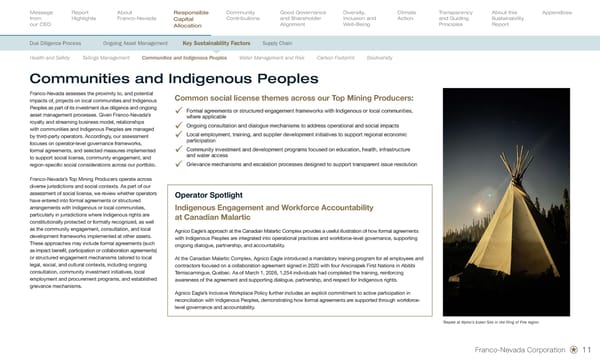
Communities and Indigenous Peoples Franco-Nevada assesses the proximity to, and potential impacts of, projects on local communities and Indigenous Peoples as part of its investment due diligence and ongoing asset management processes. Given Franco-Nevada’s royalty and streaming business model, relationships with communities and Indigenous Peoples are managed by third-party operators. Accordingly, our assessment focuses on operator-level governance frameworks, formal agreements, and selected measures implemented to support social license, community engagement, and region-specific social considerations across our portfolio. Franco-Nevada’s Top Mining Producers operate across diverse jurisdictions and social contexts. As part of our assessment of social license, we review whether operators have entered into formal agreements or structured arrangements with Indigenous or local communities, particularly in jurisdictions where Indigenous rights are constitutionally protected or formally recognized, as well as the community engagement, consultation, and local development frameworks implemented at other assets. These approaches may include formal agreements (such as impact benefit, participation or collaboration agreements) or structured engagement mechanisms tailored to local legal, social, and cultural contexts, including ongoing consultation, community investment initiatives, local employment and procurement programs, and established grievance mechanisms. Teepee at Wyloo's Esker Site in the Ring of Fire region Operator Spotlight Indigenous Engagement and Workforce Accountability at Canadian Malartic Agnico Eagle’s approach at the Canadian Malartic Complex provides a useful illustration of how formal agreements with Indigenous Peoples are integrated into operational practices and workforce-level governance, supporting ongoing dialogue, partnership, and accountability. At the Canadian Malartic Complex, Agnico Eagle introduced a mandatory training program for all employees and contractors focused on a collaboration agreement signed in 2020 with four Anicinapek First Nations in Abitibi Témiscamingue, Québec. As of March 1, 2026, 1,254 individuals had completed the training, reinforcing awareness of the agreement and supporting dialogue, partnership, and respect for Indigenous rights. Agnico Eagle’s Inclusive Workplace Policy further includes an explicit commitment to active participation in reconciliation with Indigenous Peoples, demonstrating how formal agreements are supported through workforce- level governance and accountability. Common social license themes across our Top Mining Producers: 9 Formal agreements or structured engagement frameworks with Indigenous or local communities, where applicable 9 Ongoing consultation and dialogue mechanisms to address operational and social impacts 9 Local employment, training, and supplier development initiatives to support regional economic participation 9 Community investment and development programs focused on education, health, infrastructure and water access 9 Grievance mechanisms and escalation processes designed to support transparent issue resolution Franco-Nevada Corporation 11
 Sustainability Report 2026 Page 12 Page 14