
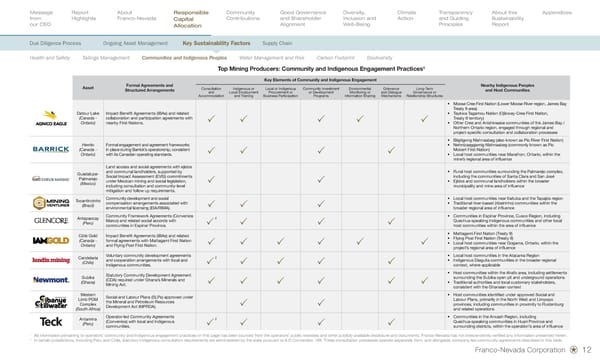
Top Mining Producers: Community and Indigenous Engagement Practices 1 Asset Formal Agreements and Structured Arrangements Key Elements of Community and Indigenous Engagement Nearby Indigenous Peoples and Host Communities Consultation and Accommodation Indigenous or Local Employment and Training Local or Indigenous Procurement or Business Participation Community Investment or Development Programs Environmental Monitoring or Information Sharing Grievance and Dialogue Mechanisms Long - Term Governance or Relationship Structures Detour Lake (Canada - Ontario) Impact Benefit Agreements (IBAs) and related collaboration and participation agreements with nearby First Nations. • Moose Cree First Nation (Lower Moose River region, James Bay Treaty 9 area) • Taykwa Tagamou Nation (Ojibway - Cree First Nation, Treaty 9 territory) • Other Cree and Anishinaabe communities of the James Bay / Northern Ontario region, engaged through regional and project - specific consultation and collaboration processes Hemlo (Canada - Ontario) Formal engagement and agreement frameworks in place during Barrick’s operatorship, consistent with its Canadian operating standards. • Biigtigong Nishnaabeg (also known as Pic River First Nation) • Netmizaaggamig Nishnaabeg (commonly known as Pic Mobert First Nation) • Local host communities near Marathon, Ontario, within the mine’s regional area of influence Guadalupe- Palmarejo (Mexico) Land access and social agreements with ejidos and communal landholders, supported by Social Impact Assessment (EVIS) commitments under Mexican mining and social legislation, including consultation and community-level mitigation and follow up requirements. • Rural host communities surrounding the Palmarejo complex, including the communities of Santa Clara and San José • Ejidos and communal landholders within the broader municipality and mine area of influence Tocantinzinho (Brazil) Community development and social compensation arrangements associated with environmental licensing (EIA/RIMA). • Local host communities near Itaituba and the Tapajós region • Traditional river - based (ribeirinho) communities within the broader regional area of influence Antapaccay (Peru) Community Framework Agreements (Convenios Marco) and related social accords with communities in Espinar Province. 2 • Communities in Espinar Province, Cusco Region, including Quechua - speaking Indigenous communities and other local host communities within the area of influence Côté Gold (Canada - Ontario) Impact Benefit Agreements (IBAs) and related formal agreements with Mattagami First Nation and Flying Post First Nation. • Mattagami First Nation (Treaty 9) • Flying Post First Nation (Treaty 9) • Local host communities near Gogama, Ontario, within the project’s regional area of influence Candelaria (Chile) Voluntary community development agreements and cooperation arrangements with local and Indigenous communities. 2 • Local host communities in the Atacama Region • Indigenous Diaguita communities in the broader regional context, where applicable Subika (Ghana) Statutory Community Development Agreement (CDA) required under Ghana’s Minerals and Mining Act. • Host communities within the Ahafo area, including settlements surrounding the Subika open pit and underground operations • Traditional authorities and local customary stakeholders, consistent with the Ghanaian context Western Limb PGM Complex (South Africa) Social and Labour Plans (SLPs) approved under the Mineral and Petroleum Resources Development Act (MPRDA). • Host communities identified under approved Social and Labour Plans, primarily in the North West and Limpopo provinces, including communities in proximity to Rustenburg and related operations Antamina (Peru) Operator - led Community Agreements (Convenios) with local and Indigenous communities. 2 • Communities in the Ancash Region, including Quechua - speaking communities in Huari Province and surrounding districts, within the operation’s area of influence 1 All information pertaining to operators’ community and Indigenous engagement practices on this page has been sourced from the operators’ public websites and other publicly available disclosure and documents. Franco-Nevada has not independently verified any information presented herein. 2 In certain jurisdictions, including Peru and Chile, statutory Indigenous consultation requirements are administered by the state pursuant to ILO Convention 169. These consultation processes operate separately from, and alongside, company-led community agreements described in this table. Franco-Nevada Corporation 12
 Sustainability Report 2026 Page 13 Page 15