
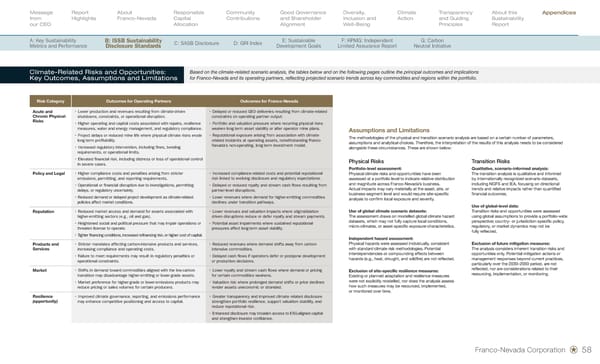
Based on the climate-related scenario analysis, the tables below and on the following pages outline the principal outcomes and implications for Franco-Nevada and its operating partners, reflecting projected scenario trends across key commodities and regions within the portfolio. Risk Category Outcomes for Operating Partners Outcomes for Franco-Nevada Acute and Chronic Physical Risks • Lower production and revenues resulting from climate-driven shutdowns, constraints, or operational disruption. • Higher operating and capital costs associated with repairs, resilience measures, water and energy management, and regulatory compliance. • Project delays or reduced mine life where physical climate risks erode long-term profitability. • Increased regulatory intervention, including fines, bonding requirements, or operational limits. • Elevated financial risk, including distress or loss of operational control in severe cases. • Delayed or reduced GEO deliveries resulting from climate-related constraints on operating partner output. • Portfolio and valuation pressure where recurring physical risks weaken long-term asset viability or alter operator mine plans. • Reputational exposure arising from association with climate- related incidents at operating assets, notwithstanding Franco- Nevada’s non-operating, long-term investment model. Policy and Legal • Higher compliance costs and penalties arising from stricter emissions, permitting, and reporting requirements. • Operational or financial disruption due to investigations, permitting delays, or regulatory uncertainty. • Reduced demand or delayed project development as climate-related policies affect market conditions. • Increased compliance-related costs and potential reputational risk linked to evolving disclosure and regulatory expectations. • Delayed or reduced royalty and stream cash flows resulting from partner-level disruptions. • Lower revenues where demand for higher-emitting commodities declines under transition pathways. Reputation • Reduced market access and demand for assets associated with higher-emitting sectors (e.g., oil and gas). • Heightened social and political pressure that may impair operations or threaten license to operate. • Tighter financing conditions, increased refinancing risk, or higher cost of capital. • Lower revenues and valuation impacts where stigmatization driven disruptions reduce or defer royalty and stream payments. • Potential asset impairments where sustained reputational pressures affect long-term asset viability. Products and Services • Stricter mandates affecting carbon-intensive products and services, increasing compliance and operating costs. • Failure to meet requirements may result in regulatory penalties or operational constraints. • Reduced revenues where demand shifts away from carbon- intensive commodities. • Delayed cash flows if operators defer or postpone development or production decisions. Market • Shifts in demand toward commodities aligned with the low-carbon transition may disadvantage higher-emitting or lower-grade assets. • Market preference for higher-grade or lower-emissions products may reduce pricing or sales volumes for certain producers. • Lower royalty and stream cash flows where demand or pricing for certain commodities weakens. • Valuation risk where prolonged demand shifts or price declines render assets uneconomic or stranded. Resilience (opportunity) • Improved climate governance, reporting, and emissions performance may enhance competitive positioning and access to capital. • Greater transparency and improved climate related disclosure strengthen portfolio resilience, support valuation stability, and reduce reputational risk. • Enhanced disclosure may broaden access to ESG-aligned capital and strengthen investor confidence. Climate-Related Risks and Opportunities: Key Outcomes, Assumptions and Limitations Assumptions and Limitations The methodologies of the physical and transition scenario analysis are based on a certain number of parameters, assumptions and analytical choices. Therefore, the interpretation of the results of this analysis needs to be considered alongside these circumstances. These are shown below: Physical Risks Portfolio-level assessment: Physical climate risks and opportunities have been assessed at a portfolio level to indicate relative distribution and magnitude across Franco - Nevada’s business. Actual impacts may vary materially at the asset, site, or business - segment level and would require site - specific analysis to confirm local exposure and severity. Use of global climate scenario datasets: The assessment draws on modelled global climate hazard datasets, which may not fully capture local conditions, micro - climates, or asset - specific exposure characteristics. Independent hazard assessment: Physical hazards were assessed individually, consistent with standard climate risk methodologies. Potential interdependencies or compounding effects between hazards (e.g., heat, drought, and wildfire) are not reflected. Exclusion of site-specific resilience measures: Existing or planned adaptation and resilience measures were not explicitly modelled, nor does the analysis assess how such measures may be resourced, implemented, or monitored over time. Transition Risks Qualitative, scenario - informed analysis: The transition analysis is qualitative and informed by internationally recognized scenario datasets, including NGFS and IEA, focusing on directional trends and relative impacts rather than quantified financial outcomes. Use of global-level data: Transition risks and opportunities were assessed using global assumptions to provide a portfolio - wide perspective; country - or jurisdiction - specific policy, regulatory, or market dynamics may not be fully reflected. Exclusion of future mitigation measures: The analysis considers inherent transition risks and opportunities only. Potential mitigation actions or management responses beyond current practices, particularly over the 2030–2050 period, are not reflected, nor are considerations related to their resourcing, implementation, or monitoring. Franco-Nevada Corporation 58
 Sustainability Report 2026 Page 59 Page 61