
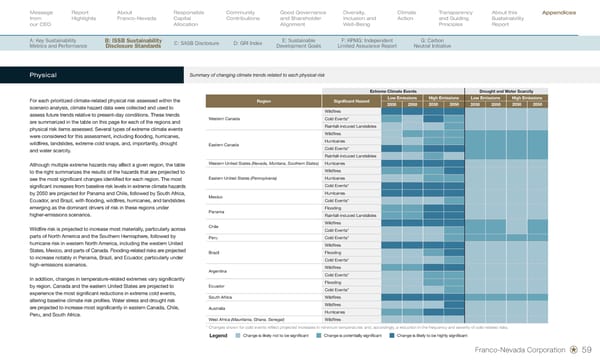
For each prioritized climate - related physical risk assessed within the scenario analysis, climate hazard data were collected and used to assess future trends relative to present - day conditions. These trends are summarized in the table on this page for each of the regions and physical risk items assessed. Several types of extreme climate events were considered for this assessment, including flooding, hurricanes, wildfires, landslides, extreme cold snaps, and, importantly, drought and water scarcity. Although multiple extreme hazards may affect a given region, the table to the right summarizes the results of the hazards that are projected to see the most significant changes identified for each region. The most significant increases from baseline risk levels in extreme climate hazards by 2050 are projected for Panama and Chile, followed by South Africa, Ecuador, and Brazil, with flooding, wildfires, hurricanes, and landslides emerging as the dominant drivers of risk in these regions under higher - emissions scenarios. Wildfire risk is projected to increase most materially, particularly across parts of North America and the Southern Hemisphere, followed by hurricane risk in western North America, including the western United States, Mexico, and parts of Canada. Flooding - related risks are projected to increase notably in Panama, Brazil, and Ecuador, particularly under high - emissions scenarios. In addition, changes in temperature - related extremes vary significantly by region. Canada and the eastern United States are projected to experience the most significant reductions in extreme cold events, altering baseline climate risk profiles. Water stress and drought risk are projected to increase most significantly in eastern Canada, Chile, Peru, and South Africa. Extreme Climate Events Drought and Water Scarcity Region Significant Hazard Low Emissions High Emissions Low Emissions High Emissions 2030 2050 2030 2050 2030 2050 2030 2050 Western Canada Wildfires Cold Events* Rainfall-induced Landslides Eastern Canada Wildfires Hurricanes Cold Events* Rainfall-induced Landslides Western United States (Nevada, Montana, Southern States) Hurricanes Eastern United States (Pennsylvania) Wildfires Hurricanes Cold Events* Mexico Hurricanes Cold Events* Panama Flooding Rainfall-induced Landslides Chile Wildfires Cold Events* Peru Cold Events* Brazil Wildfires Flooding Cold Events* Argentina Wildfires Cold Events* Ecuador Flooding Cold Events* South Africa Wildfires Australia Wildfires Hurricanes West Africa (Mauritania, Ghana, Senegal) Wildfires Legend Change is likely not to be significant Change is potentially significant Change is likely to be highly significant Physical Summary of changing climate trends related to each physical risk * Changes shown for cold events reflect projected increases in minimum temperatures and, accordingly, a reduction in the frequency and severity of cold - related risks. Franco-Nevada Corporation 59
 Sustainability Report 2026 Page 60 Page 62