
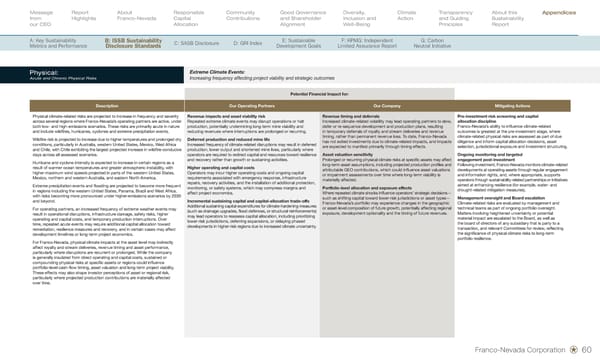
Potential Financial Impact for: Description Our Operating Partners Our Company Mitigating Actions Physical climate - related risks are projected to increase in frequency and severity across several regions where Franco - Nevada’s operating partners are active, under both low - and high - emissions scenarios. These risks are primarily acute in nature and include wildfires, hurricanes, cyclones and extreme precipitation events. Wildfire risk is projected to increase due to higher temperatures and prolonged dry conditions, particularly in Australia, western United States, Mexico, West Africa and Chile, with Chile exhibiting the largest projected increase in wildfire - conducive days across all assessed scenarios. Hurricane and cyclone intensity is expected to increase in certain regions as a result of warmer ocean temperatures and greater atmospheric instability, with higher maximum wind speeds projected in parts of the western United States, Mexico, northern and western Australia, and eastern North America. Extreme precipitation events and flooding are projected to become more frequent in regions including the western United States, Panama, Brazil and West Africa, with risks becoming more pronounced under higher - emissions scenarios by 2030 and beyond. For operating partners, an increased frequency of extreme weather events may result in operational disruptions, infrastructure damage, safety risks, higher operating and capital costs, and temporary production interruptions. Over time, repeated acute events may require additional capital allocation toward remediation, resilience measures and recovery, and in certain cases may affect development timelines or long - term project economics. For Franco - Nevada, physical climate impacts at the asset level may indirectly affect royalty and stream deliveries, revenue timing and asset performance, particularly where disruptions are recurrent or prolonged. While the company is generally insulated from direct operating and capital costs, sustained or compounding physical risks at specific assets or regions could influence portfolio - level cash - flow timing, asset valuation and long - term project viability. These effects may also shape investor perceptions of asset or regional risk, particularly where projected production contributions are materially affected over time. Revenue impacts and asset viability risk Repeated extreme climate events may disrupt operations or halt production, potentially undermining long - term mine viability and reducing revenues where interruptions are prolonged or recurring. Deferred production and reduced mine life Increased frequency of climate - related disruptions may result in deferred production, lower output and shortened mine lives, particularly where operators are required to redirect capital and resources toward resilience and recovery rather than growth or sustaining activities. Higher operating and capital costs Operators may incur higher operating costs and ongoing capital requirements associated with emergency response, infrastructure repairs, recovery activities, and the installation of additional protection, monitoring, or safety systems, which may compress margins and affect project economics. Incremental sustaining capital and capital - allocation trade - offs Additional sustaining capital expenditures for climate - hardening measures (such as drainage upgrades, flood defences, or structural reinforcements) may lead operators to reassess capital allocation, including prioritizing lower - risk jurisdictions, deferring expansions, or delaying phased developments in higher - risk regions due to increased climate uncertainty. Revenue timing and deferrals Increased climate - related volatility may lead operating partners to slow, defer or re - sequence development and production plans, resulting in temporary deferrals of royalty and stream deliveries and revenue timing, rather than permanent revenue loss. To date, Franco - Nevada has not exited investments due to climate - related impacts, and impacts are expected to manifest primarily through timing effects. Asset valuation sensitivity Prolonged or recurring physical climate risks at specific assets may affect long - term asset assumptions, including projected production profiles and attributable GEO contributions, which could influence asset valuations or impairment assessments over time where long - term viability is materially affected. Portfolio - level allocation and exposure effects Where repeated climate shocks influence operators’ strategic decisions— such as shifting capital toward lower - risk jurisdictions or asset types— Franco - Nevada’s portfolio may experience changes in the geographic or asset - level composition of future growth, potentially affecting regional exposure, development optionality and the timing of future revenues. Pre - investment risk screening and capital allocation discipline Franco - Nevada’s ability to influence climate - related outcomes is greatest at the pre - investment stage, where climate - related physical risks are assessed as part of due diligence and inform capital allocation decisions, asset selection, jurisdictional exposure and investment structuring. Ongoing monitoring and targeted engagement post - investment Following investment, Franco - Nevada monitors climate - related developments at operating assets through regular engagement and information rights, and, where appropriate, supports operators through sustainability - related partnerships or initiatives aimed at enhancing resilience (for example, water - and drought - related mitigation measures). Management oversight and Board escalation Climate - related risks are evaluated by management and technical teams as part of ongoing portfolio oversight. Matters involving heightened uncertainty or potential material impact are escalated to the Board, as well as the board of directors of any subsidiary that is party to a transaction, and relevant Committees for review, reflecting the significance of physical climate risks to long - term portfolio resilience. Physical: Acute and Chronic Physical Risks Extreme Climate Events: Increasing frequency affecting project viability and strategic outcomes Franco-Nevada Corporation 60
 Sustainability Report 2026 Page 61 Page 63