
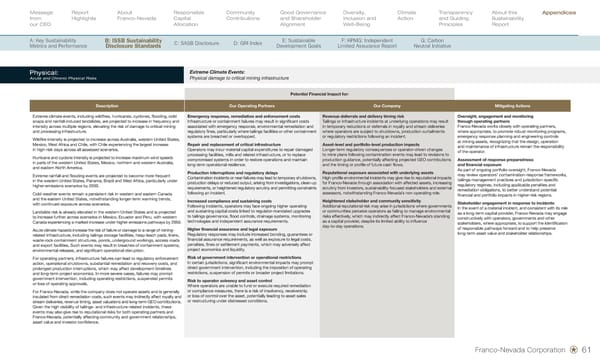
Potential Financial Impact for: Description Our Operating Partners Our Company Mitigating Actions Extreme climate events, including wildfires, hurricanes, cyclones, flooding, cold snaps and rainfall - induced landslides, are projected to increase in frequency and intensity across multiple regions, elevating the risk of damage to critical mining and processing infrastructure. Wildfire intensity is projected to increase across Australia, western United States, Mexico, West Africa and Chile, with Chile experiencing the largest increase in high - risk days across all assessed scenarios. Hurricane and cyclone intensity is projected to increase maximum wind speeds in parts of the western United States, Mexico, northern and western Australia, and eastern North America. Extreme rainfall and flooding events are projected to become more frequent in the western United States, Panama, Brazil and West Africa, particularly under higher - emissions scenarios by 2030. Cold - weather events remain a persistent risk in western and eastern Canada and the eastern United States, notwithstanding longer - term warming trends, with continued exposure across scenarios. Landslide risk is already elevated in the western United States and is projected to increase further across scenarios in Mexico, Ecuador and Peru, with western Canada experiencing a marked increase under higher - emissions pathways by 2050. Acute climate hazards increase the risk of failure or damage to a range of mining - related infrastructure, including tailings storage facilities, heap - leach pads, liners, waste - rock containment structures, ponds, underground workings, access roads and export facilities. Such events may result in breaches of containment systems, environmental releases, and significant operational disruption. For operating partners, infrastructure failures can lead to regulatory enforcement action, operational shutdowns, substantial remediation and recovery costs, and prolonged production interruptions, which may affect development timelines and long - term project economics. In more severe cases, failures may prompt government intervention, including operating restrictions, suspended permits or loss of operating approvals. For Franco - Nevada, while the company does not operate assets and is generally insulated from direct remediation costs, such events may indirectly affect royalty and stream deliveries, revenue timing, asset valuations and long - term GEO contributions. Given the high visibility of tailings - and infrastructure - related incidents, these events may also give rise to reputational risks for both operating partners and Franco - Nevada, potentially affecting community and government relationships, asset value and investor confidence. Emergency response, remediation and enforcement costs Infrastructure or containment failures may result in significant costs associated with emergency response, environmental remediation and regulatory fines, particularly where tailings facilities or other containment systems are breached or overtopped. Repair and replacement of critical infrastructure Operators may incur material capital expenditures to repair damaged processing facilities, mills and related infrastructure, or to replace compromised systems in order to restore operations and maintain long - term operational resilience. Production interruptions and regulatory delays Contamination incidents or near - failures may lead to temporary shutdowns, production delays or reduced output, arising from investigations, clean - up requirements, or heightened regulatory scrutiny and permitting constraints following an incident. Increased compliance and sustaining costs Following incidents, operators may face ongoing higher operating and sustaining capital costs linked to regulator - mandated upgrades to tailings governance, flood controls, drainage systems, monitoring technologies and independent assurance requirements. Higher financial assurance and legal exposure Regulatory responses may include increased bonding, guarantees or financial assurance requirements, as well as exposure to legal costs, penalties, fines or settlement payments, which may adversely affect project economics and liquidity. Risk of government intervention or operational restrictions In certain jurisdictions, significant environmental impacts may prompt direct government intervention, including the imposition of operating restrictions, suspension of permits or broader project limitations. Risk to operator solvency and asset control Where operators are unable to fund or execute required remediation or compliance measures, there is a risk of insolvency, receivership or loss of control over the asset, potentially leading to asset sales or restructuring under distressed conditions. Revenue deferrals and delivery timing risk Tailings or infrastructure incidents at underlying operations may result in temporary reductions or deferrals in royalty and stream deliveries where operators are subject to shutdowns, production curtailments or regulatory restrictions following an incident. Asset - level and portfolio - level production impacts Longer - term regulatory consequences or operator - driven changes to mine plans following contamination events may lead to revisions to production guidance, potentially affecting projected GEO contributions and the timing or profile of future cash flows. Reputational exposure associated with underlying assets High - profile environmental incidents may give rise to reputational impacts for Franco - Nevada through association with affected assets, increasing scrutiny from investors, sustainability - focused stakeholders and external assessors, notwithstanding Franco - Nevada’s non - operating role. Heightened stakeholder and community sensitivity Additional reputational risk may arise in jurisdictions where governments or communities perceive operators as failing to manage environmental risks effectively, which may indirectly affect Franco - Nevada’s standing as a capital provider, despite its limited ability to influence day - to - day operations. Oversight, engagement and monitoring through operating partners Franco - Nevada works closely with operating partners, where appropriate, to promote robust monitoring programs, emergency response planning and engineering controls at mining assets, recognizing that the design, operation and maintenance of infrastructure remain the responsibility of the operator. Assessment of response preparedness and financial exposure As part of ongoing portfolio oversight, Franco - Nevada may review operators’ contamination - response frameworks, tailings - management practices and jurisdiction - specific regulatory regimes, including applicable penalties and remediation obligations, to better understand potential financial and portfolio impacts in higher - risk regions. Stakeholder engagement in response to incidents In the event of a material incident, and consistent with its role as a long - term capital provider, Franco - Nevada may engage constructively with operators, governments and other stakeholders, where appropriate, to support the identification of responsible pathways forward and to help preserve long - term asset value and stakeholder relationships. Physical: Acute and Chronic Physical Risks Extreme Climate Events: Physical damage to critical mining infrastructure Franco-Nevada Corporation 61
 Sustainability Report 2026 Page 62 Page 64