
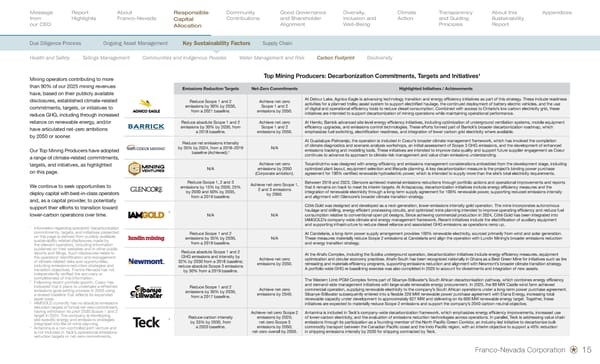
Mining operators contributing to more than 90% of our 2025 mining revenues have, based on their publicly available disclosures, established climate - related commitments, targets, or initiatives to reduce GHG, including through increased reliance on renewable energy, and/or have articulated net - zero ambitions by 2050 or sooner. Our Top Mining Producers have adopted a range of climate - related commitments, targets, and initiatives, as highlighted on this page. We continue to seek opportunities to deploy capital with best - in - class operators and, as a capital provider, to potentially support their efforts to transition toward lower - carbon operations over time. Top Mining Producers: Decarbonization Commitments, Targets and Initiatives 1 Emissions Reduction Targets Net-Zero Commitments Highlighted Initiatives / Achievements Reduce Scope 1 and 2 emissions by 30% by 2030, from a 2021 baseline. Achieve net-zero Scope 1 and 2 emissions by 2050. At Detour Lake, Agnico Eagle is advancing technology transition and energy efficiency initiatives as part of this strategy. These include readiness activities for a planned trolley assist system to support electrified haulage, the continued deployment of battery electric vehicles, and the use of digital and operational efficiency tools to reduce diesel consumption. Combined with access to Ontario’s low carbon electricity grid, these initiatives are intended to support decarbonization of mining operations while maintaining operational performance. Reduce absolute Scope 1 and 2 emissions by 30% by 2030, from a 2018 baseline. Achieve net-zero Scope 1 and 2 emissions by 2050. At Hemlo, Barrick advanced site level energy efficiency initiatives, including optimization of underground ventilation systems, mobile equipment efficiency upgrades, and emissions control technologies. These efforts formed part of Barrick’s broader decarbonization roadmap, which emphasizes fuel switching, electrification readiness, and integration of lower carbon grid electricity where available. Reduce net emissions intensity by 35% by 2024, from a 2018–2019 baseline (Achieved). 2 N/A At Guadalupe-Palmarejo, the operation is included in Coeur’s broader climate management framework, which has involved the completion of climate diagnostics and scenario analysis workshops, an initial assessment of Scope 3 GHG emissions, and the development of enhanced emissions tracking and modeling tools. These initiatives are intended to improve data quality and support future supplier engagement as Coeur continues to advance its approach to climate risk management and value chain emissions understanding. N/A Achieve net-zero emissions by 2050 (Corporate ambition). Tocantinzinho was designed with energy efficiency and emissions management considerations embedded from the development stage, including optimized plant layout, equipment selection and lifecycle planning. A key decarbonization measure is the project’s binding power purchase agreement for 100% certified renewable hydroelectric power, which is intended to supply more than the site’s total electricity requirements. Reduce Scope 1, 2 and 3 emissions by 15% by 2026, 25% by 2030 and 50% by 2035, from a 2019 baseline. Achieve net-zero Scope 1, 2 and 3 emissions by 2050. Between 2019 and 2023, Glencore achieved material emissions reductions through portfolio actions and operational improvements and reports that it remains on track to meet its interim targets. At Antapaccay, decarbonization initiatives include energy efficiency measures and the integration of renewable electricity through a long-term supply agreement for 100% renewable power, supporting reduced emissions intensity and alignment with Glencore’s broader climate transition strategy. 3 N/A N/A Côté Gold was designed and developed as a next-generation, lower-emissions intensity gold operation. The mine incorporates autonomous haulage and drilling, energy efficient processing circuits, and optimized mine planning intended to improve operating efficiency and reduce fuel consumption relative to conventional open pit designs. Since achieving commercial production in 2024, Côté Gold has been integrated into IAMGOLD’s company-wide climate and energy management framework. Recent initiatives include the electrification of auxiliary equipment and supporting infrastructure to reduce diesel reliance and associated GHG emissions as operations ramp up. Reduce Scope 1 and 2 emissions by 35% by 2030, from a 2019 baseline. N/A At Candelaria, a long-term power supply arrangement provides 100% renewable electricity, sourced primarily from wind and solar generation. These measures materially reduce Scope 2 emissions at Candelaria and align the operation with Lundin Mining’s broader emissions reduction and energy transition strategy. Reduce absolute Scope 1 and 2 GHG emissions and intensity by 32% by 2030 from a 2018 baseline; reduce absolute Scope 3 emissions by 30% from a 2019 baseline. Achieve net-zero emissions by 2050. At the Ahafo Complex, including the Subika underground operation, decarbonization initiatives include energy efficiency measures, equipment optimization and circular economy practices. Ahafo South has been recognized nationally in Ghana as a Best Green Mine for initiatives such as tire retreading and materials efficiency programs, supporting emissions reduction and alignment with Newmont’s broader climate transition strategy. A portfolio - wide GHG re - baselining exercise was also completed in 2025 to account for divestments and integration of new assets. Reduce Scope 1 and 2 emissions by 30% by 2030, from a 2017 baseline. Achieve net-zero emissions by 2040. The Western Limb PGM Complex forms part of Sibanye-Stillwater’s South African decarbonisation pathway, which combines energy efficiency and demand-side management initiatives with large-scale renewable energy procurement. In 2025, the 89 MW Castle wind farm achieved commercial operation, supplying renewable electricity to the company’s South African operations under a long-term power purchase agreement. Sibanye-Stillwater subsequently entered into a flexible 220 MW renewable power purchase agreement with Etana Energy, increasing total renewable capacity under development to approximately 627 MW and delivering on its 600 MW renewable energy target. Together, these initiatives are expected to materially reduce Scope 2 emissions and support the company’s 2040 carbon-neutral objective. 4 Reduce carbon intensity by 33% by 2030, from a 2020 baseline. Achieve net-zero Scope 2 emissions by 2025; net-zero Scope 3 emissions by 2050; net-zero overall by 2050. Antamina is included in Teck’s company-wide decarbonization framework, which emphasizes energy efficiency improvements, increased use of lower-carbon electricity, and the evaluation of emissions reduction technologies across operations. In parallel, Teck is addressing value chain emissions through its participation as a founding member of the North Pacific Green Corridor, an industry-led initiative to decarbonize bulk commodity transport between the Canadian Pacific coast and the Indo Pacific region, with an interim objective to support a 40% reduction in shipping emissions intensity by 2030 for shipping contracted by Teck. 1 Information regarding operators’ decarbonization commitments, targets, and initiatives presented on this page is derived from publicly available sustainability related disclosures made by the relevant operators, including information published on their websites and in other public reports and filings. Such disclosures relate to the operators’ identification and management of climate-related risks and opportunities, including emissions reduction strategies and transition objectives. Franco-Nevada has not independently verified the accuracy or completeness of this information. 2 Following recent portfolio growth, Coeur has indicated that it plans to undertake a refreshed emissions goal - setting process in 2026 using a revised baseline that reflects its expanded asset base. 3 IAMGOLD currently has no absolute emissions reduction targets or formal net-zero commitment, having withdrawn its prior 2030 Scope 1 and 2 target in 2024. The company is developing site-specific energy and emissions strategies integrated into life-of-mine planning. 4 Antamina is a non-controlled joint venture and is not included in Teck’s operational emissions reduction targets or net-zero commitments. Franco-Nevada Corporation 15
 Sustainability Report 2026 Page 16 Page 18