
ESG Report 2023
The 2023 ESG Report details Franco-Nevada’s environmental, social, and governance progress, highlighting its commitment to responsible capital allocation, diversity goals, and a net-zero target for corporate operations by 2050.
2023 ESG Report
Appendices Transparency & Guiding Principles Climate Action Diversity, Inclusion & Well-Being Good Governance & Shareholder Alignment Community Contributions Responsible Capital Allocation Table of Contents Message from our CEO 1 Report Highlights 2 About Franco-Nevada 4 Responsible Capital Allocation 5 Due Diligence Process 6 Ongoing Asset Management 7 Key ESG Factors 8 • Health and Safety 9 • Carbon Footprint 10 • Water Management and Risk 12 • Tailings Management 13 • Biodiversity 14 Sustainable Investment Opportunities 16 Supply Chain 19 Community Contributions 20 Community Support 21 Industry and Other Support 22 Good Governance and Shareholder Alignment 23 Corporate Governance 24 Integrity and Compliance 25 Shareholder Alignment 26 Information Security 27 Diversity, Inclusion and Well-Being 28 Diversity and Inclusion 29 Employee Benefits and Well-Being 32 Health, Safety and Security 33 Human Rights, Non-Discrimination, Anti-Harassment and Equal Opportunity 34 Climate Action 35 Climate Action Commitments and Plans 36 Overall Carbon Footprint 37 Corporate Footprint 39 Investment Footprint 42 Transparency and Guiding Principles 43 TCFD, SASB, and GRI 44 UN Global Compact and SDGs 45 Responsible Gold Mining Principles 46 ESG Ratings and Recognition 48 About this ESG Report 49 Appendices 50 Appendix A: ESG Performance Table 51 Appendix B: Operators’ Emissions 53 Appendix C: TCFD Disclosure 57 Appendix D: SASB Disclosure 73 Appendix E: GRI Index 76 Appendix F: Sustainable Development Goals 80 Appendix G: KPMG: Independent Limited Assurance Report 82 Appendix H: Carbon Neutral Initiative 83
1 Appendices Transparency & Guiding Principles Climate Action Diversity, Inclusion & Well-Being Good Governance & Shareholder Alignment Community Contributions Responsible Capital Allocation I am pleased to share our ESG Report, which describes the progress we and our partners have made on environmental, social and governance (“ESG”) issues and on our expanded commitments to sustainability. As a royalty and streaming company, we do not operate mines, develop projects or conduct exploration. Our ESG efforts fall into two categories: those relating to the operators, operations and local communities, where we deploy capital for acquisitions and those applicable to our corporate operations, including to our management, directors, and suppliers. Investment Focus Our shareholders expect us, and we are committed, to allocate capital to responsible operators that provide safe workplaces for their workforce, limit the environmental impacts of their projects and provide net benefits for their communities. We evaluate environmental and community impacts along with the technical aspects of operations during our due diligence for potential opportunities. We also seek to negotiate operator commitments to conduct operations in accordance with best operating and sustainability practices and to provide transparent reporting on their operations. Our principal ESG-related focuses when making acquisitions are as follows: • Health and safety track records, including evaluating each project’s safety performance statistics. • Carbon footprints and climate-related commitments, plans, targets and initiatives and, when available, an assessment of emissions-related metrics, such as carbon intensity. • Water risk, use and discharge and, to the extent applicable, a review of water consumption and water intensity performance indicators. • The design of planned or existing waste and tailings storage facilities and commitments from operators to implement and maintain international tailings standards. • The impact on biodiversity and ecosystems through project lifecycle, including preliminary assessments of impacts, life of project “no-net-loss” commitments, and rehabilitation and reclamation. You will see these project-specific priorities described in detail in this ESG Report, including disclosure relating to how the operators of our principal assets have performed in each category. Our second investment-oriented effort is partnering with our operators on initiatives to benefit the communities where our royalty and stream assets are located. In 2022, we increased our funding of community contributions and made several new commitments. Corporate Focus We are committed to responsible governance practices to ensure integrity in our dealings, compliance with our undertakings and alignment with our shareholders. Our Board and management team are substantial shareholders of the company, currently holding more than US$200 million in stock, and we treat shareholder funds as our own, with industry-leading low G&A, even relative to Gold ETF fees. We seek to maintain a safe and supportive environment for our team members and remove barriers and promote diversity and inclusion within our company, our communities, and in our industry. We actively seek out diverse candidates in our hiring processes and have adopted objective diversity targets for our Board of Directors and senior management. We also seek to promote diversity in the mining industry. We have made a number of donations in furtherance of our BlackNorth Initiative pledge and, in 2022, expanded the number of Franco-Nevada Diversity Scholarship awards. General Focus Climate action is an important priority for our company that relates to both our investments and our own corporate operations. We are committed to consider the decarbonization efforts and net-zero alignment of operators and operations when making investment decisions and to achieve net-zero emissions by 2050 with respect to our own corporate operations. Our climate-related plans and commitments have been formalized in our recently adopted Climate Action Policy, which is described in this ESG Report. We are also committed to providing transparency in all ESG matters relating to our business. In this ESG Report, we have measured, disclosed and attributed to our Scope 3 reporting, proportional greenhouse gas emissions from our royalty and stream interests. We have also provided disclosure aligned with the Task Force on Climate-related Financial Disclosures (TCFD) recommendations and the Sustainability Accounting Standards Board (SASB) framework, and first-time disclosure aligned with the Global Reporting Initiative (GRI) standards. We continue to rank highly with leading ESG rating agencies, which is demonstrative of our ongoing dedication to fulfilling our investment and corporate commitments and to increasing transparency in our ESG disclosure. Thank you for your continued support of Franco-Nevada. We look forward to speaking with many of you over the coming months. Message from our CEO Paul Brink, President & CEO Paul Brink President & CEO
2 Appendices Transparency & Guiding Principles Climate Action Diversity, Inclusion & Well-Being Good Governance & Shareholder Alignment Community Contributions Responsible Capital Allocation Due diligence to invest in strong ESG performers Our principal ESG-related focuses when making investments are highlighted in this ESG Report, including health and safety, carbon footprint, water management and risk, tailings management and biodiversity. We have also assessed how the operators of our top revenue-generating assets have performed in each of these five categories. Read more à (page 8) Furthered diverse representation and diversity initiatives We increased the diverse representation in our global workforce, with 43% of senior management and 60% of our overall team comprised of diverse persons. We have also expanded our Board diversity targets with the new goal of having, by 2025, at least one diverse director on grounds broader than gender diversity. The number of Franco-Nevada Diversity Scholarship awards were increased in 2022 and we made several diversity-related donations and contributions, including in furtherance of our BlackNorth Initiative pledge and our support of The Prosperity Project. Read more à (page 29) New climate action policy and net-zero goals and commitments We have adopted a Climate Action Policy, which sets out our goal to achieve net-zero GHG emissions by 2050 at our corporate workplaces and the measures we will take to further this goal, including measuring and disclosing our corporate GHG emissions, adopting science- based GHG emission reduction targets, and providing annual updates on our progress. We also commit to evaluate the decarbonization commitments, plans, targets and initiatives of operators and operations, including their alignment with net-zero, when making investment decisions and to engage with existing partners on their plans and progress toward net-zero. Read more à (page 36) Increased community contributions and commitments Our community contributions funded increased year-over-year, including our renewed Enseña Peru funding and the Alto Huarca water project, among other initiatives. During the year, we made new commitments with G Mining Ventures and Argonaut Gold to partner in community initiatives near their operations where we invested in 2022. We continue to support mining industry groups and diversity initiatives. Read more à (page 21) Focus on employee well-being and accommodations Maintaining a safe and supportive environment for our global workforce is a top priority for Franco-Nevada. We have highlighted the efforts made by our organization to promote the physical and mental well-being of our employees, including providing hybrid work arrangements, health benefits, wellness allowances, accommodations for cultural and religious beliefs, and the ability to disconnect when not working. Read more à (page 32) Financed emissions are included in Scope 3 emissions We have measured and disclosed financed GHG emissions attributable to our royalty and stream interests. Financed GHG emissions were calculated in alignment with the Greenhouse Gas Protocol reporting standards and included as Scope 3, Category 15 (Investments) emissions. In this ESG Report, we include a primer for navigating the Greenhouse Gas Protocol standards, including what comprises Scope 1, 2 and 3 emissions. Read more à (page 42) Report Highlights Continental Resources’ solar panels at West Blaine recycling facility, which Franco-Nevada is helping to finance Lloyd Hong, Chief Legal Officer (left) and Sandip Rana, Chief Financial Officer (right)
3 Appendices Transparency & Guiding Principles Climate Action Diversity, Inclusion & Well-Being Good Governance & Shareholder Alignment Community Contributions Responsible Capital Allocation Initiatives aligned with UN Sustainable Development Goals Initiatives across our business help advance a number of the Sustainable Development Goals (SDGs), which were adopted by the United Nations in 2015 as a universal call to action to end poverty, protect the planet, and ensure that by 2030 all people enjoy peace and prosperity. Read more à (page 45) Continued high rankings and recognition from ESG rating agencies We continue to receive recognition for our ESG efforts and rank highly with top ESG rating agencies, including 2022 ratings of “AA” by MSCI and “Prime” by ISS ESG. In 2022, we were also included as one of Corporate Knights Best 50 Corporate Citizens in Canada. We recently received a “Global 50 Top-Rated” ESG score for 2023 from Sustainalytics, which places us among a select group of all the companies that Sustainalytics ranks globally. Read more à (page 48) Maintained carbon neutrality for corporate emissions Since 2020, we have maintained carbon neutrality for our office operations. We have accomplished this, and will continue to do so through the reduction of our corporate GHG emissions and the purchase of high quality carbon credits to offset emissions that cannot be eliminated. Read more à (page 41) Alignment of ESG reporting with TCFD and SASB and first-time alignment with the GRI standards Our ESG disclosure is aligned with leading reporting frameworks, including the Sustainability Accounting Standards Board (SASB) and the Task Force on Climate-Related Financial Disclosures (TCFD) frameworks. This ESG Report also includes first-time reporting in line with the Global Reporting Initiative (GRI) standards. Read more à (page 44) Report Highlights (continued) Commerce Court West, Toronto “We are committed to providing transparency in all ESG matters relating to our business... We have provided disclosure aligned with the Task Force on Climate-related Financial Disclosures (TCFD) recommendations and the Sustainability Accounting Standards Board (SASB) framework, and first-time disclosure aligned with the Global Reporting Initiative (GRI) standards.“
4 Appendices Transparency & Guiding Principles Climate Action Diversity, Inclusion & Well-Being Good Governance & Shareholder Alignment Community Contributions Responsible Capital Allocation About Franco-Nevada We are the leading gold-focused royalty and stream company with the largest and most diversified portfolio of royalties and streams by commodity, geography, operator, revenue type and stage of project. We do not operate mines, develop projects or conduct exploration. Franco-Nevada has a free cash flow generating business with limited future capital commitments and management is focused on managing and growing its portfolio of royalties and streams. Our shares are listed on the Toronto and New York stock exchanges under the symbol FNV. An investment in our shares is expected to provide investors with yield and exposure to commodity price and exploration optionality while limiting exposure to cost inflation and other operating risks. Our tag-line is “Franco-Nevada is the gold investment that works” and we are committed to ensuring it does work, for our shareholders, our operating partners and our communities: • We believe that combining lower-risk gold investments with a strong balance sheet, progressively growing dividends and exposure to exploration optionality is the right mix to appeal to investors seeking to hedge market instability. Since our initial public offering over 15 years ago, we have increased our dividend annually and our share price has outperformed the gold price and all relevant gold equity benchmarks. • We build long-term alignment with our operating partners. This alignment and the natural flexibility of our royalties and streams is an effective source of capital for the cyclical resource sector. • We work to be a positive force in all our communities, promoting responsible mining, providing a safe and diverse workplace and contributing to build community support for the operations in which we invest. Our revenue is generated from various forms of agreements, ranging from net smelter return royalties, streams, net profits interests, net royalty interests, working interests and other types of arrangements. We recognize the cyclical nature of the industry and have a long-term investment outlook. We maintain a strong balance sheet to minimize financial risk and so that we can make investments during commodity cycle downturns. The focus of our business is to create exposure to gold and precious metal resource optionality. This principally involves investments in gold mines and providing funding to copper and other base metal mines to obtain exposure to by-product gold, silver and platinum group metals production. We also invest in other metals to expose our shareholders to additional resource optionality. Franco-Nevada Corporation Board of Directors at the Cobre Panama mine, Panama (2022) Franco-Nevada global workforce, Canada (2022) “Our tag-line is “Franco-Nevada is the gold investment that works” and we are committed to ensuring it does work, for our shareholders, our operating partners and our communities...”
Appendices Transparency & Guiding Principles Climate Action Diversity, Inclusion & Well-Being Good Governance & Shareholder Alignment Community Contributions 5 Responsible Capital Allocation Contents Due Diligence Process 6 Ongoing Asset Management 7 Key ESG Factors 8 • Health and Safety 9 • Carbon Footprint 10 • Water Management and Risk 12 • Tailings Management 13 • Biodiversity 14 Sustainable Investment Opportunities 16 Supply Chain 19 Responsible Capital Allocation We are committed to allocating capital to responsible operators that provide safe workplaces for their workforce, limit the environmental impacts of their projects and provide net benefits for their communities. Employees at Condestable project, Peru
6 Appendices Transparency & Guiding Principles Climate Action Diversity, Inclusion & Well-Being Good Governance & Shareholder Alignment Community Contributions Responsible Capital Allocation Due Diligence Process As a royalty and stream company, we do not operate mining or energy projects and do not exercise control over such operations. It follows that the most critical time for assessing and mitigating risks, including ESG risks, relating to an asset is at the outset, prior to entering into royalty and stream agreements. We believe that proper consideration of ESG risks in connection with the companies, projects and jurisdictions in which we seek to deploy capital will enhance the long-term performance of our company and in turn generate real value for our shareholders. With each royalty and stream opportunity we conduct a comprehensive assessment of ESG factors, which guides our investment decisions. Although we have top focuses in our ESG-related due diligence (see Key ESG Factors on page 8 for further detail), and processes vary depending on the nature of the opportunity, we will typically assess the following, with no single factor necessarily being determinative: • health, safety and human rights records of the project and operator; • climate-related impact of the project, including emission reduction commitments, targets and goals, including alignment with net-zero emissions; • energy sources and requirements and efficiency of operations; • water risk, requirements, sourcing and management plans; • tailings facilities and waste rock storage at the project and tailings standards adhered to by the operator; • impacts of development and operations on fauna, flora and biodiversity and no-net-loss initiatives and commitments of operators; • review of any environmental incidents relating to the project; • impacts of mining, operations and related activities on surrounding communities, including women, children, employees and migrant workers; • ethical track record and any history of corruption; • the reputation of the operator, locally and internationally; • workplace standards, protections and policies; • community initiatives and engagement and prior consultation with indigenous peoples; • closure plans; • air emissions and dust from the project; • management by the operator of toxic materials; • environmental, social and governance policies, programs and initiatives put in place by operator; • the commitments by, and track record of, the operator to fundamental freedoms of individuals (including relating to freedom of association, forced labour, human trafficking, child labour, non-discrimination and equal opportunity); • external certifications obtained by the operator or project; and • operator commitments to the Responsible Gold Mining Principles (RGMPs) or the principles of the International Council on Mining & Metals (ICMM), Canadian Institute of Mining Metallurgy and Petroleum (CIM), Towards Sustainable Mining (TSM) or other relevant standards. Franco-Nevada Expertise Formalized Due Diligence Checklists We use a multi-disciplinary approach when evaluating potential transactions. Beyond Franco-Nevada’s ESG expertise, our team consists of professionals with experience and expertise in the fields of geology, mining, metallurgy, engineering, energy, finance and law. ESG-related issues intersect with all of these disciplines and our team members provide valuable insight to properly mitigate ESG risks. We have enhanced our due diligence processes by creating an internal ESG due diligence checklist, which ensures consistency in our due diligence processes, help focus our ESG due diligence review on key issues, and inform our ESG-related document and information requests made of operators during all stages of our due diligence and contract negotiations. Outside Expertise Data Sourcing We routinely engage experts (including in the jurisdictions in which a project is located) to assist in the evaluation of new opportunities, which experts include external legal counsel, technical consultants, environmental consultants, corporate social responsibility consultants and governance consultants for the purpose of assessing political, ESG, technical and regulatory issues in applicable jurisdictions and the operator’s management of these issues. We have several data provider subscriptions, including McKinsey MineSpans, a data platform that provides over 1,000 data points per mine, including carbon and other greenhouse gas emissions generated by projects, for over 3,800 mines across the globe. We use this information to better inform our review of ESG-related issues for potential opportunities. “We believe that proper consideration of ESG risks in connection with the companies, projects and jurisdictions in which we seek to deploy capital will enhance the long-term performance of our company and in turn generate real value for our shareholders.” When we evaluate third party royalty acquisition opportunities, we typically have access to limited data regarding an operation as we are not directly engaged with the operator. Notwithstanding, we review any ESG and other information we can gather in the public domain and from outside consultants, including relating to the aforementioned topics. We use the following processes to facilitate our ESG-related due diligence:
7 Appendices Transparency & Guiding Principles Climate Action Diversity, Inclusion & Well-Being Good Governance & Shareholder Alignment Community Contributions Responsible Capital Allocation Ongoing Asset Management Royalty and stream agreements differ in many respects, but typically include the following types of provisions: “...our royalty and streaming agreements typically contain certain operating covenants designed to ensure that operators are conducting operations in accordance with applicable law and responsible practices...” Our royalty and streaming agreements typically contain a series of reporting obligations including the delivery of monthly and annual reports, updated mine plans, forecasts and other documentation, which serve to keep us informed of operations. Operators are also typically required to notify us of any material adverse changes to a project or its operations. Upon a material adverse change occurring, we maintain regular communication and offer our guidance and expertise to the operators, where appropriate. These reporting obligations keep us informed of ESG-related issues when they arise. Given our business model, following our initial acquisition of royalties or streams, we are not involved in our operators’ development and operation of the applicable projects. However, our royalty and streaming agreements typically contain certain operating covenants designed to ensure that operators are conducting operations in accordance with applicable law and responsible practices, including ESG-related standards such as the RGMPs and ICMM, CIM or TSM mining principles. Streaming agreements afford us the ability to terminate and recover specific remedies upon a material breach of the contractual provisions providing us with the flexibility to exit unsuitable arrangements. In some instances, we have security arrangements in respect of our royalty and stream interests (including share pledges, account pledges, mortgages and corporate guarantees), which would enable us to exert influence in the event of bankruptcy, insolvency or other event of a default. Such arrangements provide additional protections to help address material ESG risks. Our royalty and streaming agreements may have restrictions that either (a) require our consent for the operator to transfer the project, or (b) otherwise establish the circumstances in which such transfer is permissible. Such constraints are intended to ensure we continue to be partnered with a quality operator over the life of the agreement and a responsible actor when it comes to ESG-related issues. We are usually entitled to audit the books and records of the operators on a periodic basis and may access and inspect the properties comprising the project. These rights provide us further insight into the operations and management by the operators. These provisions permit us to confirm compliance with the terms of the agreements, including with covenants to comply with international tailings standards, and with applicable laws, including environmental laws and ESG-related industry standards. Reporting Obligations: Operating Covenants: Security & Remedies: Transfer Restrictions: Audit & Inspection Rights: (Left to Right): Matt Begeman (VP, Business Development), Eaun Gray (SVP, Business Development), Chris Bell (VP, Geology) and Phil Wilson (VP, Technical)
8 Appendices Transparency & Guiding Principles Climate Action Diversity, Inclusion & Well-Being Good Governance & Shareholder Alignment Community Contributions Responsible Capital Allocation Cobre Panama, Panama Northern and Southeastern Systems, Brazil Mine Waste Solutions, South Africa Antapaccay, Peru Guadalupe-Palmarejo, Mexico Stillwater, Montana, U.S. Candelaria, Chile Detour Gold, Ontario, Canada Hemlo, Ontario, Canada Antamina, Peru Key ESG Factors In the preceding pages of this ESG Report, we described the many ESG-related factors that we evaluate when making acquisitions, some of which we continue to monitor with our existing assets. At Franco-Nevada, we prioritize the following five ESG-related factors relating to investments, which are described in further detail in the following sections: • Health and Safety: We are focused on the health and safety track records of the operators and operations where we look to deploy capital. • Carbon Footprint: We evaluate the carbon footprints and climate-related commitments, targets and initiatives of operators and operations. • Water Management and Risk: We are attentive to water-related issues and risks impacting all applicable aspects of the mining lifecycle. • Tailings Management: We review all aspects of a project’s planned or constructed waste and tailings storage facilities, including implementation of, and adherence to, international tailings standards. • Biodiversity: We review the impact on biodiversity and ecosystems throughout the lifecycle of a project. For each of these five key factors, we have included an assessment of how the top 10 revenue generating mining assets in our portfolio (the “Top Mining Assets”) and, where applicable, the operators of such assets (the “Top Mining Producers”), have performed. The Top Mining Assets highlight the diversification of our royalty and stream portfolio. They operate in eight countries, produce gold, silver, copper, zinc, PGM, iron ore, among other commodities, and contributed approximately 57% of our overall revenue in 2022. The Top Mining Assets are owned and operated by 10 different Top Mining Producers, with primary listings on five stock exchanges and having an aggregate market capitalization of approximately US$250 billion. “The Top Mining Assets highlight the diversification of our royalty and stream portfolio. They operate in eight countries, produce gold, silver, copper, zinc, PGM, iron ore, among other commodities, and contributed approximately 57% of our overall revenue in 2022.” Top Mining Assets
9 Appendices Transparency & Guiding Principles Climate Action Diversity, Inclusion & Well-Being Good Governance & Shareholder Alignment Community Contributions Responsible Capital Allocation Health and Safety Health and safety risks are inherent in many businesses and especially so with mining operations. Mine sites expose employees and contractors to potentially lethal risks that, in addition to causing bodily harm, can also impact the success and viability of a project. Franco-Nevada is particularly attentive to the health and safety track records of the operators and operations in which we look to deploy capital (for further information, please see the section entitled Due Diligence Process). When making acquisitions and thereafter, we track the following widely-adopted safety metrics for certain of our existing assets: • Total recordable injury frequency rate (“TRIFR”) refers to the frequency of recordable work-related injuries for every 200,000 hours worked. TRIFR is calculated by the number of lost time, restricted work and medical treatment cases x 200,000 then divided by the total hours worked. • Lost time injury frequency rate (“LTIFR”) is a limited subset of TRIFR and refers to the frequency of lost time cases for every 200,000 hours worked. LTIFR is calculated by the number of lost time cases x 200,000 then divided by the total hours worked. • Number of fatalities refers to the total number of fatalities. While we seek to review and track safety data for the particular assets where we have deployed capital, this data is not always publicly available. We have highlighted the TRIFR, LTIFR and number of fatalities for our Top Mining Producers in the adjacent table. This information is disclosed by operators on a consolidated basis for all of their operations and the safety figures provided do not solely relate to the projects in which Franco-Nevada has royalty or stream interests. The adjacent figures have been benchmarked against GlobalData six-year (2015-2020) mining industry averages from a group of 54 major global mining companies. For the sake of simplicity, we have colour coded where such statistics are average, better than average, or below average. We acknowledge that these metrics have certain limitations and can vary depending on the operational jurisdiction, mining method, workforce capability, and the standards and methodologies employed by operators for determining and recording lost time, restricted work, etc. Notwithstanding, they are valuable in providing a snapshot of the safety profiles of our Top Mining Producers, benchmarked against industry averages. 1 Figures are based on operators’ public disclosure and are consolidated at the group level (all operations); TRIFR and LTIFR are per 200,000 hours worked and have been adjusted where certain operators have disclosed on a one million hour basis; figures include both employees and contractors; unless noted, fatalities do not relate to projects in which Franco-Nevada has a royalty or stream interest; “NR” means not recorded by the operator. 2 Safety stats are based on Teck’s percentage of ownership, including where it has less than a 50% interest (e.g. 22.5% of Antamina). In 2021, there was one fatality at Antamina in Peru, where we have a stream interest. 3 In 2021, there were two fatalities at Sibanye-Stillwater’s Stillwater mine in Montana, where we have a royalty interest. 4 Beginning in 2021, such figures are consolidated with Kirkland Lake Gold (previous owner of Detour Gold in which we have royalty interests). LTIFR was calculated using public data, including total number of hours worked at all operations and number of lost time injury incidents. 5 There was one fatality in 2021 at Barrick’s Hemlo mine in Ontario, where we have a royalty interest. 6 Source: GlobalData six-year (2015-2020) industry averages for 54 global miners: TRIFR average: 0.79 per 200,000 hours; LTIFR average: 0.44 per 200,000 hours; Number of fatalities average: 4.95. Top Mining Producers: TRIFR, LTIFR and Fatalities 1 Total recordable injury frequency rate (TRIFR) Lost time injury frequency rate (LTIFR) Fatalities (#) 2019 2020 2021 2019 2020 2021 2019 2020 2021 0.31 0.32 0.33 0.05 0.06 0.07 0 0 1 0.66 0.55 0.54 0.40 0.26 0.39 0 1 0 0.58 0.54 0.48 0.20 0.19 0.17 17 8 4 0.85 0.74 0.67 0.30 0.25 0.17 0 0 0 2 0.82 0.73 0.64 0.34 0.29 0.27 1.2 0.4 1.2 0.69 0.40 0.28 0.11 0.14 0.08 242 4 2 NR NR NR 1.23 1.27 1.24 11 6 11 3 NR 1.34 1.42 1.05 1.11 1.20 6 9 20 4 0.99 1.02 0.78 NR 0.68 0.42 0 0 1 5 0.45 0.34 0.29 0.10 0.07 0.08 0 1 2 Legend 6 - Better than average (<10% of industry average) - Average (within 10% of industry average) - Below average (>10% of industry average)
1 0 Appendices Transparency & Guiding Principles Climate Action Diversity, Inclusion & Well-Being Good Governance & Shareholder Alignment Community Contributions Responsible Capital Allocation Carbon Footprint Pressures on mining and energy companies to decarbonize are likely to intensify in the future, which demands greater climate-related action and transparency. We carefully observe the carbon footprints and climate-related commitments, targets and initiatives of the operators and operations in which we look to deploy capital (for further information, please see the section entitled Due Diligence Process). We also track these attributes for certain of our interests after acquisition. On this page, we have set out the 2021 GHG emission intensity for each of our Top Mining Assets. GHG emission intensity is measured as the tonnes of Scope 1 and 2 CO 2 e emissions per unit of production produced (“emission intensity”) from such Top Mining Assets. We have calculated emission intensities for our Top Mining Assets on a gold equivalent ounce (“GEO”) basis, which will be useful for a comparison between each of our Top Mining Assets, notwithstanding the different commodities produced. We have also calculated emission intensities for our Top Mining Assets based upon the applicable unit of the primary economic metal produced by each Top Mining Asset. Such emission intensities have been benchmarked against 2021 mining industry averages for each applicable commodity. For the sake of simplicity, we have colour coded where such statistics are average, better than average, or below average. While a comparison of the emission intensities of our Top Mining Assets against industry average benchmarks (by applicable commodity) can offer valuable insights, the carbon intensity and decarbonization challenges for mining and energy companies will vary by jurisdiction and with physical characteristics of projects, including depth of deposits and ore grades. Our Top Mining Assets operate in eight different countries and use various mining methods. On the next page, we set out the decarbonization commitments, targets, plans and initiatives adopted by our Top Mining Producers. “...we carefully observe the carbon footprints and climate-related commitments, targets and initiatives of the operators and operations in which we look to deploy capital...” 1 Figures in this table are estimated Scope 1 and Scope 2 GHG emission intensities of our Top Mining Assets. Unless otherwise noted, the underlying emission data has been provided by MineSpans (outside-in modeled data - all rights reserved). 2 GHG emission intensity (i) is provided on a 100% basis, notwithstanding that the applicable operation may be jointly owned by the referenced operator, and (ii) applies to the entire project. 3 Calculated as the aggregate Scope 1 and Scope 2 GHG emissions from the Top Mining Asset divided by the number of GEOs produced by such asset. Copper, PGMs, iron ore, and other commodities are converted to GEOs by dividing associated revenue for such commodity by the gold price. 4 Calculated as the aggregate Scope 1 and Scope 2 GHG emissions from the Top Mining Asset divided by the total production volume of the primary production (excluding by-products) of such asset. 5 Given the balanced gold and silver production at Guadalupe-Palmarejo, we have converted silver to GEOs, which are included with gold ounces in both emission intensity calculations. 6 GHG emission intensity averages apply to primary production from mining. Such averages exclude mid-stream processing, other than iron ore which includes pelletizing if integrated with a mine. Sources: (1) McKinsey global mining industry GHG emission intensities for 2021: 0.76 tCO 2 /oz (gold), 3.46 tCO 2 /t (copper), 32.67 kgCO 2 /t Fe62% (iron ore); (2) International Platinum Group Metals Association 0.9 tCO 2 /oz (PGM). Top Mining Assets: 2021 Scope 1 & 2 GHG Emission Intensity 1, 2 Assets GHG emission intensity (tCO 2 e/GEO produced) 3 GHG emission intensity (tCO 2 e/unit of primary metal produced) 4 Cobre Panama (Panama) 1.58 tCO 2 e/GEO 8.41 tCO 2 e/t Cu Candelaria (Chile) 0.77 tCO 2 e/GEO 4.51 tCO 2 e/t Cu Antapaccay (Peru) 0.49 tCO 2 e/GEO 2.59 tCO 2 e/t Cu Guadalupe-Palmarejo (Mexico) 5 0.39 tCO 2 e/GEO 0.39 tCO 2 e/oz Au Antamina (Peru) 0.25 tCO 2 e/GEO 1.78 tCO 2 e/t Cu Northern and Southeastern Systems (Brazil) 0.25 tCO 2 e/GEO 0.01 tCO 2 e/t Fe62% MWS (South Africa) 2.60 tCO 2 e/GEO 2.60 tCO 2 e/oz Au Stillwater (USA - Montana) 0.22 tCO 2 e/GEO 0.27 tCO 2 e/oz PGM Detour Lake (Canada - Ontario) 0.37 tCO 2 e/GEO 0.37 tCO 2 e/oz Au Hemlo (Canada - Ontario) 0.17 tCO 2 e/GEO 0.17 tCO 2 e/oz Au Legend 6 - Better than average (<10% of industry average) - Average (within 10% of industry average) - Below average (>10% of industry average)
1 1 Appendices Transparency & Guiding Principles Climate Action Diversity, Inclusion & Well-Being Good Governance & Shareholder Alignment Community Contributions Responsible Capital Allocation Carbon Footprint (continued) Mining operators, contributing to more than two-thirds of our 2022 revenues, have proactively established targets to reduce carbon emissions, including planned or actualized emission reductions derived from reliance upon renewable energy, or have made commitments to achieve net-zero emissions by 2050 or sooner. Our Top Mining Producers have adopted commitments, targets, plans and initiatives, as highlighted on this page. We continue to look for opportunities to deploy capital to other best-in-class operators and, as a capital provider, potentially help facilitate their low-carbon transitions. Top Mining Producers: Decarbonization Commitments, Targets, Plans and Goals Net Zero Commitments Emission Reduction Targets Renewable Energy Transition Goals NA Reduce Scope 1 and 2 emissions by 30% by 2025 and 50% by 2030 Reduce GHG intensity of copper mining by 50% by 2030 Reduce 100,000 tCO 2 e per year by 2024 by powering Cobre Panama’s expansion with renewable energy NA Reduce Scope 1 and Scope 2 emissions by 35% by 2030, from 2019 baseline NA Achieve net-zero emissions by 2045 Reduce Scope 1, 2 and 3 emissions by 15% by 2026 and 50% by 2035, from 2019 baseline NA NA Reduce net emission intensity by 35% by 2024, from 2018-2019 baseline NA Achieve net-zero Scope 2 emissions by 2025 Achieve net-zero Scope 3 emissions by 2050 Achieve net-zero emissions by 2050 Reduce carbon intensity by 33% by 2030 NA Achieve net-zero Scope 1 and 2 emissions by 2050 Reduce Scope 1 and 2 emissions by 33% by 2030 Reduce Scope 3 net emissions by 15% by 2035 Use 100% renewable energy in Brazil by 2025 and globally by 2030 Achieve net-zero emissions by 2045 Reduce Scope 1 and 2 emissions by approximately 20% by 2025, from baseline Increase renewable energy consumption to 20% by 2025 Achieve carbon neutrality for Scope 1 and 2 emissions by 2040 Reduce Scope 1 and 2 carbon emissions by 27.3% by 2025, from 2010 baseline 20% renewable energy penetration by 2030 Achieve net-zero emissions by 2050 NA NA Achieve net-zero emissions by 2050 Reduce emissions by 15% by 2025 and 30% by 2030, each from 2018 baseline NA “Mining operators, contributing to more than two-thirds of our 2022 revenues, have proactively established targets to reduce carbon emissions... or have made commitments to achieve net-zero emissions by 2050 or sooner.”
1 2 Appendices Transparency & Guiding Principles Climate Action Diversity, Inclusion & Well-Being Good Governance & Shareholder Alignment Community Contributions Responsible Capital Allocation Water Management and Risk Sustainable water management is critical within the mining industry. In our due diligence assessments of new royalty and stream opportunities, Franco-Nevada pays particular attention to water-related issues and risks impacting all applicable aspects of the mining lifecycle, including: • management of water to access ore through dewatering; • water use for ore processing and recovery from mine tailings; • provision of potable water and sanitation facilities for employees and communities; • discharge of water back to the environment; • interaction with marine water resources through port facilities; and • utilization and desalination of marine water. Using World Resource Institute’s (WRI) Aqueduct tool, we have identified the overall water risk for the areas where each of our Top Mining Assets are located, which measures all water-related risks, including physical quantity, quality and regulatory and reputational risk. Water intensity is one measurement that can be used to monitor trends in water use efficiency at a project. Water intensity is particularly important in areas of water scarcity and/or where there are competing interests for water availability. In the case of the mining sector, the metric is commonly expressed as the amount of water used per unit of ore processed. On this page, we have set out the 2021 water intensities for each of our Top Mining Assets, measured as the cubic meters (m 3 ) of water used per kilotonne (kt) of ore milled. Water intensities for our Top Mining Assets have been benchmarked against McKinsey global mining industry average for 2021. For the sake of simplicity, we have colour coded where such statistics are average, better than average, or below average. Top Mining Assets: Overall Water Risk and Water Intensity 1,2 Asset Overall Water Risk 3 Water consumption intensity (m 3 /kt ore milled) Cobre Panama (Panama) Medium-High 12.0 Candelaria (Chile) High 16.1 Antapaccay (Peru) Medium-High 12.0 Guadalupe-Palmarejo (Mexico) Low-Medium 25.8 Antamina (Peru) Low-Medium 18.1 Northern and Southeastern Systems (Brazil) Low-Medium 17.5 MWS (South Africa) Low-Medium 16.1 Stillwater (USA - Montana) Low-Medium 6.8 Detour Lake (Canada - Ontario) Low 20.6 Hemlo (Canada - Ontario) Low 25.8 “...Franco-Nevada pays particular attention to water-related issues and risks impacting all applicable aspects of the mining lifecycle...” 1 Figures in this table are estimated water consumption intensities of our Top Mining Assets. Unless otherwise noted, such information has been provided by MineSpans (outside-in modeled data - all rights reserved). 2 Water consumption intensity (i) is provided on a 100% basis, notwithstanding that the applicable operation may be jointly owned by the referenced operator, and (ii) applies to the entire project. 3 Source: World Resource Institute’s (WRI) Aqueduct tool. Overall water risk measures all water-related risks, by aggregating all selected indicators from the following Aqueduct categories: Physical Quantity, Quality and Regulatory & Reputational Risk. 4 Source: McKinsey global mining industry average water consumption intensity for 2021: 17.1 m 3 /kt ore milled. Legend 4 - Better than average (<10% of industry average) - Average (within 10% of industry average) - Below average (>10% of industry average)
1 3 Appendices Transparency & Guiding Principles Climate Action Diversity, Inclusion & Well-Being Good Governance & Shareholder Alignment Community Contributions Responsible Capital Allocation Tailings Management With several major disasters occurring in the last decade, tailings dams have been under increased regulatory scrutiny and have triggered an international response. In 2019, the Church of England Pensions Board and the Council on Ethics of the Swedish National Pension Funds wrote to mining companies, requesting disclosure of details of their tailings storage facilities and identifying the lack of a global tailings management standard as one possible contributor to the recent disasters. The Global Industry Standard on Tailings Management (the “Global Standard”) was launched in August 2020, aimed towards the goal of zero harm. Nine of our 10 Top Mining Producers have since agreed to fully implement the Global Standard or have otherwise adopted the Towards Sustainable Mining (TSM) framework, with the remaining one Top Mining Producer (Harmony Gold) implementing certain aspects of the Global Standard. Further, comprehensive information relating to all our Top Mining Assets’ tailings dams have been made publicly available by our Top Mining Producers and is available on the Global Tailings Portal - see tailing.grida.no Responsible tailings management requires operators to consider the management and governance of tailings storage facilities throughout their lifecycle, from design to closure and post-closure. When deciding where to deploy capital, depending on the stage of development of an applicable project, Franco-Nevada reviews all aspects of a project’s planned or existing waste and tailings storage facilities. When negotiating new royalty or stream acquisitions, we endeavour to negotiate contractual arrangements such that the operator commits to implement the Global Standard or another equivalent international tailings standard in respect to their tailings storage facilities and to provide Franco-Nevada with ongoing reporting with respect to adherence to such standards. On this page, we have highlighted certain attributes of the tailings storage facilities for our Top Mining Assets. Top Mining Assets: Selected Tailings Dam Characteristics 1,2 Asset Number of active tailings dams Tailings dam type Classification system adopted Cobre Panama (Panama) 1 Downstream/ centreline hybrid (1) Canadian Dam Association Candelaria (Chile) 2 Downstream (2) SERNAGEOMIN DS 248/2007 and DGA Decreto 50 (2015), Chile Antapaccay (Peru) 1 Not defined Canadian Dam Association Guadalupe- Palmarejo (Mexico) 1 Downstream (1) Canadian Dam Association Antamina (Peru) 1 Downstream/ centreline hybrid (1) Canadian Dam Association Northern and Southeastern Systems (Brazil) 3 49 Downstream (14), single step (23), upstream (12) Ordinance 70.389/17 - ANM (Mining National Agency), Brasil MWS (South Africa) 1 Upstream (1) SANS 10286, South Africa Stillwater (USA - Montana) 3 Downstream (3) US Army Corp of Engineers Detour Lake (Canada - Ontario) 1 Centreline (1) Canadian Dam Association Hemlo (Canada - Ontario) 1 Upstream/ downstream hybrid (1) Canadian Dam Association 1 Tailings data sourced from Global Tailings Portal and Vale S.A. reporting. 2 Vale S.A. figures include tailings, sediment dams and other similar internal structures. 3 Tailings dams are on the entirety of the Northern and Southeastern Systems and not necessarily covered by Franco-Nevada’s effective royalty grounds. Includes dams undergoing decharacterization. “Nine of our 10 Top Mining Producers have since agreed to fully implement the Global Industry Standard on Tailings Management or have otherwise adopted the Towards Sustainable Mining (TSM) framework...”
1 4 Appendices Transparency & Guiding Principles Climate Action Diversity, Inclusion & Well-Being Good Governance & Shareholder Alignment Community Contributions Responsible Capital Allocation Operators’ and operational impacts on biodiversity are carefully regarded by Franco-Nevada when deciding where to deploy capital (for further information, please see the section entitled Due Diligence Process). A mining or energy company’s or project’s ecological profile can be difficult to navigate, with no two environments being the same, and operators’ plans and actions are traditionally not measurable or quantifiable using universal standards or metrics. Franco-Nevada reviews the impact on biodiversity and ecosystems throughout the lifecycle of a project, including preliminary strategic assessments of biodiversity impacts caused by project development, life of project “no-net- loss” commitments to offset unavoidable impacts on biodiversity through regional conservation activities, and plans for site rehabilitation and reclamation upon project closures. We track the environmental impacts of certain of our existing assets and we look to partner with operators to contribute to biodiversity-related initiatives in proximity to projects where we have royalty and stream interests. We have included on these pages the World Benchmarking Alliance: Nature Benchmark, Ecosystems and Biodiversity rankings for our Top Mining Producers in 2022. On the next page, we have also highlighted the performance and some of the biodiversity commitments and initiatives by our Top Mining Producers, including an in-depth look at two of our Top Mining Assets, Cobre Panama and Detour Lake, which information is derived from the 2022 sustainability reports of First Quantum and Agnico Eagle, respectively. Our Top Mining Producers: 7 of 10... have formalized commitments not to explore or mine in World Heritage Sites 7 of 10... have commitments to securing a net neutral or positive impact on biodiversity at their operations 6 of 10... have submitted responses to the Carbon Disclosure Project (CDP) forests questionnaire 6 of 10... reported no significant incidents or non-compliance relating to biodiversity in 2021 6 of 10... are WGC and/or ICMM members, which have biodiversity standards and commitments for members “...Franco-Nevada reviews the impact on biodiversity and ecosystems throughout the lifecycle of a project...” Biodiversity Our Top Mining Producers Ranked: World Benchmarking Alliance: Nature Benchmark, Ecosystems and Biodiversity ranking (2022)* Out of 97 global metals and mining companies Out of 389 global companies from all industries 1 4 8 25 17 51 25 81 26 82 39 132 54 198 NR NR NR NR NR NR * The World Benchmarking Alliance is a United Nations organization launched in 2018 to ensure that business impact is measured, in an effort to boost motivation and stimulate action for a sustainable future for everyone. The Ecosystems and biodiversity measurement area assesses the extent to which companies understand their impacts and dependencies on nature as well as how they tackle their main pressures on ecosystems and biodiversity. It is composed of sixteen indicators covering topics such as land and sea use change, direct exploitation and invasive alien species.
1 5 Appendices Transparency & Guiding Principles Climate Action Diversity, Inclusion & Well-Being Good Governance & Shareholder Alignment Community Contributions Responsible Capital Allocation Agnico Eagle: Detour Lake, Ontario The Detour Lake mine continues to expand its progressive reclamation program to include new areas of focus and research. In addition to the ongoing native plant revegetation research, tailings and test cover programs, and lichen and soil biological crust restoration projects, the team has included studies using mycorrhizal fungi to help improve tree seedling survival, as well as an expansion of the lichen transplant trials from greenhouse scale up to a field transplant trial. Efforts also continue to support the preservation of the Woodland Caribou by means of ongoing aerial surveys and telemetry collaring programs, and direct habitat restoration. The West Detour Project expansion is currently being planned to make sure Woodland Caribou’s calving areas are considered. Each year, with the help of trained ecologists, the Detour Lake mine conducts a seed collection program to harvest and process native seeds for most deciduous species on the mine site. These seeds are then added to a “seed bank” which is pulled from every year to plant and sprout saplings in a greenhouse before shipping them to site to plant as part of the site’s progressive reclamation program. The operation progressively reclaims completed rock storage facility areas, including earthworks and revegetation. The mine has also developed a 3D immersive virtual model to help visualize what the site will look like at closure. Wildlife at Detour Lake Mine, Ontario Sea Turtle Conservancy turtle release, Panama First Quantum: Cobre Panama, Panama Cobre Panama lies within the Mesoamerican Biological Corridor of the Panama Atlantic (“MBCPA”) and the Golfo de los Misquitos Forests Important Bird Area. The region supports very high biodiversity and is also home to the Santa Fe and Omar Torrijos National Parks. First Quantum, through its subsidiary Minera Panama, S.A. (“Minera Panama”), has committed to support three protected areas in the MBCPA. Following the creation of the Cobre Panama Foundation in 2019, Minera Panama and the Ministry for the Environment have now signed a long-term agreement to continue to support the protected areas around MBCPA. The areas are the Santa Fe National Park (72,636 hectares), Omar Torrijos National Park (25,275 hectares) and a protected area to be established in the District of Donoso and its coastal marine zone (more than 150,000 hectares). Minera Panama has committed to reforestation of 10,475 hectares (7,375 hectares outside the mine footprint and 3,100 hectares within the mine footprint). The company has also committed to implementing a number of species level management plans. These have been developed with the aim of addressing the management needs of individual species for which the protected areas and reforestation plans may not be sufficient. Each species action plan describes a portfolio of actions aimed at ensuring a net positive impact on species viability. Minera Panama is currently partnered with the Smithsonian Tropical Research Institute of Tropical Investigations (amphibian rescue), the Sea Turtle Conservancy (sea turtles), the Peregrine Fund (Harpy Eagles), Missouri Botanical Gardens (plant life), and Yaguara (jaguars). Biodiversity (continued)
1 6 Appendices Transparency & Guiding Principles Climate Action Diversity, Inclusion & Well-Being Good Governance & Shareholder Alignment Community Contributions Responsible Capital Allocation Our diversified royalty and streaming portfolio is well positioned to participate in opportunities relating to the transition to a low-carbon economy. The following describes opportunities that we have embraced in our portfolio and that we expect will continue to be available to our company in the short, medium and long-term. Sustainable Investment Opportunities Copper: With superior electrical and thermal conductivity, copper will play a significant role in enhancing energy efficiency and decarbonizing the planet. A 2017 World Bank report* counted dozens of metals which could see a growing market with the increasing reliance on renewable and sustainable energy sources. Copper ranked first (tied with aluminum and nickel) among all metals for its prevalence in low-carbon technologies, including in wind, solar photovoltaic, carbon capture and storage, nuclear power, light emitting diodes, electric vehicles and electric motors. Franco-Nevada’s top revenue generating stream interests are from copper mines, including certain of our Top Mining Assets (Cobre Panama, Antapaccay, Antamina and Candelaria) where we receive precious metal by-products from copper concentrates. In 2021, we acquired another precious metal stream from the Condestable copper mine in Peru and, in 2022, acquired an effective royalty on the Caserones copper- molybdenum mine in Chile. Strong demand for copper increases the prospects of greater production from these operations. We also have royalties on a number of prospective copper development projects, including Copper World (Hudbay), Alpala (SolGold), Taca Taca (First Quantum) and NuevaUnión (Teck and Newmont). We expect that in the future there will be further opportunities for our company to fund copper operations, to receive interests in copper and/or precious metal by-products. Nickel and Clean Energy Metals: While most of the global demand for nickel is for the production of stainless steel, nickel sulphate, a highly purified nickel compound that helps deliver higher energy density in lithium-ion batteries, extending the driving range for electric vehicles, is expected to become the second largest application for nickel in 2030. Our company has royalties on nickel projects, including the Mount Keith nickel mine in Australia, Eagle’s Nest deposit in the Ring of Fire in Ontario, Canada and the Crawford Nickel-Cobalt project in Ontario, Canada. These projects are poised to benefit from increasing demand for nickel and we expect to see more opportunities to fund nickel and other battery metal projects both domestically and abroad. Technologies involved in the clean energy transition are emerging and advancing rapidly through innovation and increased deployment. Over the past few years, our company has evaluated cobalt, lithium, rare earth, uranium and other battery metal and clean energy opportunities. In particular, we are building capabilities to evaluate lithium opportunities, which are in many ways geologically and technically dissimilar to precious and base metals projects. * “The Growing Role of Minerals and Metals for a Low-carbon Future”, World Bank Group, June 2017.
1 7 Appendices Transparency & Guiding Principles Climate Action Diversity, Inclusion & Well-Being Good Governance & Shareholder Alignment Community Contributions Responsible Capital Allocation Iron Ore: Steel is essential to many aspects of modern life and is a key component for low-carbon technologies from electric vehicles to wind turbines. The production of low-carbon steel will be crucial in the transition to a low-carbon economy and for the achievement of climate goals. Our company has exposure to iron ore operations with a low-carbon footprint and that produce products suited to lower carbon steel production. We have equity ownership in Labrador Iron Ore Royalty Corporation (“LIORC”), which has a minority ownership in Iron Ore Company of Canada (“IOC”) and holds royalties over IOC’s operations in Newfoundland and Labrador, and we have royalty debentures covering Vale’s Northern and Southeastern System operations in Brazil. IOC pellets and concentrate are high grade products with world leading low alumina and ultra-low phosphorus, beneficial to the iron and steel industry. These pellets are high quality with a clean chemistry, which helps to lower the carbon footprint, compared to lower quality grades and forms of iron ore, when used in the iron and steel industry. In early 2021, IOC, operator at Carol Lake where we indirectly hold interests through our LIORC equity ownership, announced an initiative that will explore the viability of transforming iron ore pellets into low-carbon hot briquetted iron, a low-carbon steel feedstock, using green hydrogen generated from hydro electricity in Canada. Vale supplies iron ore products that require less energy use in steel blast furnaces, reducing emissions. One example is its Brazilian Blend Fines, a blend of ores produced in Carajás and Minas Gerais, with a higher iron content and fewer contaminants. Vale has recently partnered with Kobe Steel and Mitsui & Co. with the objective to offer low-carbon solutions and technologies to the steel industry. Natural Gas: The use of natural gas for energy results in fewer emissions of nearly all types of air pollutants and carbon dioxide than burning coal or petroleum products. For this reason, natural gas is viewed by many as a “bridge” fuel as renewable energy sources become increasingly more cost-effective and prevalent. A 2019 World Energy Outlook report* found that from 2010 to 2018, coal-to-gas switching saved around 500 million tCO 2 , an effect equivalent to putting an extra 200 million electric vehicles running on zero-carbon electricity on the road over the same period. Our company’s additions to our energy portfolio have shifted from U.S. oil to natural gas plays, including our 2019 royalty acquisition on Range Resources’ liquids-rich natural gas properties in the Marcellus shale in Pennsylvania and our 2020 royalty portfolio acquisition in the Haynesville shale, Texas, one of the most active gas plays in North America. In 2022, natural gas accounted for approximately 45% of our energy revenues and approximately 11% of our overall revenues, a significant increase from prior years, due to elevated natural gas prices for the year. * “The Role of Gas in Today’s Energy Transitions”, World Energy Outlook, July 2019. “Our diversified royalty and streaming portfolio is well positioned to participate in opportunities relating to the transition to a low-carbon economy.“ Sustainable Investment Opportunities (continued)
1 8 Appendices Transparency & Guiding Principles Climate Action Diversity, Inclusion & Well-Being Good Governance & Shareholder Alignment Community Contributions Responsible Capital Allocation Innovative Technologies: We have royalty interests and a working interest on Whitecap Resources’ Weyburn Unit in southeast Saskatchewan, which is a CO 2 injection enhanced oil recovery development. According to Whitecap, Weyburn is the largest carbon capture, utilization and storage project for enhanced oil recovery in the world using anthropogenic CO 2 . CO 2 is transported as a liquid from two separate industrial sources. At the source, the CO 2 is captured and compressed before transmission via pipeline to Weyburn. The CO 2 in liquid form is then injected at high pressure into the Weyburn Unit. The gas stream that is recovered with the oil production is processed for natural gas liquids and the remaining CO 2 volume is reinjected into the formation on an ongoing basis. Accordingly, with minor adjustment for losses, all of the CO 2 purchased and transported by pipeline for injection at Weyburn constitutes additional CO 2 volumes stored each year. Since its inception in 2000, more than 36 million tonnes of CO 2 , or an average of 1.7 million tonnes of CO 2 per annum, from two separate industrial sources have been captured and stored 1.5 km underground, the equivalent of taking 8 million cars off the road for an entire year. In addition to having carbon storage benefits, injecting CO 2 helps oil come to the surface more easily and improves the efficiency of production, maximizing the ultimate recovery of oil originally in place. The sequestered emissions attributable to our royalty and working interests in the Weyburn Unit, are 252,924 tCO 2 for 2021. For greater certainty, we do not reduce or set-off our Financed Emissions with sequestered emissions. We continue to monitor GHG Protocol guidance for direction on the treatment of eliminated GHG emissions, including sequestered emissions, in connection with our calculation of overall Financed Emissions. Mining and energy operators utilizing lower emission and emissions reduction processes and technologies demonstrate their adaptability to climate change. As decarbonisation continues to take centre stage, we will continue to look to partner with and deploy capital to these companies and projects, which involvement will improve our own sustainability profile. Sustainable Investment Opportunities (continued) “Since its inception in 2000, more than 36 million tonnes of CO 2 , or an average of 1.7 million tonnes of CO 2 per annum, from two separate industrial sources have been captured and stored 1.5 km underground, the equivalent of taking 8 million cars off the road for an entire year.” CO 2 Injection and Enhanced Oil Recovery at Weyburn
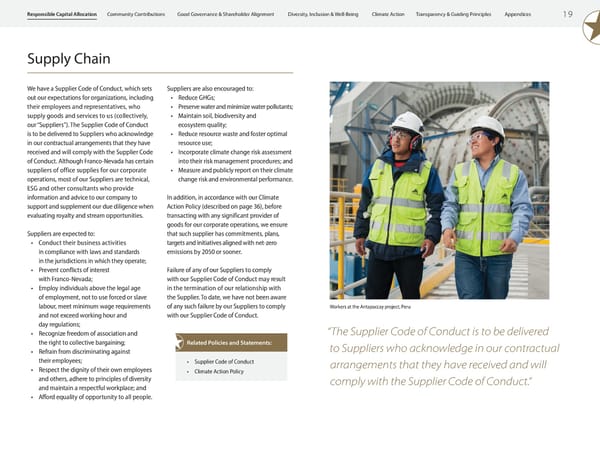
1 9 Appendices Transparency & Guiding Principles Climate Action Diversity, Inclusion & Well-Being Good Governance & Shareholder Alignment Community Contributions Responsible Capital Allocation Supply Chain We have a Supplier Code of Conduct, which sets out our expectations for organizations, including their employees and representatives, who supply goods and services to us (collectively, our “Suppliers”). The Supplier Code of Conduct is to be delivered to Suppliers who acknowledge in our contractual arrangements that they have received and will comply with the Supplier Code of Conduct. Although Franco-Nevada has certain suppliers of office supplies for our corporate operations, most of our Suppliers are technical, ESG and other consultants who provide information and advice to our company to support and supplement our due diligence when evaluating royalty and stream opportunities. Suppliers are expected to: • Conduct their business activities in compliance with laws and standards in the jurisdictions in which they operate; • Prevent conflicts of interest with Franco-Nevada; • Employ individuals above the legal age of employment, not to use forced or slave labour, meet minimum wage requirements and not exceed working hour and day regulations; • Recognize freedom of association and the right to collective bargaining; • Refrain from discriminating against their employees; • Respect the dignity of their own employees and others, adhere to principles of diversity and maintain a respectful workplace; and • Afford equality of opportunity to all people. Suppliers are also encouraged to: • Reduce GHGs; • Preserve water and minimize water pollutants; • Maintain soil, biodiversity and ecosystem quality; • Reduce resource waste and foster optimal resource use; • Incorporate climate change risk assessment into their risk management procedures; and • Measure and publicly report on their climate change risk and environmental performance. In addition, in accordance with our Climate Action Policy (described on page 36 ), before transacting with any significant provider of goods for our corporate operations, we ensure that such supplier has commitments, plans, targets and initiatives aligned with net-zero emissions by 2050 or sooner. Failure of any of our Suppliers to comply with our Supplier Code of Conduct may result in the termination of our relationship with the Supplier. To date, we have not been aware of any such failure by our Suppliers to comply with our Supplier Code of Conduct. Workers at the Antapaccay project, Peru “The Supplier Code of Conduct is to be delivered to Suppliers who acknowledge in our contractual arrangements that they have received and will comply with the Supplier Code of Conduct.” • Supplier Code of Conduct • Climate Action Policy Related Policies and Statements:
Appendices Transparency & Guiding Principles Climate Action Diversity, Inclusion & Well-Being Good Governance & Shareholder Alignment Responsible Capital Allocation 2 0 Community Contributions Community Contributions We are committed to contributing to our communities and engaging with our operators to partner in community and other initiatives where our royalty and stream assets are located. Students in Enseña Peru education program, Peru Contents Community Support 21 Industry and Other Support 22
2 1 Appendices Transparency & Guiding Principles Climate Action Diversity, Inclusion & Well-Being Good Governance & Shareholder Alignment Community Contributions Responsible Capital Allocation Community Support We are committed to partnering with operators on community and environmental initiatives near their projects where we have royalty and stream interests. These partnerships benefit local communities and environmental initiatives and also strengthen our company’s and the mining industry’s reputation in the regions in which we invest. Such initiatives have included educational initiatives, water infrastructure, recycling programs, workplace tragedy support, mental health, and COVID-19 relief efforts. Beyond the community contributions funded in 2022 and described on this page, we have recently made new commitments with the following operators, which we expect to advance over the coming months: Enseña Peru Since 2018, we have partnered with Compañía Minera Antamina S.A., the joint venture company that operates the Antamina project in Peru, in supporting Enseña Peru. Enseña Peru aims to improve education at existing schools in the region which Compañía Minera Antamina S.A. has historically supported and has the goal that by 2032, 8 out of 10 Peruvian youth will receive a quality education. Enseña Peru’s main objective is to supplement the Peruvian education ministry’s efforts in guiding volunteer teachers and other professionals through a three-month leadership program and then posting them in different schools and communities. Their other effort is to train existing teachers and increase cooperation through their Qué Maestro Program. Alto Huarca Water Project In 2022, we funded our commitment to partner with Glencore’s Compañía Miñera Antapaccay S.A., the operator at the Antapaccay project in Peru, to build a water system in order to provide potable water to the 288 inhabitants of the nearby Alto Huarca community and to safely remove waste. The initiative involves the construction of an 8.4 kilometer conduction line (with air passes, flow distribution chambers and valve chambers), a 22 kilometer distribution network with residential connections, and basic sanitation units. “Every Student, Every Day” In 2022, as part of a five-year commitment, we sponsored Victoria Gold’s “Every Student, Every Day” initiative, which works with the community to raise awareness and funds to support increased student attendance throughout the Yukon. To date, the initiative has distributed C$1.85 million to support over 180 grassroots projects. Alto Huarca Water Project, Peru Enseña Peru initiative, Peru “We are committed to partnering with operators on community and environmental initiatives near their projects where we have royalty and stream interests.”
2 2 Appendices Transparency & Guiding Principles Climate Action Diversity, Inclusion & Well-Being Good Governance & Shareholder Alignment Community Contributions Responsible Capital Allocation Industry and Other Support We provide ongoing support to several mining industry, diversity-related and other organizations and initiatives, some of which are described below. Since 2019, we have supported Threads of Life, a Canadian charity dedicated to supporting families after a workplace fatality, life-altering injury or occupational disease. We are a proactive member of the World Gold Council (“WGC”) Board and, in 2019, Franco- Nevada played a leading role at the World Gold Council during the establishment of the RGMPs, which principles must now be implemented by all World Gold Council members. Paul Brink, President & CEO of Franco-Nevada Corporation, is currently a director of the World Gold Council, serves on its Compensation Committee and is a member of its Gold247™ Working Group. In 2022, we supported Mining4Life, an initiative backed by the global mining industry with the goal to invest in the economic and social well-being of communities around the world by helping to create and support sustainable health and education solutions for children in need. We have several diversity and inclusion related contributions and initiatives, including our Franco-Nevada Diversity Scholarship, our BlackNorth Initiative pledge commitments, and The Prosperity Project sponsorship. These are described on page 31 of this ESG Report. We are the primary sponsor of the Prospectors & Developers Association of Canada (PDAC) annual awards that recognize industry successes in exploration, development, safety, environmental stewardship and aboriginal cooperation. David Harquail, Chair of the Board of Franco-Nevada Corporation, is a PDAC board member and Eaun Gray, Senior Vice President, Business Development of Franco-Nevada Corporation, sits on the PDAC Convention Planning Committee. Diversity Scholarship Franco-Nevada team members supporting WoodGreen Community Services Paul Brink and Feroz Shah, the first Franco-Nevada Diversity Scholarship recipient
Appendices Transparency & Guiding Principles Climate Action Diversity, Inclusion & Well-Being Community Contributions Responsible Capital Allocation 2 3 Good Governance & Shareholder Alignment Contents Corporate Governance 24 Integrity and Compliance 25 Shareholder Alignment 26 Information Security 27 Good Governance and Shareholder Alignment We are committed to responsible governance practices to ensure integrity in our dealings, compliance with our undertakings, and alignment with our shareholders. Franco-Nevada 2022 AGM, Canada
2 4 Appendices Transparency & Guiding Principles Climate Action Diversity, Inclusion & Well-Being Good Governance & Shareholder Alignment Community Contributions Responsible Capital Allocation Corporate Governance Our corporate governance structure is designed to encourage informed and effective decision- making and appropriate monitoring of compliance and performance, to serve the best interests of our shareholders. ESG matters are overseen and managed at the Board and management levels within Franco-Nevada. Board Oversight The Board and its Committees provide oversight of our strategic approach to all aspects of our business, which includes ESG-related risks and opportunities. The Board’s two committees, the Compensation and ESG Committee (“CESGC”) and Audit and Risk Committee (“ARC”) have oversight of ESG risks, opportunities and disclosures, which responsibilities are embedded in each committee’s charter. The CESGC develops and recommends to the Board our approach to ESG issues, reviews the adequacy of our ESG practices and policies and recommends any changes to the Board, approves the adoption of any ESG-related standards or initiatives, adopts ESG-related corporate goals used to evaluate management’s performance for executive compensation decisions and engages with our stakeholders in respect of ESG issues. The ARC oversees our ESG risk management. Management’s Role The Board and its Committees oversee senior management, who are responsible for the day-to-day management of ESG risks and opportunities. Our Chief Executive Officer is responsible for leadership on ESG matters and our Chief Legal Officer has executive responsibility over such matters. ESG-related risks and opportunities are overseen by our executive team, including our Senior Vice President, Business Development, Senior Vice President, Diversified, Chief Financial Officer and Chief Legal Officer, having stewardship over our organization’s units (including within our subsidiaries), each being responsible for implementing our ESG strategy and managing risks within their units. Our Board oversight and management leadership, including with respect to ESG-related issues, is depicted in the chart below. Board and Management Engagement All of our executives regularly attend Board and Committee meetings, including to provide updates on royalty and stream acquisition opportunities, which include ESG-related considerations. To the extent that a materially adverse ESG issue or consideration arises during the due diligence process in respect of a royalty and stream opportunity, management and the Board may decide not to proceed with the opportunity. On a number of occasions, our Company has passed on otherwise prospective opportunities due to ESG risks. The Board and its Committees also frequently meet with senior management to determine our strategy with respect to our risks and exposures. In November 2022, management met with the ARC to discuss ESG-related risks and strategy and with the CESGC to discuss strategy for improved ESG reporting in 2023. Most recently, in March 2023, management met with the CESGC to discuss Franco-Nevada’s ESG strategy, including, among other things, climate initiatives and commitments, community contributions, and diversity and inclusion goals and targets for the company. Accountability for ESG Performance ESG is a specific corporate goal used to evaluate management’s performance for executive compensation decisions. On an annual basis, the CESGC evaluates management’s performance in connection with ESG due diligence processes, reporting and compliance, community contributions, diversity and inclusion and ESG rankings. Business Development Team Senior Vice President, Business Development Diversified Team Senior Vice President, Diversified Compensation and ESG Committee* Finance Team Chief Financial Officer Audit and Risk Committee* Chief Executive Officer** Board of Directors* Legal Team Chief Legal Officer*** * Board and Committees have oversight over ESG and climate-related risks and opportunities ** Chief Executive Officer has responsibility for leadership on ESG and climate-related matters *** Chief Legal Officer has executive responsibility over ESG and climate-related matters
2 5 Appendices Transparency & Guiding Principles Climate Action Diversity, Inclusion & Well-Being Good Governance & Shareholder Alignment Community Contributions Responsible Capital Allocation Integrity and Compliance Business Integrity Policy Our Board has a Business Integrity Policy for our directors, officers and employees, which is intended to supplement the Code. The Business Integrity Policy is intended to ensure that we do not receive an improper advantage in our business dealings and that all payments and expenses are properly recorded in our financial books and records. Among other things, the policy provides guidance on dealing with our agents, contractors and with public officials, acceptance of gifts, making political contributions and dealing with certain types of payments, including charitable donations and sponsorships. On an annual basis, we publicly disclose details of political contributions or lobbying expenditures, if any, made by our company or our personnel on behalf of our company. No such contributions or expenditures have been made or incurred since our IPO. Policy Concerning Confidentiality, Fair Disclosure and Trading in Securities Our Board has adopted a Policy Concerning Confidentiality, Fair Disclosure and Trading in Securities, which serves as our corporate disclosure policy and insider trading policy, designed to ensure that personnel comply with securities legislation and the rules of applicable stock exchanges relating to insider trading, tipping and selective disclosure. Such policy generally outlines principles of confidentiality and guidelines for maintaining confidentiality, disclosure principles and guidelines for disclosure, what constitutes material information, what is non-public information and how forward-looking information should be disclosed. The policy also describes prohibitions on trading, our policies on trading windows and black-out periods, required pre-approval for trades by insiders and sanctions if improper trading were to occur. Whistleblower Policies Our Board has adopted employee complaint procedures for, among other things, accounting and auditing matters (contained in our Employee Complaint Procedures for Accounting and Auditing Matters) and violations of applicable laws or corporate policies (contained in our Whistleblower Policy) for our company’s directors, officers and employees to enable such personnel to submit good faith complaints relating to any such matters. The procedures outline how an employee with a good faith concern can report those concerns directly to the Chief Legal Officer, in the case of the Whistleblower Policy, or directly to the Chair of the ARC, in the case of the Employee Complaint Procedures for Accounting and Auditing Matters. In situations where such personnel prefer to place an anonymous report in confidence, they are encouraged to use the Franco-Nevada Compliance Hotline, hosted by a third-party hotline provider, Navex Global EthicsPoint. To date, there have been no employee complaints under either policy. We strive to meet rigorous standards of corporate governance, following industry best practices and satisfying legal, regulatory, TSX and NYSE requirements. We monitor regulatory changes and we routinely review evolving governance practices in order to identify those that will best serve the interests of our shareholders. Code of Business Conduct and Ethics Our Board has adopted a written Code of Business Conduct and Ethics (the “Code”) for our directors, officers and employees. The Code reflects our core values of honesty, responsibility and fairness and addresses the following matters: compliance with laws, rules and regulations; conflicts of interest; confidentiality; corporate opportunities; protection and proper use of corporate assets; competition and fair dealing; gifts and entertainment; payments to government personnel; non- discrimination, anti-harassment and equal opportunity; health and safety; accuracy of company records and reporting; use of e-mail and internet services; loans to or guarantees of obligations of our personnel; and reporting of any illegal or unethical behaviour. Franco-Nevada Corporation Board of Directors in 2022, Panama “...we routinely review evolving governance practices in order to identify those that will best serve the interests of our shareholders.” • Code of Business Conduct and Ethics • Business Integrity Policy • Policy Concerning Confidentiality, Fair Disclosure and Trading in Securities • Employee Complaint Procedures for Accounting and Auditing Matters • Whistleblower Policy Related Policies and Statements:
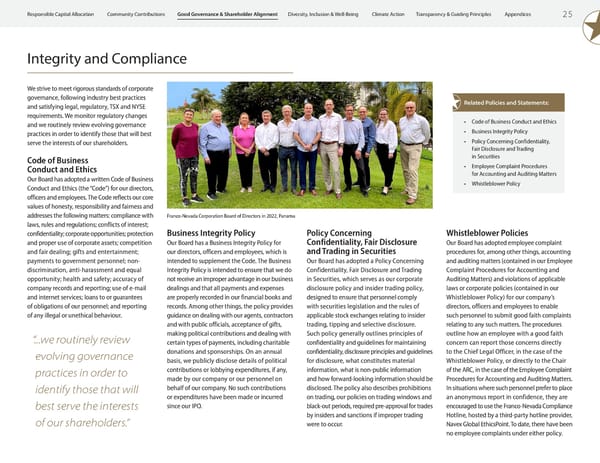
2 6 Appendices Transparency & Guiding Principles Climate Action Diversity, Inclusion & Well-Being Good Governance & Shareholder Alignment Community Contributions Responsible Capital Allocation - 0.2 0.4 0.6 0.8 1.0 08 09 10 11 12 13 14 15 16 17 18 19 20 21 22 Shareholder Alignment are “independent” other than Messrs. Harquail and Brink, by virtue of their positions as former CEO and current President & CEO, respectively. The Chair and President & CEO roles are separated and, as a matter of best practices, our Board created the position of Lead Independent Director and appointed Mr. Evans in this role. Clawback Our executives have each agreed to a clawback of their incentive compensation if our financial statements are required to be restated due to the fraudulent behaviour or other intentional misconduct of such executive officers or they are found to have engaged in intentional, egregious misconduct whether or not Franco-Nevada’s financial statements are required to be restated. In each case, they have agreed to reimburse Franco-Nevada for, or forfeit, as applicable, any entitlement to any bonus or other incentive-based or equity-based compensation received by them during the 12-month period following the issuance/filing of the financial statements required to be restated or during the 12-month period prior to when the Board became aware of the misconduct, as applicable. Communication and Collaboration In 2010, our Board adopted a policy entitled Board of Directors’ Engagement with Shareholders on Governance Matters. The policy provides that it is important to have regular and constructive engagement directly with our shareholders to allow and encourage shareholders to express their views on governance matters directly to our Board outside of our annual meetings. We recognize that shareholder engagement is an evolving practice in Canada and globally and our Board reviews its shareholder engagement policy annually to ensure that it is effective in achieving its objectives. We regularly engaged virtually and in person with our shareholders during 2022. The adjacent tables describe some examples of how we engaged and the key topics of interest from shareholders and the investment community. How we engage with our stakeholders • Investor and industry conferences • Shareholder meetings, including say-on-pay voting • Quarterly earnings conference calls • Analyst days • Investor relations correspondence • Emails, calls and meetings Key topics of interest in 2022 • Diversity and inclusion ( see pages 29–31 ) • Climate-related risks and opportunities ( see pages 16–18; Appendix C ) • Transparency and ESG reporting frameworks ( see Appendices C through E ) • Scope 3 emission reporting ( see pages 41–42 ) • ESG-related performance of investments ( see pages 7–14 ) • Capital allocation strategy (including commodity and jurisdiction) ( see page 4 ) • Security and cybersecurity ( see page 27 ) • ESG considerations in executive compensation ( see page 58 ) We take pride in our culture of company ownership, with management and the Board holding over US$200 million of equity and having the lowest G&A among our peers. This shareholder alignment flows through the entire organization with junior employees receiving stock option grants after having a minimum tenure at the company. Minimum Equity Investments Each of our executive officers is required to hold a minimum equity investment in Franco-Nevada equivalent in value to a multiple (currently five times for our CEO and three times for our other executive officers) of such executive officer’s then current base salary, depending on such executive officer’s level of responsibility. The requirement is to be satisfied in the form of our common shares and restricted share units. Our non-employee directors are required to hold minimum equity investments in Franco-Nevada equivalent in value to three times their annual retainers (currently the minimum equity investment is C$135,000) in the form of our common shares and/or deferred share units. Management and our directors are in full compliance of such minimum equity investment requirements with substantial ownership stakes in our company. Independence An independent board is comprised of directors who have no direct or indirect relationships with a company that could reasonably interfere with the exercise of the directors’ independent judgement. This avoids potential conflicts of interest and enables a board of directors to consider the best interests of its shareholders. Our Board has concluded that all of our directors G&A as % of Market Capitalization
2 7 Appendices Transparency & Guiding Principles Climate Action Diversity, Inclusion & Well-Being Good Governance & Shareholder Alignment Community Contributions Responsible Capital Allocation Information Security We have an Information Security Policy that sets out our principles for the protection of information assets and our proper controls needed to ensure compliance with our standards and external regulations. The policy is intended to define the principles and requirements of acceptable use of information assets for our personnel and describe how these will be implemented across our global operations. It also informs our personnel of our expectations and requirements for acceptable use of information assets and the role of our personnel in protecting the security and integrity of our information. The Information Security Policy is comprised of a number of policies, including our: • Password Policy • Acceptable Computer Use Policy • Removable Media Policy • Email Policy • Remote Access Policy • Incident Logging Policy Several members of our Board of Directors (six of nine or 67% of our Board, as of our May 2, 2023 annual general meeting) have skills and competencies in cybersecurity and the Board engages with management in matters relating to Franco-Nevada’s information and cybersecurity strategy. Our Audit and Risk Committee oversees the Information Security Policy and has designated our Chief Financial Officer as the executive responsible for: establishing and maintaining the practices and procedures necessary to implement the Information Security Policy, providing training to our personnel on the substance of the Information Security Policy at least once annually, and reporting to the Audit and Risk Committee on the operation of and compliance with the policy. Given the increased global threat of cyberattacks, we endeavour to improve our cyber and information security, including our processes and infrastructure in place to mitigate risks of cyberthreats and attacks, whenever possible. In 2022, we made the following improvements to our cyber and information security: • We enhanced cybersecurity risk management processes, with more frequent security updates to the Audit and Risk Committee; • We enhanced password security; • We updated and tested our disaster recovery plan; and • We engaged third-party companies to test our security and access. Equinox Gold employees at Greenstone project, Canada “Given the increased global threat of cyberattacks, we endeavour to improve our cyber and information security whenever possible.” • Information and Security Policy Related Policies and Statements:
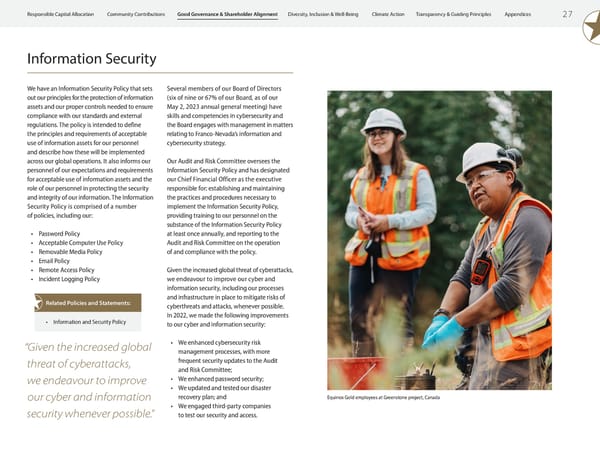
Appendices Transparency & Guiding Principles Climate Action Good Governance & Shareholder Alignment Community Contributions Responsible Capital Allocation 2 8 Diversity, Inclusion & Well-Being Contents Diversity and Inclusion 29 Employee Benefits and Well-Being 32 Health, Safety and Security 33 Human Rights, Non-Discrimination, Anti-Harassment and Equal Opportunity 34 Diversity, Inclusion and Well-Being We are committed to maintaining a safe and supportive environment for our team members and to removing barriers and promoting diversity and inclusion. Members of Franco-Nevada’s Board and management team
2 9 Appendices Transparency & Guiding Principles Climate Action Diversity, Inclusion & Well-Being Good Governance & Shareholder Alignment Community Contributions Responsible Capital Allocation Diversity and Inclusion Diversity and Inclusion Policy We are committed to diversity among our employees, executive officers and on our Board and have made meaningful progress over the past few years in improving our diversity practices and policies and increasing the number of Diverse Persons within our company. Our Diversity and Inclusion Policy emphasizes all forms of diversity in identifying candidates to recommend for appointment/election to the Board and for appointment/promotion to senior management positions. Diverse candidates must be included in any search for new Board members and senior management positions, including for any new roles established by our company (including internal promotions). The Diversity and Inclusion Policy provides for the following goals: • maintaining a Board composition in which at least 30% of the independent directors are women; • achieving, by 2025, and thereafter maintaining, 40% Diverse Persons at the Board and senior management level (on an aggregated basis), and • achieving, by 2025, and thereafter maintaining, a Board composition in which at least one independent director is a Diverse Person on grounds broader than gender diversity. • Diversity and Inclusion Policy Related Policies and Statements: “We... have made meaningful progress over the past few years in improving our diversity practices and policies and increasing the number of Diverse Persons within our company.” Women in Senior Management Visible Minorities in Senior Management Diverse Persons in Senior Management 2 of 14 or 14.3% 6 of 14 or 42.9% 6 of 14 or 42.9% Women in Global Workforce Visible Minorities in Global Workforce Diverse Persons in Global Workforce 17 of 40 or 42.5% 18 of 40 or 45.0% 24 of 40 or 60.0%
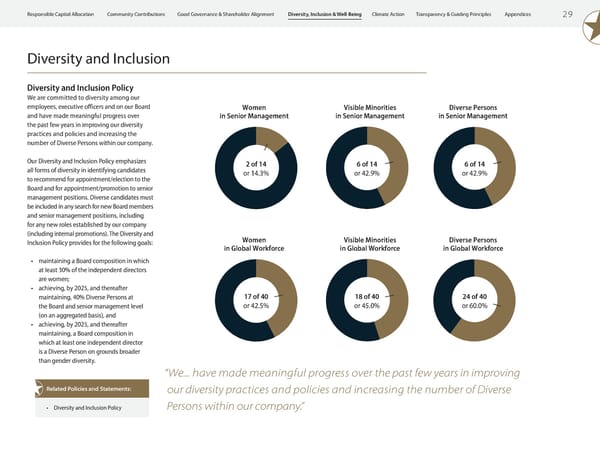
3 0 Appendices Transparency & Guiding Principles Climate Action Diversity, Inclusion & Well-Being Good Governance & Shareholder Alignment Community Contributions Responsible Capital Allocation Diversity and Inclusion (continued) We are committed to ensuring diversity and inclusion at all levels within our organization. We aim to accomplish this through (i) objective diversity targets at the senior management and Board levels; (ii) ensuring diverse candidate pools are considered for management and Board appointments; and (iii) contributing to diversity and inclusion initiatives. Date Progress 2021 • In March 2021, we amended our Diversity and Inclusion Policy to provide that diverse candidates are to be included when filling Board and senior management roles and set out a new goal of achieving 40% Diverse Persons* at the Board and senior management level (on an aggregated basis) by 2025 • In May 2021, we achieved our goal of 30% women directors, one year earlier than planned 30% (3 of 10) of Board members are women • In mid-2021, we awarded the first Franco-Nevada Diversity Scholarship to a student entering mining engineering at the University of Toronto • In the second half of 2021, we established the Franco-Nevada Diversity Committee. The Committee arranged for unconscious bias training for all of our employees and conducted an internal diversity and inclusion survey • In December 2021, we promoted a female member of a visible minority to the senior management team at Franco-Nevada Corporation 2022 • In April 2022, we hired a male member of a visible minority to the senior management team at Franco-Nevada Corporation • In August 2022, we expanded our Franco-Nevada Diversity Scholarship program by awarding four scholarships to diverse mining engineering students at three Canadian universities • In late 2022, we contributed to four registered Canadian charitable organizations in support of the Black community and in furtherance of our BlackNorth Initiative pledge 2023 • In March 2023, we amended our Diversity and Inclusion Policy to set a new goal of achieving at least one Diverse Person* on grounds broader than gender diversity at the Board level by 2025 Date Progress 2015 • In March 2015, we adopted our Diversity Policy relating to identifying women as candidates to recommend for appointment/election to the Board and for appointment/promotion to senior management positions • In May 2015, Catharine Farrow joined our Board 11% (1 of 9) of Board members are women 2016 • In 2016, we hired a female member of a visible minority and promoted another female, both to senior positions at Franco-Nevada Corporation 2019 • In March 2019, we amended our Diversity Policy to adopt a target of 30% women directors by 2022 • In May 2019, Jennifer Maki joined our Board 22% (2 of 9) of Board members are women 2020 • In March 2020, we amended our Diversity Policy to incorporate principles of inclusion and additional diversity and renamed the policy the Diversity and Inclusion Policy • In May 2020, Maureen Jensen joined our Board 27% (3 of 11) of Board members are women • In July 2020, we signed the BlackNorth Initiative pledge to combat anti-Black systemic racism • In December 2020, a female member of a visible minority was promoted to the senior management team at Franco-Nevada (Barbados) Corporation and promoted a male member of a visible minority to the senior management team at Franco-Nevada Corporation * Diverse Persons include women, Black, Indigenous and other people of colour, individuals who identify as LGBTQ2S+ and people with disabilities • Diversity and Inclusion Policy Related Policies and Statements:
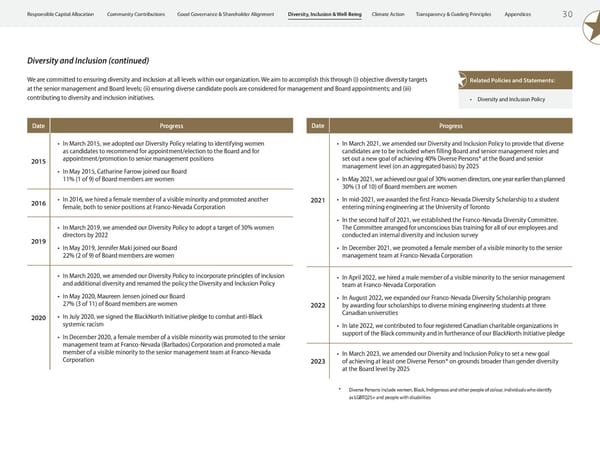
3 1 Appendices Transparency & Guiding Principles Climate Action Diversity, Inclusion & Well-Being Good Governance & Shareholder Alignment Community Contributions Responsible Capital Allocation Diversity and Inclusion Initiatives We are proud to have progressed the following diversity and inclusion initiatives during 2022 and year to date: Diversity Scholarship Franco-Nevada Diversity Scholarships In 2022, we grew the Franco-Nevada Diversity Scholarship, established in 2021 to promote diversity in the mining industry, by expanding the program to four annual scholarship awards, which were awarded during the year to diverse students attending mining engineering programs at several Canadian universities. We also renewed the annual scholarship awarded to the program’s first recipient. BlackNorth Initiative The BlackNorth Initiative was created by The Canadian Council of Business Leaders Against Anti-Black Systemic Racism to combat anti-Black systemic racism in Corporate Canada. We became a signatory to the BlackNorth Initiative pledge at its inaugural summit in July 2020. Our pledge includes the following commitments: (i) hire on average at least 5% within our student workforce from the Black community; (ii) invest by 2025 at least 3.5% of corporate donations and sponsorships to promote investment and create economic opportunities in the Black community; and (iii) set numeric diversity goals for the representation of Diverse Persons, including Black people, on our Board and among senior management. To date we have exceeded our student workforce commitment and, in 2022, we surpassed our donation and sponsorship commitment donating to four separate registered Canadian charitable organizations, supporting the Black community in the areas of education, health, youth, and business. In early 2023, we amended our Diversity and Inclusion Policy to include an additional diversity goal to achieve at least one Diverse Person on grounds broader than gender diversity at the Board level by 2025. The Prosperity Project The Prosperity Project was established to help mitigate the disproportionate impact of COVID-19 on Canadian women who are being disproportionately affected and underscoring the economic importance of gender equality during the COVID-19 pre-recovery, recovery and post-recovery periods. In early 2021, we became an Influence Level Partner of The Prosperity Project’s Annual Gender Diversity Data Tracking Initiative. The Initiative tracks women in board, executive officer roles, and in the pipeline to executive officer roles in large public companies, Crown corporations, pension funds, co-operatives and Canadian subsidiaries of foreign-owned public companies. The Initiative applies intersectional identities and inclusivity lenses in order to track the representation of white and BIPOC women as well as women with disabilities at the leadership level over time and the progress being made towards achieving gender parity. We renewed our support for The Prosperity Project for 2022. Maureen Jensen, one of our Board members, is a board member of The Prosperity Project and both Ms. Jensen and Jennifer Maki, another member of our Board, are “Founding Visionaries” of The Prosperity Project. “In early 2023, we amended our Diversity and Inclusion Policy to include an additional diversity goal to achieve at least one Diverse Person on grounds broader than gender diversity at the Board level by 2025.” “...we exceeded our donation and sponsorship commitment donating to four separate registered Canadian charitable organizations, supporting the Black community in the areas of education, health, youth, and business.”
3 2 Appendices Transparency & Guiding Principles Climate Action Diversity, Inclusion & Well-Being Good Governance & Shareholder Alignment Community Contributions Responsible Capital Allocation We strive to create an inclusive, safe, and supportive environment for all our employees, which includes opportunities for hybrid work, health benefits and wellness allowances, and robust workplace policies and practices. Hybrid Work Arrangements The way in which we live and work has changed significantly over the past several years. In many ways, the COVID-19 pandemic changed the way employees balance their work and personal lives. In 2022, despite the easing of COVID-19 restrictions and public health advisories, we have maintained a hybrid office model and continue to support our employees who prefer or require flexible and personalized work options. Workplace Accommodations We value the diverse representation of our workforce and seek to promote inclusivity and remove barriers by accommodating our employees where possible so that no individual is disadvantaged relative to other members of our team. In 2022, we collaborated with one of our employees in Toronto and retrofitted existing office space to accommodate for religious practices and observances to be carried out during the work day. Health and Wellness Benefits We provide our employees with comprehensive health and insurance benefits. During 2022, in an effort to further support our employees and their families and to allow for more benefits flexibility, we implemented a new Wellness Allowance Policy, which broadened the scope and increased the quantum of employees’ wellness-related benefits. Employee Pay We are committed to ensuring that all of our employees receive salaries significantly exceeding minimum and living wages in the applicable jurisdictions of their workplaces and all such employees receive vacation pay, sick pay and parental leave pay and other benefits. The adjacent table sets out the sources and methodologies used to determine minimum and living wages in each of the four jurisdictions in which we have corporate offices in order to demonstrate that 100% of our global workforce receive salaries exceeding both the minimum and living wage in those jurisdictions. Labour Rights and Standards We are committed to the fundamental labour standards and rights at work set out in the International Labour Organization’s Declaration on Fundamental Principles and Rights at Work. In accordance with our Human Rights Policy and as enshrined in the Canadian Charter of Rights and Freedoms, we are supportive of the fundamental freedoms of our employees (and of all individuals), including the freedom of thought, belief, opinion and expression, the freedom of peaceful assembly and the freedom of association. In 2023, we adopted a new Disconnecting from Work Policy to formalize our commitment to recognizing the importance of our employees’ ability to balance their work and personal lives, all while performing their duties to the best of their abilities. None of our employees are organized by a trade union or labour union and there are no collective bargaining agreements in place in respect of our staff or company. As such, there have been no strikes or lock-outs in our company’s history. Notwithstanding, we respect the right to collective bargaining (ILO C98), the protection of workers’ representatives and prevention of workers’ representatives discrimination (ILO C135). Minimum and Living Wage and Franco-Nevada Employee Pay 1,2 Jurisdiction; % of Full-Time Employees (FTEs) in Jurisdiction Minimum Wage (US$) Living Wage 3 (US$) % of Franco-Nevada FTE Pay Exceeding Minimum and Living Wage Canada (Toronto, ON) 67.5% $11.48 4 $17.134 4 100% USA (Colorado) 10% $13.65 5 $20.25 6 100% Barbados 20% $4.21 7 $6.00 8 100% Australia 2.5% $14.53 9 $17.00 10 100% 1 All dollar figures are in USD (or converted to USD as at December 31, 2022) and are on a per-hour basis. 2 All information current as of December 31, 2022, unless otherwise specified. 3 A living wage is a measure intended to represent the remuneration received by a worker in a particular location sufficient to afford a decent standard of living for the worker and their family. Elements of a decent standard of living include food, water, housing, education, health care, transportation, clothing, and other essential needs, including provision for unexpected events. 4 Source: ontariolivingwage.ca 5 Source: cdle.colorado.gov/wage-and-hour-laws 6 Source: livingwage.mit.edu/counties/08035 7 Source: gisbarbados.gov.bb/download/minimum-wage-national-and-sectoral-minimum-wage-order-2021 8 Source: salaryexplorer.com/salary-survey.php?loc=19&loctype=1; Specific Barbados living wage unavailable so calculated as 60% of median income based upon general guidance of numerous authorities. 9 Source: fairwork.gov.au/pay-and-wages/minimum-wages 10 Source: raffwu.org.au/campaigns/industry/living-wages; povertyandinequality.acoss.org.au/poverty Employee Benefits and Well-Being • Wellness Allowance Policy • Human Rights Policy • Disconnecting from Work Policy Related Policies and Statements:
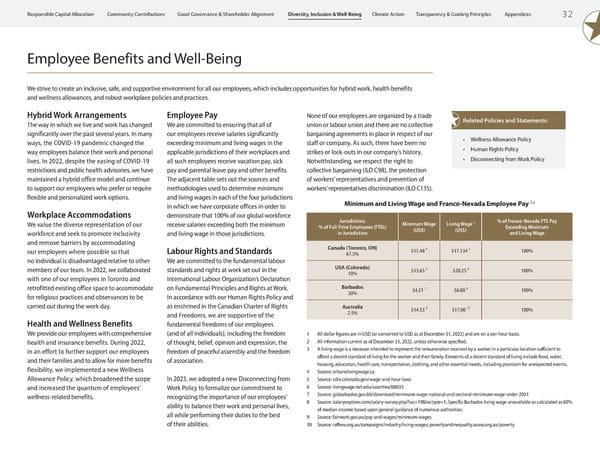
3 3 Appendices Transparency & Guiding Principles Climate Action Diversity, Inclusion & Well-Being Good Governance & Shareholder Alignment Community Contributions Responsible Capital Allocation Health, Safety and Security Health and Safety The health and safety of our employees remains of utmost priority. During the heights of the COVID-19 pandemic that extended into 2022, we worked closely with building management at our Toronto office to ensure the safety of our personnel when entering, exiting and working in the office and we developed an internal office protocol, which was updated as and when needed, outlining our COVID-related health and safety procedures. We have a Health and Safety Policy applying to our company (including all subsidiaries) and employees necessitating compliance with applicable legal and regulatory health and safety requirements of the jurisdictions in which we operate and setting out standards for a safe work environment, including a workplace free from injuries and from violence and harassment. Our Health and Safety Policy is complemented by our Non-Discrimination, Anti-Harassment & Equal Opportunity Policy, which provides for a procedure in the case of any incident of discrimination, harassment or violence, including the reporting of the occurrence to our Chief Legal Officer, the oversight of the policy by our CESGC, and the provision of education and training programs from time-to-time. Further, in accordance with our Corporate Responsibility Policy, we are committed to make a positive impact on social issues. Security Although our employees operate in office environments, members of technical and business development teams frequently travel domestically and internationally, including when conducting due diligence for new potential opportunities, auditing our existing assets, and attending conferences and investor meetings. On occasion, these include destinations that may have higher risks, including political instability, natural disasters, extreme climates, or pandemic, endemic and epidemic disease. In order to partially mitigate the safety risk to our employees who visit these locations, we rely on an international health and security service coordinator called International SOS (“ISOS”). ISOS has globally established alarm centres that have the ability to coordinate assistance on a regional level. Expert health and security information can be requested to be sent directly to personnel or may be accessed via the ISOS self-service portals, including ISOS’ Global site monitoring portal. In 2022, we adopted a Travel Safety Policy that formalizes measures mitigating risks associated with travel, and seeks to minimize these through appropriate measures. Among other things, the protocols include our employees: • Conducting an independent risk assessment of a travel destination before departure; • Engaging with ISOS to obtain applicable information relating to a travel destination; • Sharing travel itineraries with their team before departure; • Discussing elevated travel-related risks with their team; • Taking certain precautions in respect of air travel, ground transportation, and hotel accommodations; and • Communicating openly and reporting all incidents to their team. Antapaccay site visit by Franco-Nevada personnel, Peru • Health and Safety Policy • Corporate Responsibility Policy • Non-Discrimination, Anti-Harassment & Equal Opportunity Policy • Travel Safety Policy Related Policies and Statements:
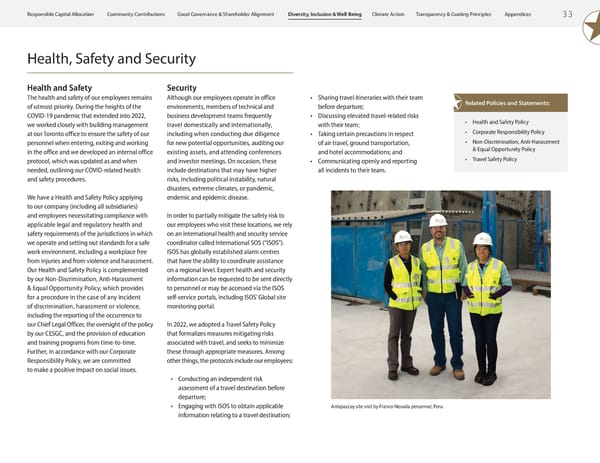
3 4 Appendices Transparency & Guiding Principles Climate Action Diversity, Inclusion & Well-Being Good Governance & Shareholder Alignment Community Contributions Responsible Capital Allocation Human Rights, Non-Discrimination, Anti-Harassment and Equal Opportunity Human Rights Policy In 2020, our Board adopted the Human Rights Policy, which applies on a company-wide basis, thereby formalizing our actions, practices and beliefs since our inception. The Human Rights Policy sets out our commitment to the following items, among other things: • Complying with human rights laws in regions in which we conduct business; • Supporting fundamental freedoms of all individuals, including the freedom of thought, belief, opinion and expression, the freedom of peaceful assembly, the freedom of association and other rights and freedoms; • Complying with proper labour laws and standards including in respect of legal age limits, forced or slave labour, minimum wages and benefits, and working hours and working day limits; • Maintaining workplaces free from harassment and discrimination and complying with health and safety standards; • Conducting appropriate human rights due diligence when making investments; • Consulting with our stakeholders regarding human rights and other social issues; • Reviewing and assessing our human rights policies, practices and procedures on a regular basis; • Organizing appropriate training and educational programs for our personnel to address human rights issues and to properly implement our Human Rights Policy; • Expecting that our suppliers and service providers conduct their business practices in accordance with our values, including in respect of human rights; and • Disclosing our progress and initiatives on human rights. In 2021, we updated our Human Rights Policy to formalize our commitment to the fundamental labour standards and rights at work set out in the International Labour Organization’s Declaration on Fundamental Principles and Rights at Work. Non-Discrimination, Anti-Harassment & Equal Opportunity Policy We have a Non-Discrimination, Anti-Harassment & Equal Opportunity Policy, which provides the framework to maintain an environment free of discrimination and harassment, in which all individuals are treated with respect and dignity, are able to contribute fully and have equal opportunities. Grounds for discrimination include age, religion, sexual orientation, gender, family or marital status, disability, race, ancestry, place of origin, ethnic origin, citizenship, colour, record of offences, and any other ground that is listed in human rights legislation that applies to the jurisdiction in which we are operating. Such policy also provides that we are supportive of the fundamental freedoms of our employees (and of all individuals), including the freedom of thought, belief, opinion and expression, the freedom of peaceful assembly and the freedom of association. The Non-Discrimination, Anti-Harassment & Equal Opportunity Policy also deals with harassment and workplace violence. This policy articulates our position with respect to diversity and equal opportunity as well as (i) zero tolerance for discrimination, harassment and threats or acts of violence; (ii) reporting inappropriate conduct, harassment and workplace violence; (iii) disciplinary measures; and (iv) the development of procedures to prevent and address human rights issues. “In 2020, our Board adopted the Human Rights Policy, which applies on a company- wide basis, thereby formalizing our actions, practices and beliefs since our inception. “ • Human Rights Policy • Non-Discrimination, Anti-Harassment & Equal Opportunity Policy Related Policies and Statements: Employee at Bald Mountain project, Nevada
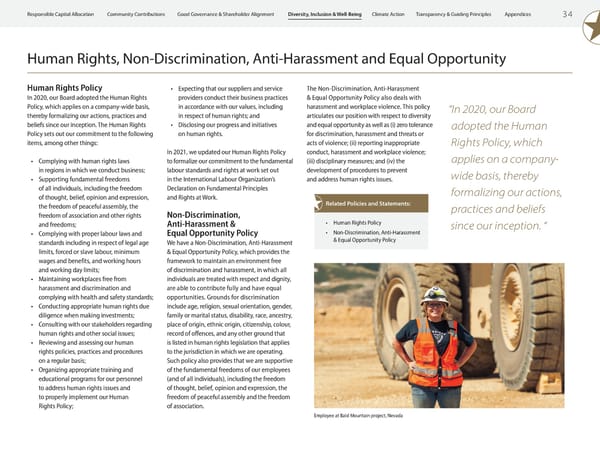
Appendices Transparency & Guiding Principles Diversity, Inclusion & Well-Being Good Governance & Shareholder Alignment Community Contributions Responsible Capital Allocation 3 5 Climate Action Contents Climate Action Commitments and Plans 36 Overall Carbon Footprint 37 Corporate Footprint 39 Investment Footprint 42 Climate Action We have a goal to achieve net-zero GHG emissions by 2050 with respect to our corporate operations and are committed to considering the decarbonization efforts and the net-zero alignment of operators and operations when making investment decisions. Vale’s Income Generation Support Program, Brazil
3 6 Appendices Transparency & Guiding Principles Climate Action Diversity, Inclusion & Well-Being Good Governance & Shareholder Alignment Community Contributions Responsible Capital Allocation Climate Action Commitments and Plans In 2020, we committed to maintain carbon neutrality at our corporate operations and, in 2022, we accomplished this for the third consecutive year. In 2023, we set a goal to achieve net-zero emissions relating to our global corporate operations (our “Corporate Emissions”) by 2050, in line with global efforts to limit warming to 1.5°C (“net-zero emissions by 2050 or sooner”). While our commitment to carbon neutrality primarily involves the purchase of carbon offsets, our net-zero aspiration entails a concerted effort to reduce our absolute emissions. Our greatest impact in addressing climate change is through deploying capital to responsible operators and operations committed to reducing carbon footprints and environmental impacts. Accordingly, we have also committed to assess the decarbonization efforts and net-zero alignment, including with respect to the commitments, plans, targets and initiatives, of operators and operations when making investment decisions and to engage with new and existing partners on their efforts to decarbonize and achieve net-zero emissions by 2050 or sooner. We have adopted a Climate Action Policy, which is summarized below and formalizes the abovementioned climate-related goals and commitments relating to all aspects of our business. Our Climate Action Policy also establishes the measures that we will implement to further these commitments. Corporate Operations We aspire to achieve net-zero Corporate Emissions by 2050. To reach this goal, we will: • Measure and record our Corporate Emissions in accordance with the Greenhouse Gas Protocol; • By 2024, adopt short and long-term science-based GHG emission reduction targets for our Corporate Emissions in line with the achievement of net-zero emissions by 2050 or sooner; • Maintain carbon neutrality on an annual basis for our Corporate Emissions by purchasing high quality carbon offsets for those Corporate Emissions that cannot be eliminated; and • Report on our progress and provide climate-related disclosures aligned with the recommendations from the Task Force for Climate-related Financial Disclosures (TCFD) and regulatory requirements applicable to our company. Investments We are committed to assessing the decarbonization efforts and net-zero alignment of operators and operations when making investment decisions. We are also committed to engaging with new and existing partners on their efforts to decarbonize and achieve net-zero emissions by 2050 or sooner. To achieve this, we will: • Assess the decarbonization commitments, plans, targets and initiatives of operators, including commitments to or progress towards achieving net-zero emissions by 2050 or sooner in our due diligence processes when evaluating new opportunities; • Monitor operators’ decarbonization efforts and progress towards net-zero emissions by 2050 or sooner and endeavour to include contractual provisions requiring operators to provide us with sufficient information in order to do so; • Measure and record our attributable emissions from our royalty and stream interests in accordance with the Greenhouse Gas Protocol and other leading supplementary guidance; and • Explore options on how we may assist operators’ energy transitions, climate-related community and other initiatives, and/or other activities aimed at decarbonization and achieving net-zero emissions by 2050 or sooner. Stakeholders To further support and awareness of climate reduction goals, including net-zero emissions by 2050 or sooner, we will: • Ensure that our external consultants are familiar with our support for the goal of decarbonization and net-zero emissions by 2050 or sooner and understand Franco-Nevada’s commitments under the Climate Action Policy; and • Ensure before transacting with any significant provider of goods for our corporate operations, that such supplier is aligned with the goal of net-zero emissions by 2050 or sooner. We are committed to: • Our goal to achieve net-zero emissions relating to our global corporate operations by 2050 or sooner • Assess the decarbonization efforts and net-zero alignment of operators and operations when making investment decisions • Engage with new and existing operators on their efforts to decarbonize and achieve net-zero emissions by 2050 or sooner • Further awareness of and support for climate reduction goals, including net-zero emissions by 2050 or sooner, with our stakeholders • Climate Action Policy Related Policies and Statements:
3 7 Appendices Transparency & Guiding Principles Climate Action Diversity, Inclusion & Well-Being Good Governance & Shareholder Alignment Community Contributions Responsible Capital Allocation Overall Carbon Footprint 50.4 -63.0 59.6 -74.5 20.6 -25.8 3.6 -4.5 495,709 131,656 -252,924 627,365 -260,000 -160,000 -60,000 40,000 140,000 240,000 340,000 440,000 540,000 640,000 -100 100 200 300 400 500 (tCO 2 e) (tCO 2 e) Corporate Emissions (2022) Financed Emissions (2021) Gross emissions Offsets Gross emissions Sequestered emissions Legend Emissions from corporate operations Purchased carbon offsets Financed Emissions from mining interests Financed Emissions from energy interests Sequestered emissions from Weyburn working interest and royalties Franco-Nevada’s carbon footprint is comprised of emissions relating to our corporate offices as well as financed emissions, which are estimated emissions based upon production attributable to our royalty and stream interests (referred to as “Financed Emissions”). Since 2020, our corporate operations have been carbon neutral. We have accomplished this, and will continue to do so, through initiatives to reduce our corporate GHG emissions and through the purchase of high quality carbon credits to offset emissions that cannot be eliminated. While it is important for us to be operationally carbon neutral, we acknowledge that our own total operational emissions are minimal relative to the operations in which we invest and much of our ability to have a positive impact on the climate relates to our engagement with and support of our current operators and to our future capital allocation strategy. Corporate Emissions and Financed Emissions depicted below and adjacent are not to scale, with total Financed Emissions being approximately 5,000 times Corporate Emissions Scope 2 Electricity and Steam ( see page 40 ) Scope 3 Business Travel and Employee Commuting ( see page 41 ) Scope 3 Office Supplies ( see page 41 ) Scope 3 Water and Waste ( see page 41 ) Scope 3 Investments ( see page 42 ) Sequestered emissions attributable to our Weyburn working and royalty interests We do not reduce or set-off our Financed Emissions with such sequestered emissions ( see page 18 ) Purchased carbon offsets for 125% of our Corporate Emissions ( see page 41 )
3 8 Appendices Transparency & Guiding Principles Climate Action Diversity, Inclusion & Well-Being Good Governance & Shareholder Alignment Community Contributions Responsible Capital Allocation Scope 1, 2 and 3 Primer All of our emissions are calculated using the Greenhouse Gas Protocol Corporate Accounting and Reporting Standard, the most widely-used international accounting tool for companies to understand, quantify, and manage GHG emissions. The Greenhouse Gas Protocol (the “GHG Protocol”), launched in 1998, categorizes a company’s GHG emissions into three scopes: • Scope 1 emissions are direct emissions from owned or controlled sources (e.g., emissions associated with fuel combustion in boilers, furnaces, vehicles). • Scope 2 emissions are indirect emissions from the generation of purchased electricity or steam. • Scope 3 emissions are all other indirect emissions that occur in the value chain of the reporting company, including both upstream and downstream emissions. The 15 categories of Scope 3 emissions are depicted in the adjacent GHG Protocol diagram. In accordance with the GHG Protocol, emissions associated with certain kinds of investments (e.g. majority equity holdings, loans with known use of proceeds, etc.) are required to be calculated and included as Scope 3, Category 15 (Investments) emissions. For other alternative investments, including royalty and stream interests, emissions attributable to such investments may optionally, but are not required to, be included in Scope 3, Category 15 (Investments), with the GHG Protocol acknowledging that for many of these investments, investors may have minimal or no control or insight into the operations of the investees. To the extent that emissions relating to investments are disclosed by investors, irrespective of whether such disclosure is optional or mandatory, the GHG Protocol provides that the “reporting company’s Scope 3 emissions from investments are the Scope 1 and Scope 2 emissions of investees.” Franco-Nevada’s Progression Franco-Nevada accounts for the following emissions applicable to our corporate operations: Scope 1 (nil, as our offices are not heated from the direct combustion of natural gas or propane), Scope 2 (emissions relating to the use of electricity and steam for our offices) and Scope 3 (applicable categories for our corporate operations include Category 1 (Purchased Goods and Services); Category 5 (Waste); Category 6 (Business Travel); and Category 7 (Employee Commuting)). As Franco-Nevada does not operate, develop or conduct exploration for the operations in which we have royalty and stream interests, and does not exercise control over such operations given the passive nature of our interests, we have not previously included Financed Emissions in our Scope 3 emissions. We recognize the increasing importance for shareholders, ESG rating agencies and others to have visibility of the carbon footprints of asset managers’, investment funds’ and royalty and streaming companies’ portfolios. There have also been gradual improvements in data availability for emissions relating to our investments. For these reasons, we have included in this ESG Report estimated emissions attributable to our royalty and stream interests. Please refer to the section entitled Investment Footprint below. Source: GHG Protocol “We recognize the increasing importance for shareholders, ESG rating agencies and others to have visibility of the carbon footprints of asset managers’, investment funds’ and royalty and streaming companies’ portfolios... we have included in this ESG Report estimated emissions attributable to our royalty and stream interests.”
3 9 Appendices Transparency & Guiding Principles Climate Action Diversity, Inclusion & Well-Being Good Governance & Shareholder Alignment Community Contributions Responsible Capital Allocation In terms of our own environmental impact, our carbon footprint is very small. Our workforce, consisting of 40 full-time employees, operates solely within office environments, including at our head office in Toronto in Commerce Court West. Our remaining staff work in office spaces located in Barbados, the United States and Australia. Notwithstanding our small workforce and office settings, we do whatever we can to reduce our carbon footprint and environmental impact. Since 2019, we have utilized Notice-and-Access delivery procedures for our management information circular and annual meeting materials sent to our shareholders to encourage electronic access of such materials to reduce consumption of paper products. Commerce Court West In December 2017, Commerce Court West (the office tower in which our Canadian head office is located) achieved BOMA BEST Platinum level certification. This is the highest level of certification in the BOMA BEST green buildings certification program, Canada’s largest environmental assessment and certification program for existing buildings. In 2021, Commerce Court was awarded BOMA Canada The Outstanding Building of the Year (TOBY) Award for a building with over 1 million square feet. Commerce Court is certified LEED EB Gold reflecting the successful implementation of its long-term sustainability strategy and an ongoing commitment to the environment and other sustainability-focused initiatives. The LEED Canada EB rating system applies a rigorous internationally-recognized standard measuring and evaluating the effectiveness of a property’s sustainable practices and policies in a range of green categories. Commerce Court West, Toronto Corporate Footprint “Our workforce, consisting of 40 full-time employees, operates solely within office environments, including at our head office in Toronto in Commerce Court West. Our remaining staff work in office spaces located in Barbados, the United States and Australia.”
4 0 Appendices Transparency & Guiding Principles Climate Action Diversity, Inclusion & Well-Being Good Governance & Shareholder Alignment Community Contributions Responsible Capital Allocation Corporate Scope 1 GHG Emissions Operating solely in office environments, our company does not have any quantifiable Scope 1 emissions. For example, Commerce Court West, our corporate head office building in Toronto, is heated with steam and utilizes electricity, which are reported under Scope 2 emissions. We acknowledge that some of our workforce may from time-to-time access certain public areas during their work days that are heated by, or otherwise utilize, fossil fuels. Although we do not have access to sufficient data to calculate our share of these Scope 1 emissions, we have purchased carbon offsets accounting for 125% of our overall reported corporate emissions to factor these in. Corporate Scope 2 GHG Emissions* The production of GHGs associated with our energy usage and heating sources, comprised of electricity and steam, are indirect (Scope 2) emissions, which are set out in the adjacent chart. There has been a significant reduction of our Scope 2 emissions since 2019 (Scope 2 emissions were 62.0 tCO 2 e in 2019 or approximately 23% higher than 2022), which is primarily due to our shift to remote and hybrid work arrangements during 2020, 2021 and 2022. We expect that these emissions will normalize over time. 19.4 14.2 20.3 29.6 21.8 30.1 49.0 36.0 50.4 - 10.0 20.0 30.0 40.0 50.0 60.0 70.0 80.0 90.0 100.0 2020 2021 2022 Electricity Steam 8.8 8.7 28.9 11.5 37.7 20.2 - 10.0 20.0 30.0 40.0 50.0 60.0 70.0 80.0 90.0 100.0 2020 2021 Employee Commuting - Car 6.0 7.0 0.1 14.1 14.0 16.0 * Due to certain logistical constraints, reported utility data for electricity and steam (including applicable Scope 2 emissions) and water and waste (including applicable Scope 3 emissions) relates to our Toronto and Barbados offices and for 2022 covers 87.5% (35 of 40 full-time employees) of our company (2020 - 88.6%; 2021 – 88.9%). The water usage and waste data relating to our Toronto office has been generated by building management and represents our proportionate share of the building’s aggregate water usage and waste. Corporate Utility Usage and Waste* The following sets out our annual utility usage and waste for the years 2020 to 2022. Unit 2020 2021 2022 Electricity kWh 204,016 190,545 213,596 Steam lb 467,412 305,306 393,124 Chilled Water ton-h 31,119 33,448 27,513 Water m 3 478 371 450 Waste kg 850 833 1,511 “There has been a significant reduction of our Scope 2 emissions since 2019, which is primarily due to our shift to remote and hybrid work arrangements during 2020, 2021 and 2022.” Commerce Court West, Toronto Commerce Court, North Tower (part of the building complex of our head office) Total Corporate Scope 2 Emissions (tCO 2 e)
4 1 Appendices Transparency & Guiding Principles Climate Action Diversity, Inclusion & Well-Being Good Governance & Shareholder Alignment Community Contributions Responsible Capital Allocation Corporate Scope 3 GHG Emissions Our corporate Scope 3 emissions are comprised of estimated GHG emissions associated with work-related travel (including airplane travel* and personal car mileage), purchase and use of office supplies and services (including paper, electronic devices, kitchen supplies and other office goods and services), and water and waste**. The increase of our corporate Scope 3 emissions in 2022 is primarily due to the resumption of business travel and certain other work-related activities. While corporate Scope 3 emissions are still below pre-COVID levels (total corporate Scope 3 emissions were 91.2 tCO 2 e in 2019 or approximately 9% higher than 2022), we expect that these emissions will normalize going forward. Carbon Neutral for Corporate Operations We are committed to reducing our footprint. Since 2020, our corporate operations have been carbon neutral and we are committed to achieving this annually going forward. We accomplished this primarily by purchasing high quality carbon offsets to account for emissions we cannot eliminate. For 2022, we offset our global operational emissions by purchasing from Less Emissions, a Canadian supplier of high quality carbon offsets, an equal combination of (1) Gold Standard-certified emission reduction offsets produced from international projects, and (2) CSA Standard-certified emission reduction offsets from Canadian projects. The choice to source our offsets from both international and Canadian projects was intended so that we could have an impact in developing countries and in Canada. Appendix H to this ESG Report contains further details regarding our 2022 carbon neutrality. * Scope 3 emissions relating to Business Travel are based on data provided by our corporate travel agent, plus additional estimated emissions for flights booked individually by Franco-Nevada personnel or through other travel agents. ** Due to certain logistical constraints, reported data for Scope 3 emissions generated from water and waste relates to our Toronto and Barbados offices and for 2022 covers 87.5% (35 of 40 full-time employees) of our company (2020 - 88.6%; 2021 – 88.9%). Employee Commuting - Car Business Travel - Air Other Purchased Goods and Services Electronics Paper Use Water Waste Corporate Scope 3 Emissions (tCO 2 e) 8.8 28.9 8.7 11.5 22.2 37.4 2.5 0.4 1.2 1.2 2.2 0.4 9.4 18.0 0.8 1.5 0.7 1.5 0.4 0.6 3.0 44.1 33.4 83.8 37.7 4.1 2.3 20.2 11.0 2.2 59.6 20.6 3.6 - 10 20 30 40 50 60 70 80 90 2020 2021 2022 2020 2021 2022 2020 2021 2022 2020 2021 2022 (tCO2 e) Business Travel* and Employee Commuting Purchased Goods and Services Water and Waste** Total Corporate Scope 3 Emissions
4 2 Appendices Transparency & Guiding Principles Climate Action Diversity, Inclusion & Well-Being Good Governance & Shareholder Alignment Community Contributions Responsible Capital Allocation 0.8 0.7 0.6 1.5 1.5 5.6 2.3 2.2 6.2 - 1.0 2.0 3.0 4.0 5.0 6.0 7.0 2020 2021 2022 Water Waste 44.1 33.4 78.3 - 10.0 20.0 30.0 40.0 50.0 60.0 70.0 80.0 90.0 2020 2021 2022 1.2 1.2 1.7 2.5 9.4 12.3 0.4 0.4 0.1 4.1 11.0 14.1 - 2.0 4.0 6.0 8.0 10.0 12.0 14.0 16.0 2020 2021 2022 Other Purchased Good & Services Electronics Paper Use 599,648 549,184 495,709 137,459 143,240 131,656 737,107 692,424 627,365 - 100,000 200,000 300,000 400,000 500,000 600,000 700,000 800,000 2019 2020 2021 Mining Interests Energy Interests The GHG Protocol does not provide guidance for calculating Financed Emissions related to many of the alternative investment types that may be optionally reported, including royalty and stream interests. There are additional industry-specific guidelines which aim to supplement the GHG Protocol guidance, including the Partnership for Carbon Accounting Financials’ (PCAF) Standard for certain Financed Emissions, but to date there have been no guidelines or agreed methodologies for Scope 3 Financed Emissions relating to royalties and streams. At a high level, all of the existing methodologies for calculating emissions attributable to investments take the proportion of an investee’s enterprise or asset value held by the investor, and apply this proportion to the investee’s or asset’s Scope 1 and Scope 2 GHG emissions. After extensive internal strategic discussions and correspondence with shareholders, analysts, and ESG rating agencies, we have adopted the following production-based methodology for determining Financed Emissions from each of our producing royalty and stream interests: Investment Footprint * Includes our Vale debentures and equity interest in Labrador Iron Ore Royalty Corporation, which we consider as royalty equivalents. Franco-Nevada holds one other small equity holding of a producing mining operator, which emissions are negligible and have not been included. Where total production figures for certain mining operations have not been publicly disclosed, we have sourced such data from S&P Capital IQ. ** Operator emissions and emission intensities include Scope 1 and 2 emissions. We have relied upon McKinsey MineSpans for emissions data for producing mining operations. Emissions for non-producing mining and energy operators are deemed to be negligible and have not been included. *** Includes emissions relating to our working interests over which we do not exercise any control. For certain of our energy royalties and other interests covering large land packages with numerous operators, asset-by-asset emissions estimates are not practicable or available. For consistency, we have calculated all of our Scope 3 emissions from our energy interests using the most accurate publicly available emission intensities (tCO 2 e/bbl) and have applied the volume (bbls) received by Franco-Nevada from each operation or region to calculate our attributable emissions. Financed Emissions for mining interests * = (Franco-Nevada GEOs from operation ÷ Operation’s GEOs) x Operation’s emissions ** Financed Emissions for energy interests *** = Franco-Nevada production volume (bbls) from operation or region x Emission intensity ** Scope 3 Financed Emissions GHG emissions attributable to our mining and energy mining and energy interests, classified by the GHG Protocol as Scope 3, Category 15 (Investments), are set out in the adjacent chart. Such Financed Emissions have been calculated using the abovementioned methodologies. Due to the delayed timing of availability of production and emission data from our operators, Financed Emissions have been calculated for 2019, 2020 and 2021. Although our Financed Emissions decreased each year from 2019 to 2021, total emissions from our producing mining assets (i.e. on a 100% basis for such operations, as set out in Appendix B ) were flat between 2019 and 2020 and increased in 2021. The decreases to our Financed Emissions over such period result from the fact that for certain assets (particularly copper mines where we receive precious metal by-products), the proportion of Franco-Nevada’s GEOs relative to the overall operations’ GEOs decreased. This is primarily due to the disproportionate increase during this period of the price of copper relative to precious metals prices. Scope 3 Financed Emissions (tCO 2 e) “We have measured, disclosed and attributed to our Scope 3 reporting, proportional greenhouse gas emissions from our royalty and stream interests.”
Appendices Climate Action Diversity, Inclusion & Well-Being Good Governance & Shareholder Alignment Community Contributions Responsible Capital Allocation 4 3 Transparency & Guiding Principles Contents TCFD, SASB, and GRI 44 UN Global Compact and SDGs 45 Responsible Gold Mining Principles 46 ESG Ratings and Recognition 48 Transparency and Guiding Principles We are committed to providing transparency in all ESG matters relating to our business and to reporting annually on our progress made towards our objectives.
4 4 Appendices Transparency & Guiding Principles Climate Action Diversity, Inclusion & Well-Being Good Governance & Shareholder Alignment Community Contributions Responsible Capital Allocation TCFD, SASB, and GRI Our 2023 ESG Report leverages reporting frameworks and standards such as the Task Force on Climate-related Financial Disclosures (TCFD), Sustainable Accounting Standards Board (SASB), and the Global Reporting Initiative (GRI). Task Force on Climate-related Financial Disclosures (TCFD) Sustainability Accounting Standards Board (SASB) Global Reporting Initiative (GRI) The TCFD seeks to develop consistent climate-related financial risk disclosures for companies in their financial and sustainability reporting. The TCFD considers the physical, liability and transition risks associated with climate change and what constitutes effective financial disclosures. Both the Canadian Securities Administrators and the Securities and Exchange Commission have recently proposed climate-related disclosure requirements aligned with the TCFD. Using the Sustainable Industry Classification System® (SICS®), which was created by SASB to group like companies based on their sustainability-related risks and opportunities, SASB has established industry-specific standards for the recognition and disclosure of financially material environmental, social and governance impacts, which are geared towards investors and capital providers. The standards are designed to generate standardized and comparable data that is useful for investors and typically quantitative. GRI is an international independent standards organization with the world’s most widely adopted sustainability standards, which helps companies identify, gather and report this information in a clear and comparable manner. The standards cover relevant topics across the economic, environmental and social dimensions. Organizations select from among these to report on their significant impacts, which can either be implemented into a standalone report or can be indexed. The climate disclosure included in this year’s ESG Report, including in Appendix C , is our third consecutive year of reporting aligned with the TCFD framework. This marks our company’s third consecutive year of disclosure aligned with the SASB framework, which disclosure is included in Appendix D . This is our company’s first year aligning with the GRI standards. Appendix E includes an index, which maps our disclosure, including in our ESG Report, to the GRI standards.
4 5 Appendices Transparency & Guiding Principles Climate Action Diversity, Inclusion & Well-Being Good Governance & Shareholder Alignment Community Contributions Responsible Capital Allocation UN Global Compact and SDGs In early April 2020, we joined the United Nations Global Compact, the world’s largest corporate sustainability initiative with over 21,000 corporate participants in 162 countries. The Global Compact is based on ten principles organized around four themes (human rights, labour, environmental and anti-corruption) and is intended to promote responsible business practices and the United Nations’ values among the global business community. The UN Global Compact’s Ten Principles are derived from: the Universal Declaration of Human Rights, the International Labour Organization’s Declaration on Fundamental Principles and Rights at Work, the Rio Declaration on Environment and Development, and the United Nations Convention Against Corruption. In September 2020, we joined 1000+ businesses from more than 100 countries in demonstrating our support for the United Nations and inclusive multilateralism by signing the Statement from Business Leaders for Renewed Global Cooperation. The full list of signatories can be found here: ungc-communications-assets.s3.amazonaws. com/docs/publications/UN75_ UnitingBusinessStatement.pdf As part of our Global Compact commitment, we have completed our Communication on Progress for 2022 describing the practical actions that we have taken and the qualitative and quantitative results of our company in furtherance of the ten principles. Our Communication on Progress is available on the UN Global Compact website. Initiatives across our business help advance a number of the Sustainable Development Goals (SDGs), which were adopted by the United Nations in 2015 as a universal call to action to end poverty, protect the planet, and ensure that by 2030 all people enjoy peace and prosperity. In Appendix F , we provide first-time disclosure as to Franco-Nevada’s initiatives that are aligned with and support the SDGs. “Initiatives across our business help advance a number of the Sustainable Development Goals (SDGs), which were adopted by the United Nations in 2015 as a universal call to action to end poverty, protect the planet, and ensure that by 2030 all people enjoy peace and prosperity. “
4 6 Appendices Transparency & Guiding Principles Climate Action Diversity, Inclusion & Well-Being Good Governance & Shareholder Alignment Community Contributions Responsible Capital Allocation Responsible Gold Mining Principles We are a long-standing member of the World Gold Council (“WGC”) and, in 2012, led the establishment of the WGC’s new Conflict-Free Gold Standard to combat the potential misuse of mined gold to fund unlawful armed conflict. David Harquail, our Chair of the Board, was Chair of the WGC from 2017 to 2020. Paul Brink, our President & CEO, is currently a director of the WGC, serves on the WGC’s Compensation Committee and is a member of the WGC’s Gold247™ Working Group focused on creating more open, inclusive and competitive gold markets. Franco-Nevada played a leading role at the WGC during the establishment of the RGMPs. In September 2019, we officially committed to the RGMPs. The RGMPs were established by the WGC as a framework that sets out clear standards as to what constitutes responsible gold mining, incorporating ESG principles aligned with the expectations of governments, investors, employees and contractors, communities, supply chain partners and civil society. The principles incorporate 51 separate ESG principles addressing 10 broad topics depicted on this page. Commitment to RGMP Requirements As a royalty and stream company, we are committed to implement the RGMPs which require finance and capital providers to publicly endorse the RGMPs, use our best endeavours to encourage adoption of the RGMPs at all operations where we have influence and, to the extent applicable, ensure conformance with the RGMPs for any gold mining operations over which we have direct control. In addition to endorsing and encouraging the adoption of the RGMPs in accordance with the RGMP guidelines, we are committed to expanding awareness and understanding of the RGMPs with our investees, directors, officers, consultants, shareholders and other stakeholders. RGMP Policy Implementation On March 10, 2021, we adopted our Responsible Gold Mining Principles Policy (the “RGMP Policy”) to formalize our commitment to the RGMPs. The RGMP Policy was updated on March 9, 2022, which formalized certain changes to our RGMP Policy measures made in 2021, which changes are described on the following page. The full text of the RGMP Policy can be found on our website at franco-nevada.com/corporate/ policies-mandates . In the RGMP Policy, we commit to implement the RGMP requirements for royalty and stream companies, to the extent applicable, including the requirement to publicly endorse the RGMPs. RGMP Policy Measures in the table on the following page represent our internally- developed criteria in furtherance of our commitment to the RGMPs and against which we measure our RGMP Policy implementation described under the Description of Implementation in the following table. The measures in the following table were implemented as at December 31, 2022. • Responsible Gold Mining Principles Policy Related Policies and Statements: “Franco-Nevada played a leading role at the WGC during the establishment of the RGMPs.”
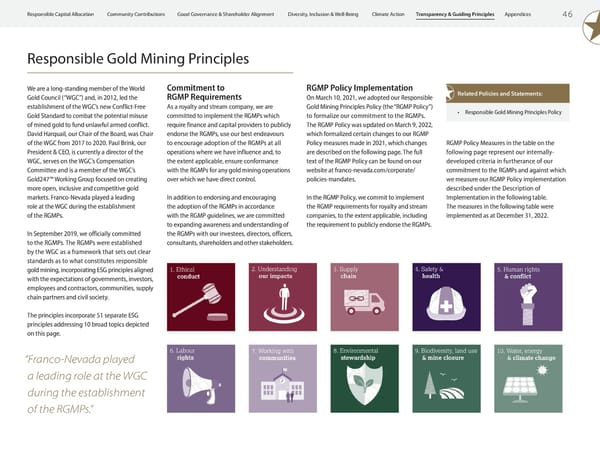
4 7 Appendices Transparency & Guiding Principles Climate Action Diversity, Inclusion & Well-Being Good Governance & Shareholder Alignment Community Contributions Responsible Capital Allocation Assurance Statement Although there is no obligation in the RGMPs for royalty and streaming companies to arrange for external assurance for their RGMP commitments, Franco-Nevada engaged the services of an assurance provider, KPMG LLP (“KPMG”), to provide limited assurance on our description of implementation against specific RGMP Policy measures set out in the table above. KPMG’s Independent Limited Assurance Report is included in Appendix G to this ESG Report. RGMP Policy Measures Description of Implementation Training. Franco-Nevada will conduct training sessions to promote the understanding of: Franco-Nevada’s obligations and objectives under the RGMPs, internal systems and processes in place to conform to such obligations and objectives, and the progress made and to be made by Franco-Nevada in conforming to such obligations and objectives. Such training sessions will be conducted for employees every three years, with the exception of new employees who will receive such training during the calendar year that they join Franco-Nevada. Initial RGMP training for Franco-Nevada employees covering the training subject matter set out in the RGMP Policy took place in November 2020, with two subsequent training sessions for new hires being held in December 2021 and November 2022. All of our employees attended one of the training sessions and provided a written acknowledgement of their participation in the training session. All of our employees also provided a separate annual written acknowledgement of their understanding of the RGMPs and Franco-Nevada’s RGMP obligations and commitments. Due Diligence. Franco-Nevada will identify and record RGMP implementation and conformance when evaluating new mining investments, including whether the applicable miner is a WGC member and/or has adopted the RGMPs or whether the RGMPs are not applicable to the miner (e.g. if the operator is a diversified mineral producer). If the miner has adopted the RGMPs, Franco-Nevada will identify and record the stage of implementation of and conformance with the RGMPs at the applicable mining operation. We have developed an ESG due diligence checklist used for evaluating our royalty and stream opportunities, which includes an assessment of the applicability of the WGC and RGMPs to the miner, including the membership by the miner in the WGC, the adoption of the RGMPs by the miner, and the stage of implementation and conformance with the RGMPs by the miner. A summary of such assessment is included in the final memorandum in connection with the opportunity submitted for final approval to the Franco-Nevada Board of Directors or, if within management’s authority to approve such transaction, the executive committee. In 2022, we included such assessment in all final memorandums submitted for final approval. External Consultants. When Franco-Nevada engages technical, ESG or other third-party consultants to assist Franco-Nevada with its evaluation of new mining investments, Franco-Nevada will ensure that the consultants are familiar with the RGMPs and understand Franco-Nevada’s commitments thereunder and Franco-Nevada will obtain a written acknowledgement from the consultants verifying their awareness. New external consultants engaged during 2022 verified in their consulting agreements that they are familiar with the RGMPs, the RGMP requirements for capital and finance providers, and Franco-Nevada’s commitments thereto. Contractual Provisions. Franco-Nevada will endeavour to negotiate appropriate contractual provisions when making new investments with a view to having gold miners (“Gold Miners”) use commercially reasonable efforts to adopt (or to continue to adopt and implement) the RGMPs and to ensure that the Gold Miners provide sufficient transparency to facilitate Franco-Nevada’s assessment of the compliance by the Gold Miners with any agreed contractual provisions. In all new instances where we contracted with Gold Miners in 2022, we were successful in including RGMP-related contractual provisions in our royalty or stream agreement with them. Monitoring. After each new royalty or stream acquisition in respect of a mining operation, Franco-Nevada will monitor whether the miner has adopted the RGMPs, the stage of implementation of and conformance with the RGMPs, and any material issues disclosed by the miner regarding such implementation and conformance. In our internal asset summaries for all new mining royalty or stream acquisitions made in 2022 (irrespective of whether such acquisitions related to gold or other mining operations), we have recorded whether the applicable miner is a WGC member and, if so, whether such miner has adopted the RGMPs and the stage of implementation of, and conformance with, the RGMPs. Transparency. On an annual basis, Franco-Nevada will publicly report on the status of its conformance to its RGMP commitments and the measures described in our RGMP Policy. This segment of our ESG Report comprises our reporting in relation to our RGMP Policy implementation. “As a royalty and stream company, we are committed to... use our best endeavours to encourage adoption of the RGMPs at all operations where we have influence and, to the extent applicable, ensure conformance with the RGMPs for any gold mining operations over which we have direct control.”
4 8 Appendices Transparency & Guiding Principles Climate Action Diversity, Inclusion & Well-Being Good Governance & Shareholder Alignment Community Contributions Responsible Capital Allocation ESG Ratings and Recognition Global 50 Top Rated by Sustainalytics in 2023 Best 50 Corporate Citizens in Canada in 2022 “B-“ CDP score in 2022 Rated “AA” by MSCI in 2022 Rated “Prime” by ISS ESG in 2022
4 9 Appendices Transparency & Guiding Principles Climate Action Diversity, Inclusion & Well-Being Good Governance & Shareholder Alignment Community Contributions Responsible Capital Allocation About this ESG Report Scope This ESG Report includes information about Franco-Nevada Corporation and its subsidiaries (“Franco-Nevada”, the “company”, “we”, “us” or “our”). Unless otherwise specified in this ESG Report, reference to “Franco-Nevada”, the “company”, “we”, “us” or “our” refers to our entire corporate structure and global operations and workforce. This ESG Report complements but does not form part of our most recent Annual Report, Management Information Circular, and Annual Information Form available at www.franco- nevada.com and filed with the Canadian securities regulatory authorities on www.sedar. com or with the Securities and Exchange Commission on www.sec.gov . Certain information is based on the public disclosure of our operators and has not been independently verified by Franco-Nevada. Materiality The ESG topics and issues described in this ESG Report are those that we have identified as most important to our shareholders and our other stakeholders. Our processes to assess the materiality of ESG issues for our company involve routine strategy meetings between management and our Board of Directors. We also engage regularly with our shareholders and other stakeholders to determine whether our ESG strategy and efforts are aligned with the key concerns and priorities of our employees, directors, shareholders, community members, ESG rating agencies and other stakeholders. Please refer to page 26 of this ESG Report for a summary of the ways in which we engage with our stakeholders and their key topics of interest in 2022. We actively collaborate with industry leaders through our involvement with the World Gold Council and other industry associations. Through these various discussions and collaborations, we identify our ESG priorities, which are reflected in our corporate policies, in our corporate goals, targets and initiatives, and in this ESG Report. Reporting Period All data and examples contained in this ESG Report reflect activities undertaken during the 2022 fiscal year, unless otherwise noted. ESTMA Franco-Nevada supports efforts to increase transparency and accountability in the mining and energy industries. Please refer to Franco- Nevada’s enrollment under Extractive Sector Transparency Measures Act (“ESTMA”): www.franco-nevada.com/investors/ESTMA Currency All amounts in this document are in U.S. dollars unless otherwise noted. Feedback We would like to hear what you think about our ESG Report or any aspect of our ESG and sustainability efforts. Please send any questions or comments to info@franco-nevada.com . Forward Looking Information Certain statements made in this ESG Report contain “forward looking information” and “forward looking statements” within the meaning of applicable Canadian securities laws and the United States Private Securities Litigation Reform Act of 1995, respectively. Such forward looking statements reflect management’s current beliefs and assumptions and are based on information currently available to management. Often, but not always, forward looking statements can be identified by the use of words such as “plans”, “expects”, “is expected”, “budgets”, “potential for”, “scheduled”, “estimates”, “forecasts”, “predicts”, “projects”, “intends”, “targets”, “aims”, “anticipates” or “believes” or variations (including negative variations) of such words and phrases or may be identified by statements to the effect that certain actions “may”, “could”, “should”, “would”, “might” or “will” be taken, occur or be achieved. Forward looking statements involve known and unknown risks, uncertainties and other factors, which may cause the actual results, performance or achievements of Franco-Nevada to be materially different from any future results, performance or achievements expressed or implied by the forward looking statements. Many factors could cause actual events or results to differ materially from any forward looking statement. Franco-Nevada cannot assure investors that actual results will be consistent with these forward looking statements. Accordingly, investors should not place undue reliance on forward looking statements due to the inherent uncertainty therein. For additional information with respect to risks, uncertainties and assumptions, please refer to Franco-Nevada’s most recent Annual Information Form filed with the Canadian securities regulatory authorities on www.sedar. com and Franco-Nevada’s most recent Annual Report filed on Form 40-F filed with the SEC on www.sec.gov . The forward looking statements in this ESG Report are made as of the date indicated and Franco-Nevada does not assume any obligation to update or revise them to reflect new information, estimates or opinions, future events or results or otherwise, except as required by applicable law. This ESG Report does not constitute an offer to sell or a solicitation for an offer to purchase any security in any jurisdiction.
Transparency & Guiding Principles Climate Action Diversity, Inclusion & Well-Being Good Governance & Shareholder Alignment Community Contributions Responsible Capital Allocation 5 0 Appendices Contents Appendix A: ESG Performance Table 51 Appendix B: Operators’ Emissions 53 Appendix C: TCFD Disclosure 57 Appendix D: SASB Disclosure 73 Appendix E: GRI Index 76 Appendix F: Sustainable Development Goals 80 Appendix G: KPMG: Independent Limited Assurance Report 82 Appendix H: Carbon Neutral Initiative 83 Appendices Miners at Marigold gold mine, Nevada
5 1 Appendices Transparency & Guiding Principles Climate Action Diversity, Inclusion & Well-Being Good Governance & Shareholder Alignment Community Contributions Responsible Capital Allocation Appendix A: ESG Performance Table 1 1 Unless otherwise noted, the figures in this ESG Performance Table relate to Franco-Nevada Corporation and all of its subsidiaries. “NR” means such information was not recorded by our company for the applicable year. 2 Workforce figures are determined as at December 31 of each applicable year. 3 Full-time employees (FTE) for all of our office operations, in Toronto, Barbados, United States and Australia. 4 “BIPOC” means Black, Indigenous, and people of colour 5 “Diverse Persons” includes women, Black, Indigenous and other people of colour, individuals who identify as LGBTQ2S+ and people with disabilities. 6 After our May 2, 2023 annual general meeting, our Board of Directors will be comprised of 9 Board members, 7 (78%) independent directors, 3 (33%) women, and 3 (33%) Diverse Persons. 7 Includes transition of senior management of the Company and its subsidiaries to non-executive directorship roles. Workforce 2 Unit 2022 2021 2020 Full-time employees (“FTE”) 3 # 40 36 35 FTE – Women # (%) 17 (43%) 18 (50%) 17 (49%) FTE – Visible minorities # (%) 18 (45%) 15 (42%) 14 (40%) FTE – BIPOC 4 # (%) 18 (45%) 15 (42%) 14 (40%) FTE – Diverse Persons 5 # (%) 24 (60%) 22 (61%) 21 (60%) Senior management (VP and higher) # 14 11 10 Women in senior management positions # (%) 2 (14%) 1 (8%) Nil (Nil) Visible minorities in senior management positions # (%) 6 (43%) 4 (33%) 2 (20%) BIPOC individuals in senior management positions # (%) 6 (43%) 4 (33%) 2 (20%) Diverse Persons in senior management positions # (%) 6 (43%) 4 (33%) 2 (20%) Board members 6 # 11 10 11 Independent directors # (%) 9 (82%) 8 (80%) 9 (82%) Women on Board of Directors # (%) 3 (27%) 3 (30%) 3 (27%) Visible minorities on Board of Directors # (%) Nil Nil Nil BIPOC individuals on Board of Directors # (%) Nil Nil Nil Diverse Persons on Board of Directors # (%) 3 (27%) 3 (30%) 3 (27%) Labour Unit 2022 2021 2020 Collective bargaining agreements # Nil Nil Nil Strikes or lock-outs # Nil Nil Nil Labour violations or fines (e.g. age limits, wages, maximum hours and days) # Nil Nil Nil Human rights violations # Nil Nil Nil Reports of violence or harassment # Nil Nil Nil FTEs making greater than minimum wage % 100 100 100 FTEs receiving vacation pay, sick pay and parental leave pay and receive health and other benefits % 100 100 100 Total FTE turnover # 5 1 1 Voluntary turnover of FTEs 7 # 5 1 1 Involuntary turnover of FTEs # Nil Nil Nil New FTE hires # 9 2 2 Internal FTE promotions # 2 5 5 Employees receiving annual performance reviews % 100 100 100 Health & Safety Workplace incidents relating to FTEs or contractors reported # Nil Nil Nil Lost days due to personnel or contractor workplace injuries # Nil Nil Nil Workplace personnel or contractor fatalities # Nil Nil Nil Instances of occupational diseases among our personnel or contractors # Nil Nil Nil Health & safety fines, penalties, litigation, liabilities or settlements # Nil Nil Nil
5 2 Appendices Transparency & Guiding Principles Climate Action Diversity, Inclusion & Well-Being Good Governance & Shareholder Alignment Community Contributions Responsible Capital Allocation Climate & Environment Unit 2022 2021 2020 Hazardous waste tonnes Nil Nil Nil Fresh water withdrawn m 3 Nil Nil Nil Total water withdrawn m 3 Nil Nil Nil Water recycled m 3 Nil Nil Nil Board members having climate expertise # 6 6 6 Scope 1 - Total GHG emissions from fuel tCO 2 e Nil Nil Nil Scope 2 - Total GHG emissions from electricity and steam 1 tCO 2 e 50.4 36.0 49.0 Scope 3 - Total GHG emissions from indirect sources tCO 2 e 83.8 2 627,398.1 692,468.2 • from purchased goods and services (Scope 3 Category 1) tCO 2 e 20.6 11.0 4.1 • from waste and wastewater (Scope 3 Category 5) 3 tCO 2 e 3.6 2.2 2.3 • from business travel (Scope 3 Category 6) tCO 2 e 37.4 11.5 28.9 • from employee commuting (Scope 3 Category 7) tCO 2 e 22.2 8.7 8.8 • from investments (Scope 3 Category 15) tCO 2 e NR 4 627,364.7 692,424.1 Total GHG emissions tCO 2 e 134.2 2 627,434.1 692,517.2 GHG reductions from carbon offsets purchased 5 tCO 2 e (167.8) (86.8) (116.4) Carbon neutrality for corporate operations Yes/No Yes Yes Yes Community & Other Contributions Community and operator energy transition contributions actually funded 6 $ 1,070,785 787,190 619,041 Government & Lobbying 7 Unit 2022 2021 2020 Facilitation payments $ Nil Nil Nil Political donations $ Nil Nil Nil Lobbying expenditures $ Nil Nil Nil Trade associations or tax-exempt groups whose role is to influence political campaigns and legislation $ Nil Nil Nil Known government ownership % Nil Nil Nil Compliance, Disputes, Fines & Litigation Cases of non-compliance or breaches of our corporate policies # Nil Nil Nil Instances of whistleblower complaints # Nil Nil Nil Environmental fines, penalties, litigation, liabilities or settlements # Nil Nil Nil Bribery & Anti-Corruption Incidents of discipline or dismissal among staff or consultants due to non-compliance with anti-corruption policies # Nil Nil Nil Anti-bribery, or anti-corruption fines, penalties, litigation, liabilities or settlements # Nil Nil Nil Cost of fines, penalties or settlements in relation to bribery or corruption $ Nil Nil Nil Information Security Significant cybersecurity breaches # Nil Nil Nil Board members having cybersecurity expertise # 6 6 3 Financial Revenue (million) $ 1,315.7 1,300.0 1,020.2 1 Scope 2 emissions relate only to our Toronto and Barbados offices and for 2022 covers 87.5% (35 of 40 FTE) of our company (2020 – 88.6%; 2021 – 88.9%). 2 Excludes Scope 3, Category 15 emissions from Investments. Due to the delayed timing of availability of production and emission data from our operators, Financed Emissions have been calculated and disclosed for 2020 and 2021. 3 Scope 3 Category 5 emissions (from water and wastewater) relate only to our Toronto and Barbados offices and for 2022 covers 87.5% (35 of 40 FTE) of our company (2020 – 88.6%; 2021 – 88.9%). 4 Due to the delayed timing of availability of production and emission data from our operators, finance emissions have been calculated and disclosed for 2020 and 2021. 5 Please refer to pages 41 and 83 for descriptions of our annual purchase of carbon offsets for 125% of our reported emissions from our corporate operations. 6 Inclusive of industry and diversity-related contributions. Excludes (i) charitable donations by company employees, including relating to Franco-Nevada’s annual United Way campaign, and (ii) commitments made in a calendar year but not funded. Franco-Nevada has made additional commitments exceeding $2 million, which have not yet been funded. 7 All Government & Lobbying figures are Nil since our initial public offering in 2007.
5 3 Appendices Transparency & Guiding Principles Climate Action Diversity, Inclusion & Well-Being Good Governance & Shareholder Alignment Community Contributions Responsible Capital Allocation Appendix B: Operators’ Emissions * Emissions (tCO 2 e) 2021 2020 2019 Asset Operator Scope 1 Scope 2 Total Scope 1 Scope 2 Total Scope 1 Scope 2 Total Agate Creek (Australia - Queensland) Laneway Resources Limited - - - 3,442.0 7,146.0 10,588.0 612.0 1,357.0 1,969.0 Agnew (Vivien Gold Mine) (Australia - W. Australia) Remelius Resources Limited 9,614.8 8,351.7 17,966.6 7,440.0 6,701.0 14,141.0 8,623.0 7,599.0 16,222.0 Antamina (Peru) Teck Resources Limited 564,073.6 230,270.1 794,343.8 381,951.4 166,304.3 548,255.7 442,276.2 172,630.8 614,907.0 Antapaccay (Peru) Glencore plc 302,057.5 141,100.4 443,157.9 297,744.4 166,004.3 463,748.7 306,001.9 215,354.7 521,356.6 Bald Mountain (USA - Nevada) Kinross Gold Corporation 125,910.3 24,975.4 150,885.7 121,554.0 44,495.0 166,049.0 112,988.0 52,891.0 165,879.0 Bowen Basin (Moorvale) (Australia - Queensland) Peabody Energy Corp 150,245.9 14,662.1 164,908.0 139,211.0 14,443.0 153,654.0 163,782.0 25,498.0 189,280.0 Brucejack (Canada - British Columbia) Newcrest Mining Limited 30,363.4 1,222.3 31,585.7 20,676.0 1,291.0 21,967.0 20,608.0 1,366.0 21,974.0 Canadian Malartic (Canada - Quebec) Agnico Eagle Mines Limited 210,395.2 791.6 211,186.8 218,268.0 847.0 219,115.0 227,041.0 1,482.0 228,523.0 Candelaria (Chile) Lundin Mining Corporation 341,568.9 342,965.9 684,534.8 279,650.2 279,610.2 559,260.4 323,346.0 335,372.2 658,718.2 Carol Lake (Canada - Newfoundland & Labrador) Rio Tinto plc 393,318.5 - 393,318.5 394,058.6 - 394,058.6 407,055.8 - 407,055.8 Caserones (Chile) JX Nippon Mining & Metals Corporation 307,225.1 285,867.7 593,092.7 - - - - - - Castle Mountain (USA - California) Equinox Gold Corp. 7,156.6 2,661.4 9,818.0 957.0 416.0 1,373.0 - - - Cerro Moro (Argentina) Pan American Silver Corp. 42,625.2 - 42,625.2 41,500.0 - 41,500.0 49,894.0 - 49,894.0 Cobre Panama (Panama) First Quantum Minerals Ltd. 2,512,552.2 270,145.9 2,782,698.2 2,187,011.0 73,279.2 2,260,290.2 1,991,271.0 149,383.8 2,140,654.8 * Figures in this table are estimated greenhouse gas emissions of producing mining assets where we have royalty and stream interests. Unless otherwise noted, such information has been provided by McKinsey MineSpans (outside-in modeled data - all rights reserved). Such data only relates to mine production and excludes emissions attributable to mine construction, pre-stripping, underground development relating to non-operational activities, care and maintenance of assets, and mine rehabilitation. Emission data (i) is provided on a 100% basis, notwithstanding that the applicable operation may be jointly owned by the referenced operator and (ii) applies to the entire project. “NA” means that data is not publicly available and has not been modeled by McKinsey MineSpans.
5 4 Appendices Transparency & Guiding Principles Climate Action Diversity, Inclusion & Well-Being Good Governance & Shareholder Alignment Community Contributions Responsible Capital Allocation Emissions (tCO 2 e) 2021 2020 2019 Asset Operator Scope 1 Scope 2 Total Scope 1 Scope 2 Total Scope 1 Scope 2 Total Condestable (Peru) Southern Peaks Mining LP 7,378.9 17,790.3 25,169.2 6,116.9 8,553.9 14,670.8 6,777.2 23,095.8 29,873.0 Cue Gold (Day Dawn) (Australia - W. Australia) Westgold Resources Limited 62,647.1 - 62,647.1 53,786.0 - 53,786.0 51,547.0 - 51,547.0 Detour Lake (Canada - Ontario) Agnico Eagle Mines Limited 248,961.9 17,871.6 266,833.5 241,626.0 19,647.0 261,273.0 231,832.0 19,781.0 251,613.0 Dublin Gulch (Eagle) (Canada - Yukon) Victoria Gold Corp. 75,567.9 8,692.6 84,260.5 25,440.0 3,539.0 28,979.0 9,412.0 1,669.0 11,081.0 Duketon (Australia - W. Australia) Regis Resources Limited 213,810.1 - 213,810.1 203,638.1 - 203,638.1 212,184.2 - 212,184.2 EaglePicher (USA - Nevada) EP Minerals LLC NA NA NA NA NA NA NA NA NA Edikan (Ghana) Perseus Mining Limited 53,331.8 65,485.5 118,817.2 80,721.0 30,051.0 110,772.0 79,823.0 37,265.0 117,088.0 Fire Creek/Midas (USA - Nevada) Hecla Mining Company 7,081.6 11,667.2 18,748.8 8,196.0 14,258.0 22,454.0 7,819.0 15,493.0 23,312.0 Flying Fox (Australia - W. Australia) Western Areas NL 4,227.8 14,633.1 18,860.9 4,132.1 14,628.1 18,760.2 5,664.7 18,441.0 24,105.7 Gold Quarry (USA - Nevada) Nevada Gold Mines LLC 365,189.8 169,137.6 534,327.4 669,929.3 267,643.7 937,573.0 600,416.1 246,165.4 846,581.5 Goldstrike (USA - Nevada) Nevada Gold Mines LLC 20,034.5 532,162.8 552,197.3 24,603.0 456,256.7 480,859.7 13,123.3 370,384.9 383,508.2 Guadalupe-Palmarejo (Mexico) Coeur Mining, Inc. 25,609.6 54,079.7 79,689.3 21,305.8 48,914.8 70,220.6 21,378.5 52,172.5 73,551.0 Hemlo (Canada - Ontario) Barrick Gold Corporation 21,805.4 3,642.5 25,447.9 30,955.0 5,072.0 36,027.0 37,953.0 6,077.0 44,030.0 Henty (Australia - Tasmania) Catalyst Metals Ltd 945.3 2,020.3 2,965.7 542.0 1,281.0 1,823.0 991.0 1,730.0 2,721.0 Island Gold (Canada - Ontario) Alamos Gold Inc. 14,895.3 2,105.9 17,001.2 12,954.0 2,020.0 14,974.0 13,743.0 2,253.0 15,996.0 Karma (Burkina Faso) Endeavour Mining plc 50,963.8 - 50,963.8 46,408.0 - 46,408.0 39,664.0 - 39,664.0 Kirkland Lake (Canada - Ontario) Agnico Eagle Mines Limited 5,313.9 4,512.1 9,825.9 89.0 9,850.0 9,939.0 92.0 10,743.0 10,835.0
5 5 Appendices Transparency & Guiding Principles Climate Action Diversity, Inclusion & Well-Being Good Governance & Shareholder Alignment Community Contributions Responsible Capital Allocation Emissions (tCO 2 e) 2021 2020 2019 Asset Operator Scope 1 Scope 2 Total Scope 1 Scope 2 Total Scope 1 Scope 2 Total Kiziltepe (Türkiye) Ariana Resources plc 5,334.5 4,784.4 10,118.8 2,764.0 2,538.0 5,302.0 5,475.0 2,870.0 8,345.0 Marigold (USA - Nevada) SSR Mining Inc. 138,523.7 9,414.7 147,938.3 99,919.0 38,217.0 138,136.0 72,921.0 39,215.0 112,136.0 Matilda (Australia - W. Australia) Wiluna Mining Corporation 60,561.8 - 60,561.8 52,433.0 - 52,433.0 51,782.0 - 51,782.0 Mesquite (USA - California) Equinox Gold Corp. 58,390.0 9,053.3 67,443.2 78,616.0 8,778.0 87,394.0 68,147.0 13,060.0 81,207.0 Millmerran (Commodore Coal Mine) (Australia - Queensland) Millmerran Power Management Pty Ltd 126,197.6 3,254.9 129,452.5 129,943.0 3,585.0 133,528.0 127,031.0 3,525.0 130,556.0 Milpillas (Mexico) Industrias Peñoles, S.A.B. de C.V. 5,183.9 25,893.0 31,076.9 7,153.5 37,704.4 44,857.9 11,571.9 68,118.2 79,690.1 Mt. Keith (Australia - W. Australia) BHP Group Limited 71,770.4 139,960.9 211,731.4 90,188.2 172,546.2 262,734.4 84,387.2 163,843.0 248,230.2 Musselwhite (Canada - Ontario) Newmont Corporation 23,669.9 2,722.0 26,391.8 36,917.0 2,386.0 39,303.0 2,093.0 235.0 2,328.0 MWS (South Africa) Harmony Gold Mining Company Limited 6,150.5 231,294.2 237,444.6 5,829.0 236,537.0 242,366.0 6,739.0 280,078.0 286,817.0 Northern System (Brazil) Vale S.A. 1,123,646.2 48,105.7 1,171,751.8 994,423.8 128,895.2 1,123,319.0 849,653.7 136,078.7 985,732.4 Pandora (South Africa) Sibanye-Stillwater Ltd. NA NA NA NA NA NA NA NA NA Robinson (USA - Nevada) KGHM International Ltd. 194,085.2 109,313.4 303,398.6 193,805.3 116,926.8 310,732.1 190,309.8 127,830.6 318,140.4 Sabodala (Senegal) Endeavour Mining plc 183,167.1 - 183,167.1 199,047.0 - 199,047.0 159,996.0 - 159,996.0 Sissingué (Côte d’Ivoire) Perseus Mining Limited 37,228.5 - 37,228.5 37,946.5 - 37,946.5 38,063.0 - 38,063.0 Sossego (Brazil) Vale S.A. 98,608.7 - 98,608.7 108,333.0 - 108,333.0 116,930.8 - 116,930.8 South Arturo (USA - Nevada) Nevada Gold Mines LLC 806.5 6,475.3 7,281.8 1,805.0 10,396.0 12,201.0 3,156.0 3,930.0 7,086.0 South Kalgoorlie (Mt Marion Lithium) (Australia - W. Australia) Mineral Resources Limited 96,472.1 - 96,472.1 81,345.5 - 81,345.5 66,506.7 11,977.6 78,484.3
5 6 Appendices Transparency & Guiding Principles Climate Action Diversity, Inclusion & Well-Being Good Governance & Shareholder Alignment Community Contributions Responsible Capital Allocation Emissions (tCO 2 e) 2021 2020 2019 Asset Operator Scope 1 Scope 2 Total Scope 1 Scope 2 Total Scope 1 Scope 2 Total South Kalgoorlie (New Celebration) (Australia - W. Australia) Northern Star Resources Limited 10,373.1 13,935.4 24,308.6 12,980.0 20,022.0 33,002.0 11,659.0 18,494.0 30,153.0 Southestern System (Brazil) Vale S.A. 1,732,322.6 100,027.9 1,832,350.6 1,442,456.0 117,214.0 1,559,670.0 1,714,017.4 126,676.5 1,840,693.9 Stillwater* (USA - Montana) Sibanye-Stillwater Ltd. 38,433.0 116,351.0 154,784.0 63,303.0 110,272.0 173,575.0 37,345.0 101,385.0 138,730.0 Subika (Ghana) Newmont Corporation 4,739.3 13,845.4 18,584.7 3,739.0 18,134.0 21,873.0 3,455.0 21,872.0 25,327.0 Sudbury-McCreedy West Mine (Canada - Ontario) KGHM International Ltd. 1,162.2 3,019.6 4,181.7 1,284.5 3,748.4 5,032.9 1,926.7 5,549.6 7,476.3 Tasiast (Mauritania) Kinross Gold Corporation 102,701.4 53,551.8 156,253.3 295,687.0 - 295,687.0 298,392.0 - 298,392.0 Timmins West (Canada - Ontario) Pan American Silver Corp. 14,865.2 11,966.7 26,831.9 15,754.0 12,616.0 28,370.0 13,488.0 13,749.0 27,237.0 Yandal (Julius/Red Lake) (Australia - W. Australia) Northern Star Resources Limited 137,249.6 - 137,249.6 117,103.0 - 117,103.0 114,596.0 - 114,596.0 * Emission data sourced from operator’s CDP reports.
5 7 Appendices Transparency & Guiding Principles Climate Action Diversity, Inclusion & Well-Being Good Governance & Shareholder Alignment Community Contributions Responsible Capital Allocation Appendix C: TCFD Disclosure Board Oversight The Board and its Committees provide oversight of our strategic approach to climate change and our ESG risks, which includes climate-related risks and opportunities affecting our business. A number of our Board members have skills and competencies in climate-related matters, including David Harquail, Tom Albanese, Derek Evans, Catharine Farrow, Maureen Jensen, and Elliott Pew. † Each of the Board’s Committees have oversight of ESG and climate-related risks, opportunities and disclosures, which are embedded in the Committees’ Charters: • Compensation and ESG Committee (“CESGC”): Our CESGC develops and recommends to the Board our approach to ESG issues, including climate-related issues, reviews the adequacy of our ESG practices and policies and recommends any changes to the Board, approves the adoption of any ESG-related standards or initiatives, adopts ESG-related corporate goals used to evaluate management’s performance for executive compensation decisions and engages with our stakeholders in respect of ESG issues. • Audit and Risk Committee (“ARC”): Our ARC oversees our risk management, including climate change risks. Management’s Role The Board and its Committees oversee senior management, who are responsible for the management of ESG and climate-related risks and for the execution of ESG and climate-related opportunities. Our Chief Executive Officer is responsible for leadership on ESG and climate- related matters and our Chief Legal Officer has executive responsibility over such matters. Climate-related risks and opportunities are overseen by the following members of our executive team having stewardship over our organization’s units (including within our subsidiaries), each being responsible for implementing our ESG strategy and managing risks within their units: • Business Development (Senior Vice President, Business Development) • Diversified (Senior Vice President, Diversified) • Finance (Chief Financial Officer) • Legal (Chief Legal Officer) Our Board oversight and management leadership of ESG and climate-related issues is depicted in the adjacent chart. Board and Management Engagement All of our executives regularly attend Board and Committee meetings, including providing updates on royalty and stream acquisition opportunities, which include ESG-related considerations. To the extent that a materially adverse ESG issue or consideration arises during the due diligence process in respect of a royalty and stream opportunity, management and the Board may decide not to proceed with the opportunity. On a number of occasions, our Company has passed on otherwise prospective opportunities due to ESG risks. The Board and its Committees also frequently meet with senior management to determine our strategy with respect to our risks and exposures. In November 2022, management met with the ARC to discuss ESG-related risks and strategy and with the CESGC to discuss strategy for improved ESG reporting in 2023. Most recently, in March 2023, management met with the CESGC to discuss Franco-Nevada’s ESG strategy, including, among other things, climate initiatives and commitments, community contributions, and diversity and inclusion goals and targets for the company. Business Development Team Senior Vice President, Business Development Diversified Team Senior Vice President, Diversified Compensation and ESG Committee* Finance Team Chief Financial Officer Audit and Risk Committee* Chief Executive Officer** Board of Directors* Legal Team Chief Legal Officer*** * Board and Committees have oversight over ESG and climate-related risks and opportunities ** Chief Executive Officer has responsibility for leadership on ESG and climate-related matters *** Chief Legal Officer has executive responsibility over ESG and climate- related matters † After our May 2, 2023 annual general meeting, Board members with skills and competencies in climate-related matters will include David Harquail, Tom Albanese, Derek Evans, Catharine Farrow, Maureen Jensen, and Jacques Perron. Our governance around climate-related risks and opportunities Governance
5 8 Appendices Transparency & Guiding Principles Climate Action Diversity, Inclusion & Well-Being Good Governance & Shareholder Alignment Community Contributions Responsible Capital Allocation ESG and Climate-Related Accountability Starting in 2020, ESG was adopted as a specific corporate goal used to evaluate management’s performance for executive compensation decisions, in recognition of the importance of managing ESG issues, including climate-related issues, to our business and the greater emphasis on ESG that the CESGC would apply in evaluating management’s performance. On an annual basis, the CESGC will evaluate management’s performance in connection with ESG due diligence processes, reporting and compliance, community contributions, diversity and inclusion and ESG rankings. For further details as to this corporate goal and its subcomponents, please refer to the adjacent chart. ESG Objectives for Evaluating Management ESG Due Diligence ESG due diligence is critical in growing the Corporation’s business Diversity and Inclusion Diversity and inclusion are key components to the Corporation’s success ESG Rankings ESG rankings recognize management’s efforts with respect to ESG Appropriate level of ESG due diligence was presented to the Board in connection with new opportunities. Look-back basis in the event of an ESG issue at an existing asset to determine if such issue was reasonably foreseeable through due diligence. Progress in the area of diversity and inclusion including in recruiting, internal promotions and disclosed diversity goals. ESG Reporting and Compliance ESG initiatives should be adopted to be responsive to shareholders and stakeholders Keeping the Board informed as to ESG initiatives and effective shareholder outreach. Successful implementation of Board approved ESG initiatives, many of which can be multi-year projects. Contributions and Community Outreach The Corporation should make a positive impact in the local communities in which its assets are located as well as locally Successful execution of ESG contributions which will include pro-active outreach to operators. Personal engagement in making positive contributions to the local community. Corporation’s ESG rankings by the major agencies followed by institutional shareholders. Management will not be evaluated for matters solely within the Board’s purview.
5 9 Appendices Transparency & Guiding Principles Climate Action Diversity, Inclusion & Well-Being Good Governance & Shareholder Alignment Community Contributions Responsible Capital Allocation Climate-Related Risks As we have a small workforce operating solely within office environments, we are not directly exposed to most climate-related risks that mining and energy operators face. Notwithstanding, the climate-related risks of the operators of the projects in which we hold royalty and stream interests can pass through to us. Climate-related incidents, trends or developments have the potential to adversely impact production at an operation and, by extension, royalty or stream payments or deliveries to our company. Additionally, risks related to changes in the market price of commodities that underlie our royalty and stream interests, which changes may be driven by climate-related events, trends or sentiments, can impact our revenues. As demonstrated in Resilience of our Portfolio in this appendix, exposure to these risks is substantially mitigated for our company. Notably, of the four major categories of financial impact set out by the TCFD (Revenues, Expenditures, Assets and Liabilities, and Capital and Financing)*, the impacts of climate-related risks may affect our Revenues (Income Statement) and our Assets (Balance Sheet) but are unlikely to increase our Expenditures (Income Statement) or Liabilities (Balance Sheet) and are unlikely to materially adversely impact our access to Capital and Financing (Balance Sheet). The following discussion describes our operators’ climate-related risks, the potential financial impact for our operators and their corresponding financial impact to our company. Given the breadth and diversity of our royalty and stream portfolio and due to the fact that most of our royalty and stream interests are perpetual or have long durations, we have exposure to each of the risks below over short, medium and long-term horizons and such risks are identified and are part of our climate-related strategy and decision making, as appropriate. Certain acute physical risks will typically involve a short-term impact (less than 1 year), chronic physical risks, regulatory and legal risks, market risks and reputational risks can lead to medium-term (1 to 5 years) and long-term (5 years+) impacts. In 2022, we worked with Critical Resource to expand upon past disclosure relating to climate-related risks impacting our operators and our company. In particular, Critical Resource has provided assessments, which are summarized in the tables on the following pages, of: • Physical climate risks specific to certain jurisdictions where we have a high concentration of assets and/or material assets. In conducting its geographic physical risk assessment for Ontario, Nevada, Panama, Chile and Peru, Critical Resource applied SSP1-2.6 (low emissions scenario) and SSP5-8.5 (high emissions scenario) for 2030 and 2050 and relied on publicly available information and projections, including the World Bank’s Climate Change Knowledge Portal. The assessment is high level in nature (e.g. physical risks applying generally across the country or applicable jurisdiction and not necessarily relating to any of Franco- Nevada’s particular assets) and does not address any additional risks or mitigating factors (e.g. topographical, sunk capital costs to build a mine, relative contribution of mine to a country’s GDP, etc.) specific to Franco-Nevada’s assets in these jurisdictions. • Socio-political, regulatory and legal risks, market risks and reputational risks that might impact key commodities in our commodity mix (gold, silver, PGMs, iron ore, energy (oil, gas, NGL) and nickel) in the transition to a low-carbon economy. * “Implementing the Recommendations of the Task Force on Climate-related Financial Disclosures”, Task Force on Climate-related Financial Disclosures (June 2017). The actual and potential impacts of climate-related risks and opportunities on our business, strategy, and financial planning Climate Strategy
6 0 Appendices Transparency & Guiding Principles Climate Action Diversity, Inclusion & Well-Being Good Governance & Shareholder Alignment Community Contributions Responsible Capital Allocation Physical Risks Potential Financial Impact for: Description of Physical Risks Our Operators Our Company Summary Acute: Extreme weather events caused by global warming (e.g. droughts, floods, hurricanes, etc.) These events may lead to production delays and cessation of operations • Short-term delay (deferral) of Revenues Chronic: Gradual shifts in weather conditions (e.g. water scarcity, shifts in rainfall patterns, rising sea levels, etc.) These shifts may lead to recurring production delays and cessations of operations and increased operating costs to adapt to climate changes, which may lead to projects being abandoned or placed on care and maintenance if adaptation costs erode anticipated profitability • Longer-term and potentially recurring delays (deferrals) of Revenues • Potential impact to valuation of Assets on balance sheet (e.g. impairment or write-off of assets) By Jurisdiction Chile • Reduction in annual precipitation rates is likely to exacerbate Chile’s pre-existing issues of water stress as well as the frequency and length of droughts • Despite an overall trend towards decreasing precipitation, extreme rainfall events are expected to intensify • Chile is projected to experience lower rates of warming than the global average, yet rising temperatures still pose risks Main risks: Health and safety of employees; social license to operate as increasing temperatures and decreasing rainfalls leads to loss of biodiversity; inability to permit new mines or mine life extensions using ground water Financial impacts to operations: Reduction in revenue due to production delays; increased operational costs (i.e. repairs to operations, energy costs) Revenue could be impacted in the short, medium or long-term due to interruptions to production caused by physical climate hazards Risk of stranded Assets: Low-medium Nevada • Nevada is at high risk of extreme heat, with the increased severity and frequency of heat waves posing a significant risk to people and projects • There is a high likelihood that rising temperatures will increase the severity and intensity of droughts • The risk of wildfires will increase, while flooding and storms may also become more common Main risks: Health and safety of employees; social license to operate given water scarcity issues caused by extreme heat in some areas Financial impacts to operations: Reduction in revenue due to production delays; increased operational costs (i.e. repairs to operations, energy costs) Revenue could be impacted in the short, medium or long-term due to interruptions to production caused by physical climate hazards Risk of stranded Assets: Low Peru • Temperatures are projected to rise in Peru, creating an increased risk of extreme heat, while increased rainfall also raises the risk of flooding, landslides and storms • The impact of climate change on precipitation rates is expected to vary considerably across Peru • Glacial retreat is occurring at an accelerated rate in Peru, increasing the risk of floods and landslides • Climate change could exacerbate existing water stress, creating challenges for mining operations Main risks: Health and safety of employees; social license to operate given water scarcity issues caused by extreme heat and droughts Financial impacts to operations: Reduction in revenue due to production delays; increased operational costs (i.e. repairs to operations, energy costs) Revenue could be impacted in the short, medium or long-term due to interruptions to production caused by physical climate hazards Risk of stranded Assets: Low
6 1 Appendices Transparency & Guiding Principles Climate Action Diversity, Inclusion & Well-Being Good Governance & Shareholder Alignment Community Contributions Responsible Capital Allocation Potential Financial Impact for: Description of Physical Risks Our Operators Our Company By Jurisdiction (continued) Panama • Panama’s vulnerability to tropical storms and droughts is expected to increase as climate change impacts the El Niño/La Niña phenomenon • Episodes of extreme heat and the occurrence of wildfires are projected to rise • Flooding and landslides could pose a significant risk, but the impact of climate change on these hazards is uncertain Main risks: Health and safety of employees, damage to infrastructure; supply chain disruptions Financial impacts to operations: Reduction in revenue due to production delays; increased operational costs (i.e. repairs to operations, energy costs) Revenue could be impacted in the short, medium or long-term due to interruptions to production caused by physical climate hazards Risk of stranded Assets: Medium Northern Ontario • Wildfires, water stress and drought are projected to increase • Rising temperatures in Ontario will reduce the risk of extreme cold • Changes to precipitation levels are expected, but the possible impacts on mining operations appear limited Main risks: Health and safety of employees; damage to infrastructure; supply chain disruptions Financial impacts to operations: Reduction in revenue due to production delays; increased operational costs (i.e. repairs to operations, energy costs) Revenue could be impacted in the short, medium or long-term due to interruptions to production caused by physical climate hazards Risk of stranded Assets: Low
6 2 Appendices Transparency & Guiding Principles Climate Action Diversity, Inclusion & Well-Being Good Governance & Shareholder Alignment Community Contributions Responsible Capital Allocation Socio-Political, Regulatory and Legal Risks Potential Financial Impact for: Description of Socio-Political, Regulatory and Legal Risks Our Operators Our Company Summary Policy, regulatory and legal changes in a jurisdiction that seek to promote adaptation to climate change and/or constrain the activities of operators and operations that contribute to adverse effects of climate change. These regulatory and legal changes may require extensive capital expenditures by operators to accommodate or conform to such changes, which may lead to projects being abandoned or placed on care and maintenance if such mandatory expenditures erode anticipated profitability. • Potential delay (deferral) of Revenues if mandatory adaptation results in delays or cessation of operations • Potential impact to valuation of Assets on balance sheet (e.g. impairment or write-off of assets) By Commodity Increased pricing of GHG emissions: Regulation of emissions, such as through carbon taxation or cap-and-trade schemes, can significantly increase costs for businesses. As more countries set net-zero emissions goals and increasingly ambitious 2030 targets, it is possible that carbon pricing regulations could become more widely implemented and/or made more stringent globally. The impact of these regulations will differ depending on the location of the assets and the carbon intensity of production, which varies significantly both within and between commodities. Commodities at highest risk: All commodities These regulatory and legal changes may require extensive capital expenditures by operators to accommodate or conform to such changes, which may lead to projects being abandoned or placed on care and maintenance if such mandatory expenditures erode anticipated profitability. • Potential delay (deferral) of Revenues if mandatory adaptation results in delays or cessation of operations • Potential impact to valuation of Assets on balance sheet (e.g. impairment or write-off of assets) Mandates on and regulation of existing products and services: If carbon-intensive industries are stigmatised for their contributions to climate change, the use of products and services from these industries could be curbed by new regulations. Commodities at highest risk: Energy (oil, gas, NGLs) Given the contribution of fossil fuels to climate change, regulation and mandates on the use of these products, including derivatives such as gasoline and plastics, may be subject to regulation from policy makers (e.g. ban on gas-powered cars in city centers, increased focus on reducing single-use plastics), which could impact demand for products. • Potential reduction of Revenues if demand for carbon-intensive commodities is restricted due to widespread regulation of products Enhanced emissions reporting obligations: As governments seek to improve emissions data and meet their respective long-term emissions goals, there may be increased obligations to report on energy usage and emissions and/or to obtain independent external assurance for such data. Companies may be required to comply with detailed mandatory TCFD or other reporting legislation as a result. Commodities at highest risk: All commodities Companies may face growing pressure to report their emissions in compliance with mandatory disclosure regimes, which will increase costs. Such companies could also encounter financial losses as a result of fines if they are unwilling or unable to comply with new regulations. • Potential increase to Operating Expenditures with growing demand to collect data, produce emissions reports, obtain external assurance, etc. Exposure to litigation: The expansion of climate-related legislation creates litigation risks for those companies that are unable to keep up with the pace of developments. Companies in heavy industries, such as mining and oil and gas, could also face legal action due to their relatively higher levels of emissions/emissions intensities, with some claimants also seeking to link climate change to other sustainability concerns, such as human rights. Commodities at highest risk: Energy (oil, gas, NGLs) Legal actions against Energy producers could increase operating costs (e.g. through payment of legal fees, fines, settlements, or insurance fees), reduce demand for products, and cause reputational damage. Energy producers in North America and Europe have already faced legal challenges on various grounds, with accusations ranging from misleading investors to infringing on the rights of nature and the right of life of future generations. • Corresponding direct impact to Revenues upon reduction of demand for commodities due to reputational damage to entire sectors or industries • Potential impact to valuation of Assets on balance sheet (e.g. impairment or write-off of assets) if increased operating costs cause uneconomic assets to become stranded
6 3 Appendices Transparency & Guiding Principles Climate Action Diversity, Inclusion & Well-Being Good Governance & Shareholder Alignment Community Contributions Responsible Capital Allocation Market Risks Potential Financial Impact for: Description of Market Risks Our Operators Our Company Summary Shifts in supply and demand for certain commodities based on their real or perceived impact on the climate. Reductions in commodity prices may impact the applicable operator’s bottom line and in serious cases may ultimately render a project uneconomic, which may lead to projects being abandoned or placed on care and maintenance until commodity prices recover. • Corresponding direct impact to Revenues (e.g. our sales) and potential long-term delay (deferral) of Revenues if project placed on care and maintenance By Commodity Changing customer behaviour: Demand for certain commodities is expected to reduce as a result of the energy transition, which may impact prices. While this trend could be the same across a single commodity, in some cases the significance of this risk will vary depending on the carbon intensity of specific assets. In the latter case, it is possible that the market will start to fragment between low-carbon and high carbon products, with some customers willing to pay a premium for low-carbon products. Commodities at highest risk: Energy (oil, gas, NGLs) Energy producers may encounter reduced demand for their products due to changing customer behaviour in the energy transition. The level of risk and timeframe will vary depending on the carbon production intensity of assets – for instance, low-carbon gas is projected to be competitive in many jurisdictions for longer than high-carbon intensity oil. Other non-energy producers may be impacted but this shift is more likely to be specific to the carbon intensity of a given asset than a blanket trend witnessed across the commodity group. • Potential reduction of Revenues if demand for carbon-intensive commodities or assets are reduced due to changing customer behaviour • Potential impact to valuation of Assets on balance sheet (e.g. impairment or write-off of assets) if decrease in demand causes uneconomic assets to become stranded
6 4 Appendices Transparency & Guiding Principles Climate Action Diversity, Inclusion & Well-Being Good Governance & Shareholder Alignment Community Contributions Responsible Capital Allocation Reputational Risks Potential Financial Impact for: Description of Reputational Risks Our Operators Our Company Summary Changing public perceptions of an operator’s climate-related activities and their contributions to or detractions from the transition to a low-carbon economy. May affect access to equity capital or the ability to raise new debt or refinance existing debt, which may lead to projects changing hands or being temporarily or permanently abandoned. • Potential delay (deferral) of Revenues if operator’s inability to raise capital or finance debt results in operations changing hands • Potential impact to valuation of Assets on balance sheet (e.g. impairment or write-off of assets) By Commodity Stigmatization of sector: Growing scrutiny of the climate impacts of different sectors has created the perception that some industries are inherently ‘dirty’ and ‘polluting’, creating a stigma around certain activities. Commodities at highest risk: All commodities Stigmatisation of sectors could lead to reduced demand and lower prices for products and services. Of particular risk of stigmatization will be ‘heavy industry’ commodity producers, including energy producers. This risk can be mitigated by operators and industries deploying energy efficient and low-carbon technologies in the production process and the lower carbon emitting producers, even within a stigmatised industry, will be rewarded while there is still demand for their products. • Potential reduction of Revenues if demand for carbon-intensive commodities or assets are reduced due to stigmatization of sectors • Potential impact to valuation of Assets on balance sheet (e.g. impairment or write-off of assets) if decrease in demand and/or lower prices causes uneconomic assets to become stranded Shifts in consumer preferences: Climate change could lead to a moral shift in customer preferences, with stakeholders becoming increasingly aware of their own carbon footprint and new regulations and policies incentivising lower-carbon lifestyles. Commodities at highest risk: Energy (oil, gas, NGLs) and gold Energy operators are most vulnerable to this risk as customers are likely to receive incentives to reduce use of these commodities due to their climate impacts. Gold and other commodities that are not considered to be essential to industry or the energy transition may come under greater scrutiny, potentially resulting in reduced demand. • Potential reduction of Revenues if demand for carbon-intensive commodities or assets are reduced due to shift in preferences • Potential impact to valuation of Assets on balance sheet (e.g. impairment or write-off of assets) if decrease in demand and/or lower prices causes uneconomic assets to become stranded Increased stakeholder concern: With stakeholders having growing access to information about company performance, those companies perceived to be causing environmental and social harms could encounter increased scrutiny over their impacts. This could pose a significant threat to a company’s social license to operate and require proactive mitigation. Commodities at highest risk: Energy (oil, gas, NGLs) Operators producing commodities that are not critical to the energy transition and/or typically have high-carbon intensity will be most vulnerable to this risk, with energy producers being particularly exposed. This may impact operator’s access to capital and asset valuations significantly impacted if negative stakeholder concern erodes operators’ social license to operate. • Potential reduction of Revenues if demand for carbon-intensive commodities or assets are reduced due to negative feedback or concern • Potential impact to valuation of Assets on balance sheet (e.g. impairment or write-off of assets) if erosion of social license causes uneconomic assets to become stranded
6 5 Appendices Transparency & Guiding Principles Climate Action Diversity, Inclusion & Well-Being Good Governance & Shareholder Alignment Community Contributions Responsible Capital Allocation Resilience of Our Portfolio Our exposure to climate-related risks is substantially mitigated by the diversification of our royalty and stream portfolio. No one operator or asset contributed more than 17% of our total 2022 revenues, which mitigates operator-specific or localized climate-related risks (e.g. reputational, acute physical and local regulatory and legal risks). We also receive revenues from various commodity types produced in a multitude of jurisdictions, which mitigates risks impacting broader regions and markets (e.g. chronic physical, country-wide regulatory and legal, and market risks). While we do have significant exposure to gold, broader market and reputational climate-related risks which may impact the gold industry are further mitigated through our rigorous due diligence process geared towards investing in best-in-class operators, many of whom have already set long-term climate-related goals and commenced low-carbon transitions. Certain mitigation factors are also inherent with our business model. For example, as a royalty and stream company, we are a free cash flow business without direct exposure to operating, capital or closure costs. • In the short and medium-term, any climate-related cessation of production at an operation in which we have a royalty or stream interest can be viewed as deferral of revenue for our company realizable upon re-commencement of production. • Most of our assets are non-cost bearing. In the long term, other than an asset becoming uneconomic, we are generally insulated from rising costs, including those related to carbon pricing, associated with the transition to a low carbon economy. Due to the breadth and diversification of our portfolio, our exposure to climate-related events, trends or sentiments adversely impacting a particular project or operator or more broadly adversely affecting a commodity type or jurisdiction is reduced. Climate risk exposure is further mitigated by factors inherent in our business portfolio, including those eliminating cost exposure in respect of our assets, and our high standards and rigorous due diligence processes geared toward investing in best-in-class operators and operations. Gold 55% Silver 11% PGM 4% Iron Ore 4% Other Mining 0% Oil 12% Gas 12% NGL 2% Commodity Canada & USA 41% South America 27% Mexico & Central America 23% Rest of World 9% Geography First Quantum 17% Lundin 10% Glencore 7% Coeur 6% Teck 5% Barrick 4% Vale 3% Others 48% Operator Cobre Panama 17% Candelaria 10% Antapaccay 7% Guadalupe 6% Antamina 5% Vale 3% Energy 25% Others 27% Assets Diversification of Portfolio (% of revenue)
6 6 Appendices Transparency & Guiding Principles Climate Action Diversity, Inclusion & Well-Being Good Governance & Shareholder Alignment Community Contributions Responsible Capital Allocation Sustainable Investment Opportunities As a royalty and streaming company, we are well positioned to participate in sustainable investment opportunities arising in connection with the transition to a low-carbon economy. The following describes sustainable investment opportunities that we have already embraced in our portfolio and that we expect will continue to be available to our company in the short, medium and long-term. Products and Services Our investments in commodities used for low emission products and services may increase revenues and bring competitive advantage due to the increased demand from shifting consumer preferences. Copper: With superior electrical and thermal conductivity, copper will play a significant role in enhancing energy efficiency and decarbonizing the planet. A 2017 World Bank report* counted dozens of metals which could see a growing market with the increasing reliance on renewable and sustainable energy sources. Copper ranked first (tied with aluminum and nickel) among all metals for its prevalence in low-carbon technologies, including in wind, solar photovoltaic, carbon capture and storage, nuclear power, light emitting diodes, electric vehicles and electric motors. Franco-Nevada’s top revenue generating stream interests are from copper mines, including certain of our Top Mining Assets (Cobre Panama, Antapaccay, Antamina and Candelaria) where we receive precious metal by-products from copper concentrates. In 2021, we acquired another precious metal stream from the Condestable copper mine in Peru and, in 2022, acquired an effective royalty on the Caserones copper- molybdenum mine in Chile. Strong demand for copper increases the prospects of greater production from these operations. We also have royalties on a number of prospective copper development projects, including Copper World (Hudbay), Alpala (SolGold), Taca Taca (First Quantum) and NuevaUnión (Teck and Newmont). We expect that in the future there will be further opportunities for our company to fund copper operations, to receive interests in copper and/or precious metal by-products. Nickel and Clean Energy Metals: While most of the global demand for nickel is for the production of stainless steel, nickel sulphate, a highly purified nickel compound that helps deliver higher energy density in lithium-ion batteries, extending the driving range for electric vehicles, is expected to become the second largest application for nickel in 2030. Our company has royalties on nickel projects, including the Mount Keith nickel mine in Australia, Eagle’s Nest deposit in the Ring of Fire in Ontario, Canada and the Crawford Nickel-Cobalt project in Ontario, Canada. These projects are poised to benefit from increasing demand for nickel and we expect to see more opportunities to fund nickel and other battery metal projects both domestically and abroad. Technologies involved in the clean energy transition are emerging and advancing rapidly through innovation and increased deployment. Over the past few years, our company has evaluated cobalt, lithium, rare earth, uranium and other battery metal and clean energy opportunities. In particular, we are building capabilities to evaluate lithium opportunities, which are in many ways geologically and technically dissimilar to precious and base metals projects. * “The Growing Role of Minerals and Metals for a Low-carbon Future”, World Bank Group, June 2017.
6 7 Appendices Transparency & Guiding Principles Climate Action Diversity, Inclusion & Well-Being Good Governance & Shareholder Alignment Community Contributions Responsible Capital Allocation Iron Ore: Steel is essential to many aspects of modern life and is a key component for low-carbon technologies from electric vehicles to wind turbines. The production of low-carbon steel will be crucial in the transition to a low-carbon economy and for the achievement of climate goals. Our company has exposure to iron ore operations with a low-carbon footprint and that produce products suited to lower carbon steel production. We have equity ownership in Labrador Iron Ore Royalty Corporation (“LIORC”), which has a minority ownership in Iron Ore Company of Canada (“IOC”) and holds royalties over IOC’s operations in Newfoundland and Labrador, and we have royalty debentures covering Vale’s Northern and Southeastern System operations in Brazil. IOC pellets and concentrate are high grade products with world leading low alumina and ultra-low phosphorus, beneficial to the iron and steel industry. These pellets are high quality with a clean chemistry, which helps to lower the carbon footprint, compared to lower quality grades and forms of iron ore, when used in the iron and steel industry. In early 2021, IOC, operator at Carol Lake where we indirectly hold interests through our LIORC equity ownership, announced an initiative that will explore the viability of transforming iron ore pellets into low-carbon hot briquetted iron, a low-carbon steel feedstock, using green hydrogen generated from hydro electricity in Canada. Vale supplies iron ore products that require less energy use in steel blast furnaces, reducing emissions. One example is its Brazilian Blend Fines, a blend of ores produced in Carajás and Minas Gerais, with a higher iron content and fewer contaminants. Vale has recently partnered with Kobe Steel and Mitsui & Co. with the objective to offer low-carbon solutions and technologies to the steel industry. Natural Gas: The use of natural gas for energy results in fewer emissions of nearly all types of air pollutants and carbon dioxide than burning coal or petroleum products. For this reason, natural gas is viewed by many as a “bridge” fuel as renewable energy sources become increasingly more cost-effective and prevalent. A 2019 World Energy Outlook report* found that from 2010 to 2018, coal-to-gas switching saved around 500 million tCO 2 , an effect equivalent to putting an extra 200 million electric vehicles running on zero-carbon electricity on the road over the same period. Our company’s additions to our energy portfolio have shifted from U.S. oil to natural gas plays, including our 2019 royalty acquisition on Range Resources’ liquids-rich natural gas properties in the Marcellus shale in Pennsylvania and our 2020 royalty portfolio acquisition in the Haynesville shale, Texas, one of the most active gas plays in North America. In 2022, natural gas accounted for approximately 45% of our energy revenues and approximately 11% of our overall revenues, a significant increase from prior years, due to elevated natural gas prices for the year. * “The Role of Gas in Today’s Energy Transitions”, World Energy Outlook, July 2019. “Our diversified royalty and streaming portfolio is well positioned to participate in opportunities relating to the transition to a low-carbon economy.“
6 8 Appendices Transparency & Guiding Principles Climate Action Diversity, Inclusion & Well-Being Good Governance & Shareholder Alignment Community Contributions Responsible Capital Allocation Carbon Sequestration at Weyburn (Franco-Nevada has royalty interests and a working interest at Weyburn) Whitecap Resources’ Weyburn Unit in southeast Saskatchewan is a CO 2 injection enhanced oil recovery project. CO 2 is transported as a liquid from two separate industrial sources. At the source, the CO 2 is captured and compressed before transmission via pipeline to Weyburn. The CO 2 in liquid form is then injected at high pressure into the Weyburn Unit. The gas stream that is recovered with the oil production is processed for natural gas liquids and the remaining CO 2 volume is reinjected into the formation on an ongoing basis. Accordingly, with minor adjustment for losses, all of the CO 2 purchased and transported by pipeline for injection at Weyburn constitutes additional CO 2 volumes stored each year. Since its inception in 2000, more than 36 million tonnes of CO 2 , or an average of 1.7 million tonnes of CO 2 per annum, from two separate industrial sources have been captured and stored 1.5 km underground, the equivalent of taking approximately 8 million cars off the road for an entire year. In addition to having carbon storage benefits, injecting CO 2 helps oil come to the surface more easily and improves the efficiency of production, maximizing the ultimate recovery of oil originally in place. Mining and energy operators utilizing lower emission and emissions reduction processes and technologies demonstrate their adaptability to climate change. As decarbonisation continues to take centre stage, we will continue to look to partner with and fund these companies and projects, which involvement will improve our own sustainability profile. Continental Resources Carbon Capture and Sequestration Project (Franco-Nevada has a strategic royalty acquisition joint venture with Continental) In March 2022, Continental Resources announced that it would be investing $250 million over the next two years to help Summit Carbon Solutions build a $4.5 billion carbon capture and sequestration project. It is anticipated that the project will capture and transport via pipeline 8 million metric tonnes per year of CO 2 from 31 ethanol plants across the US Midwest. That carbon will then be sequestered in subsurface geologic formations in North Dakota, where Continental Resources will leverage its geologic expertise gained from its extensive oil and gas drilling operations in the Bakken Shale. The project aims to bring operations online the first half of 2024 and will have the capability of expanding to ultimately transport up to 20 million metric tonnes per year of CO 2 . Mt. Keith Solar Farm and Carbon Capture (Franco-Nevada has royalty interests on the Mt. Keith nickel operation) In July 2021, BHP announced its plans to build a 27.4 MW solar farm at its Mt. Keith nickel operations, BHP’s first off-grid large-scale renewable energy project across its global operations, which will replace power currently supplied by diesel and gas. The solar farm, where construction is currently underway, will significantly reduce BHP’s Scope 2 emissions at Mt. Keith. In October 2021, BHP also announced plans to conduct trials at the Mt. Keith tailings dam at Nickel West, which could store about 40,000 tonnes of CO 2 from the atmosphere per year. BHP’s initial research has indicated that enhancing the mineral carbonation rate of the tailings dam could significantly increase its capacity to store CO 2 . Resilient Operators Our investments in organizations, projects and initiatives developing adaptive capacity to respond to climate change to better manage climate-related risks and seize opportunities may improve our own reputation, market valuation and resilience to the transition to a low-carbon economy. Many of the assets in our portfolio are operated by best-in-class operators. The ingenuity and technical skills of these operators, including relating to sustainable practices, processes and technologies, often provide them with a competitive advantage, reducing their costs and their operating risks and ultimately reducing their cost of capital. Mining and energy operators, including all of our Top Mining Producers, contributing to more than two-thirds of our 2022 revenues have proactively set targets and developed plans to reduce carbon emissions, with some committing to the long-term achievement of net-zero emissions. We continue to look for opportunities to invest in other best-in-class operators and, as a capital provider, potentially facilitate their low-carbon transitions. On this page, we have highlighted the resourcefulness of certain of our operators, their efforts to reduce their carbon footprints, and their commitments to combating climate change, which exemplify the types of operators and operations where we look to deploy capital. “Mining and energy operators, including all of our Top Mining Producers, contributing to more than two-thirds of our 2022 revenues have proactively set targets and developed plans to reduce carbon emissions, with some committing to the long-term achievement of net-zero emissions.”
6 9 Appendices Transparency & Guiding Principles Climate Action Diversity, Inclusion & Well-Being Good Governance & Shareholder Alignment Community Contributions Responsible Capital Allocation A scenario analysis is an important tool for our company and our stakeholders to better understand our strategy for climate-related risks and opportunities and to assess how this strategy positions our company in a low-carbon future. The TCFD recommends that organizations conduct at least one climate scenario analysis at 2°C (i.e. average global temperatures of 2°C above pre-industrial levels) or lower to evaluate the potential resiliencies of strategic plans and to identify options for increasing business resiliency to plausible climate-related risks and opportunities through adjustments to strategic and financial plans. We have chosen to apply a 2°C scenario, focusing particularly on the implications and outcomes for our existing gold and energy assets that generated approximately 80% of our 2022 revenues, and the climate-related risks and investment opportunities relating to these commodities. The scenario analysis assumes that our strategy will be focused upon growing our exposure to gold and other precious metals, but also with investments in other metals when good opportunities become available. To guide our 2°C scenario analysis, we have also incorporated certain data and assumptions from the International Energy Agency’s (“IEA”) 2020 Sustainable Development Scenario (the “SDS”)*, which are summarized in the Highlights and Assumptions table on this page. The SDS demonstrates a plausible path until 2050 to concurrently achieve universal energy access, set a path towards meeting the objectives of the Paris Agreement on climate change and significantly reduce air pollution. Although ambitious, demanding a set of dramatic new actions from governments, companies, investors and citizens, this scenario and its extended time horizon (prior IEA scenarios stopped at 2040) aligns with the increasing commitments of our mining and energy operators to achieve “net-zero” emissions by 2050. It also applies the most stringent assessment of the resilience of our company’s business model and strategy in the face of climate-related risk. * World Energy Outlook, 2020, International Energy Agency, October 2020. Climate Scenario Analysis 2°C Scenario: Highlights and Assumptions Energy Efficiency and Availability • By 2030, rapid progress is made in innovation and the deployment of low-carbon fuels and energy technologies. • The proportion of renewables in global electricity generation grows from just over 25% in 2019 to more than 50% in 2030. • By 2030, low-carbon sources of electricity accounts for almost two-thirds of total generation worldwide. The emissions intensity of industrial activity is reduced 40% from 2019 intensities. Electric vehicles comprise 40% of new vehicle sales. • Supported by government policy and the non-profit sector and the increase in decentralized energy solutions, universal access to energy is achieved by 2030. Fossil Fuels • The proportion of fossil fuels in the primary energy mix, which has remained above 80% since the 1950s, falls to 70% in 2030. • Demand for oil peaks pre-COVID in 2019. Reductions in oil use over the period to 2030 mean that global oil demand never returns to 2019 highs. Although demand for oil is more resilient in sectors such as petrochemicals, total oil demand in 2030 is 12% lower than in 2019. • Global natural gas demand exceeds 2019 levels throughout the mid-2020s. It peaks soon after with demand returning to 2019 levels by 2030. • Lower demand for fossil fuels leads to modestly reduced prices through 2030. There is less need to produce fossil fuels from resources higher up the supply cost curve. • There are widespread and successful efforts to reduce the emissions intensity of oil and gas production, and sources with lower emissions intensities are increasingly preferred for development. Emissions • Global output of CO 2 emissions peaks pre-COVID in 2019. Concentrations of the major air pollutants drop dramatically through to 2030. • CO 2 pricing is established in nearly all advanced economies. In addition, several developing economies are assumed to put in place schemes to limit CO 2 emissions. • The CO 2 emissions reduction trends that were visible prior to 2030 (e.g. efficiency, electrification and move away from fossil fuels) continue to 2050. • Emissions outputs and trends through 2030 are consistent with achieving net-zero energy sector CO 2 emissions globally by 2070. A number of industries, sub-sectors and countries achieve net-zero by 2050 or in advance of 2070. • Carbon capture, utilisation and storage processes and technologies play a large role in continuing the pace of emissions reduction after 2030. “A scenario analysis is an important tool for our company and our stakeholders to better understand our strategy for climate-related risks and opportunities and to assess how this strategy positions our company in a low-carbon future.”
7 0 Appendices Transparency & Guiding Principles Climate Action Diversity, Inclusion & Well-Being Good Governance & Shareholder Alignment Community Contributions Responsible Capital Allocation Risk Outcomes for Operators Acute and Chronic Physical Risks • Extreme and intermittent weather events persist and increase over time. As climate change is limited to 2°C, such events are manageable. • Certain events and weather patterns cause production delays and cessations for certain operations. Such risks are unlikely to materially impact or impair broader gold and energy markets. Socio- Political, Regulatory and Legal Risks • Stringent climate-related policy and regulatory changes are enacted by governments, particularly from those countries and regions pledging alignment with “net-zero” emissions. Increased capital expenditures are required by some operators to accommodate and conform to mandatory changes and transitions. • Carbon pricing policies are implemented globally with certain governments imposing caps on carbon. Low-carbon energy producers are rewarded and given a competitive advantage. Carbon pricing increases the costs of many mining operations impacting the viability of some operations with higher cost structures and/or large carbon footprints. • Greater climate impacts will increase sensitivity to the environmental impacts of mining operations, making the permitting of new mines increasingly difficult. Market Risks • A reduction in overall demand for oil occurs due to gradual behavioural transition to low-carbon goods and services and access to more sustainable, lower-cost and decentralized energy sources. Decreased prices adversely impact revenues of energy producers, although most operations continue to be profitable, with lower cost producers remaining resilient to fulfil reduced demand, including in sectors such as petrochemicals. • Prices and demand for natural gas remains consistent, given perception as a sustainable alternative or “bridge fuel”. • Gold has a continued role as a “safe haven” in a financial landscape that can at times be increasingly volatile. Reputational Risks • Broader reputational implications for energy industry in low-carbon transition is mitigated for those pledging “net-zero” and executing low-carbon transitions, including reliance on renewable energy sources. • There are impacts on the ability of energy producers to access equity capital or raise debt, but this does not extend to sustainable, low-carbon producers. • Gold operators committing to and achieving staged decarbonization retain access to equity capital and debt. Outcomes Outcomes for Franco-Nevada General • Extreme weather events causing production delays and intermittent cessations of production at mining and energy operations in which we hold royalty and stream interests, will have the effect of a deferral of our revenue over short or medium-term horizons, realizable upon recommencement of operations. • More persistent weather events, when combined with other pre-existing factors such as water scarce conditions, will result in the inability to expand operations or extend the mine life of operations, which will have the effect of reducing our royalty and stream revenue. • Inevitable increased capital and operating costs (including carbon pricing costs) due to mandatory changes and transitions resulting from policy and regulatory reform will be borne by our operators. Subject to instances where higher cost projects are rendered uneconomic and are temporarily or permanently abandoned, we will continue to have no exposure to costs of operations in which we hold royalty and stream interests. Energy • Lower demand for oil and less capital available to oil operations will reduce the level of drilling activity on a number of our energy portfolio assets, reducing the rate of production from those assets. Oil prices may increase as a result of supply shortfalls, which would mitigate the impact of such reduced production levels. While the production from these assets will be lower, subject to certain assets being permanently abandoned due to decreased demand, much of the resource will still be exploited over time due to the demand for fossil fuels in the continuing transition to low-carbon energy sources. • Our current capital allocation strategy for energy opportunities will remain the same. We will not look to grow the energy mix in our portfolio above 20% of our overall revenue through acquisition to manage our exposure to fossil fuel related climate risk. Gold • Greater climate impacts will increase sensitivity to the environmental impacts of mining operations, making the permitting of new mines increasingly difficult. This may result in development of brownfields assets over which we have existing royalty interests. • Carbon pricing increases the costs of many mining operations impacting the viability of some operations with higher cost structures and/or large carbon footprints. Most of the projects over which we have royalty and stream interests have strong economics and such projects are not expected to be stranded due to rising costs. • The gold industry is energy intensive and there will be reputational risks for operators that do not decarbonize their operations. Many of our gold operators are best-in-class and have taken steps towards making low-carbon transitions. To the extent that our gold operators make strides towards decarbonization through increased access to low-cost large-scale renewable energy that will reduce their carbon footprint heavily weighted to electricity, this will mitigate climate-related reputational risk for such operators, and indirectly for our company, due to decreased reliance on fossil fuels. • The effort to tackle climate change and to cover losses created by climate change will require substantial government capital. This will increase government deficits and debt. Gold’s appeal will be preserved due to its “safe haven” role. 2°C Scenario: Outcomes for Our Operators 2°C Scenario: Outcomes for Franco-Nevada
7 1 Appendices Transparency & Guiding Principles Climate Action Diversity, Inclusion & Well-Being Good Governance & Shareholder Alignment Community Contributions Responsible Capital Allocation Our company does not operate mines, develop projects or conduct exploration. Rather, our business model is focused on growing and managing our portfolio of royalty and streams with the view to holding onto these perpetual or long-life interests for extended time horizons. Since our IPO in 2007, we have not made any material divestment of the assets in our portfolio. It follows that the crucial period for the identification and assessment of ESG risks, including climate-related risks, is at the outset, prior to acquiring royalty and stream assets. We have adopted a comprehensive due diligence process when selective opportunities and potential operating partners. This due diligence review involves utilizing the extensive experience of our multi-disciplinary management team and board of directors to evaluate ESG and climate risks specific to a mining or energy operation and the plans adopted by the operator to manage such risks. In early 2022, we subscribed to McKinsey MineSpans, a data platform providing more than 1,000 cost and supply points per mine for over 3,800 mines globally. Access to this service will facilitate the institutionalization of the review of climate and other ESG data prior to making acquisitions. We also routinely engage external experts to assess risks, including climate-related physical, regulatory, market and reputational risks. The climate-related considerations relating to a specific opportunity will vary considerably depending on the commodity-type, jurisdiction, operator, operation, etc. but, by way of example, these may include water scarcity, power supply and environmental permitting considerations. For an in-depth discussion of our due diligence process, please refer to page 6 in this ESG Report. If ESG risks, including climate-related risks, identified in our due diligence processes are assessed and deemed to be material or adverse to the prospects of the operator or project or to our royalty or stream interest, this may result in our decision not to proceed with an opportunity. We have passed on a number of otherwise prospective opportunities because the ESG risks were too substantial. If we elect to proceed with an opportunity, we endeavour to include in our contractual arrangements provisions including reporting obligations, audit and inspection rights, operating covenants, transfer restrictions and remedies, which help manage and mitigate climate-related risks. For an in-depth discussion of these contractual protections, please refer to page 7 in this ESG Report. Once we have acquired an asset, the process of identifying and assessing ESG risks, including climate-related risks, involves regular engagement with our operators, leveraging the aforementioned contractual reporting obligations and our audit and inspection rights, in order receive regular updates. If any ESG or climate-related event or occurrence transpires at an operation, we offer to provide assistance to the operator. We also monitor the performance, including the carbon footprint and the climate-related commitments, plans, targets and initiatives of certain of our producing assets. For further information regarding the climate-related performance of our top revenue generating mining assets, please refer to page 10 of this ESG Report. Finally, we also regularly engage with our own stakeholders to provide what transparency we can of ESG and climate-related risks impacting our assets and to respond to any significant concerns. This helps identify, assess and mitigate reputational risks. As discussed in Governance section above in this Appendix C, the Board and its Committees frequently meet with senior management to discuss our company’s ESG and climate-related risks and exposures. This collaborative effort is aimed at defining our ESG and climate strategy going forward, particularly in respect of our capital allocation. Management, the Board and its Committees also apply a “look-back” in the event of an ESG or climate-related event or issue arising at an existing asset to determine if such issue was (or should have been) accurately identified and assessed in due diligence. This approach is intended to identify any gaps in our due diligence and to strengthen our risk identification and management processes. Risk Management Pass on Opportunity OR Provide for Contractual Protections Retrospective look back to strengthen risk identification and assessment processes Due diligence process leveraging experience of: • Board of Directors • Management • External consultants How did we do? What will we do? Collaboration between management, the Board and its committees to define ESG and climate strategy Risk identification and assessment through: • Monitoring assets and operators • Engagement with operators • Stakeholder engagement Capital Allocation Risk Identification, Assessment & Management Integration into Overall Risk Management Asset Management Our processes used to identify, assess, and manage climate-related risks Risk Management
7 2 Appendices Transparency & Guiding Principles Climate Action Diversity, Inclusion & Well-Being Good Governance & Shareholder Alignment Community Contributions Responsible Capital Allocation Emissions relating to our corporate operations and our royalty and stream portfolio, calculated in accordance with the GHG Protocol Corporate Accounting and Reporting Standard, are set out on pages 39–42 in this ESG Report. In 2022, we produced no (nil) Scope 1 GHG emissions, 50.4 tCO 2 e of Scope 2 GHG emissions and 83.8 tCO 2 e of Scope 3 GHG emissions for an aggregate total of 134.2 tCO 2 e. Such Scope 3 GHG emission total excludes any Financed Emissions (or Scope 3, Category 15 (Investments) emissions). Due to the delayed timing of availability of production and emission data from our operators, Financed Emissions have been calculated and disclosed for 2019, 2020 and 2021. In 2023, we made a new goal to achieve net-zero emissions relating to our global corporate operations (our “Corporate Emissions”) by 2050, in line with global efforts to limit warming to 1.5°C (“net-zero emissions by 2050 or sooner”). We also committed to consider the decarbonization efforts and net-zero alignment, including with respect to the commitments, plans, targets and initiatives, of operators and operations when making investment decisions and to engage with new and existing partners on their efforts to decarbonize and achieve net-zero emissions by 2050 or sooner. We have adopted a Climate Action Policy, which is summarized below and formalizes our climate-related commitments and measures relating to corporate operations and our investment decisions, and other commitments regarding our other stakeholders. Corporate Operations We aspire to achieve net-zero Corporate Emissions by 2050. To reach this goal, we will: • Measure and record our Corporate Emissions in accordance with the Greenhouse Gas Protocol; • By 2024, adopt short and long-term science-based GHG emission reduction targets for our Corporate Emissions in line with the achievement of net-zero emissions by 2050 or sooner; • Maintain carbon neutrality on an annual basis for our Corporate Emissions by purchasing high quality carbon offsets for those Corporate Emissions that cannot be eliminated; and • Report on our progress and provide climate-related disclosures aligned with the recommendations from the Task Force for Climate-related Financial Disclosures (TCFD) and regulatory requirements applicable to our company. Progress made towards commitments and measures: • We have measured and recorded our Corporate Emissions ( see pages 40–41 ) • In 2022, we engaged with representatives from Carbon Disclosure Project (CDP) and Science Based Targets initiative (SBTi) for preliminary discussions about our net-zero commitments and associated emission reduction targets • We achieved carbon neutrality for our Corporate Emissions ( see page 41 ) • In this ESG Report, we have reported on our progress, including in alignment with TCFD in this Appendix Investments We are committed to considering the decarbonization efforts and net-zero alignment of operators and operations when making investment decisions. We are also committed to engaging with new and existing partners on their efforts to decarbonize and achieve net-zero emissions by 2050 or sooner. To achieve this, we will: • Assess the decarbonization commitments, plans, targets and initiatives of operators, including commitments to or progress towards achieving net-zero emissions by 2050 or sooner in our due diligence processes when evaluating new opportunities; • Monitor operators’ decarbonization efforts and progress towards net-zero emissions by 2050 or sooner; • Measure and record Financed Emissions from our royalty and stream assets in accordance with the Greenhouse Gas Protocol and other leading supplementary guidance; and • Explore options on how we may assist operators’ energy transitions, climate-related community and other initiatives, and/or other activities aimed at decarbonization and achieving net-zero emissions by 2050 or sooner. Progress made towards commitments and measures: • Since the recent adoption of our Climate Action Policy, we have assessed the net-zero alignment of operators when evaluating new opportunities • In this ESG Report, we have summarized the progress of our Top Mining Producers in achieving their decarbonization goals and net-zero ambitions ( see page 11 ) • We have measured and recorded our Financed Emissions for 2019, 2020 and 2021 ( see page 42 ) • In 2022, we helped finance Continental Resources’ solar-powered water recycling project in Oklahoma Stakeholders To further support and awareness of climate reduction goals, including net-zero emissions by 2050 or sooner, we will: • Ensure that our external consultants are familiar with our support for the goal of decarbonization and net-zero emissions by 2050 or sooner and understand Franco-Nevada’s commitments under the Climate Action Policy; and • Ensure before transacting with any significant supplier of goods for our corporate operations, that such supplier is aligned with the goal of net-zero emissions by 2050 or sooner. Progress made towards commitments and measures: • Since the recent adoption of our Climate Action Policy, we have ensured that our consultants acknowledge familiarity with our net-zero goal and our Climate Action Policy commitments • We have ensured that our significant suppliers of goods for our corporate operations have commitments, plans, targets or initiatives aligned with net-zero The metrics and targets used to assess and manage relevant climate-related risks and opportunities Metrics and Targets
7 3 Appendices Transparency & Guiding Principles Climate Action Diversity, Inclusion & Well-Being Good Governance & Shareholder Alignment Community Contributions Responsible Capital Allocation Appendix D: SASB Disclosure In the continuously evolving ESG landscape, we are committed to providing transparency in our sustainability reporting by providing meaningful information to our shareholders and continuing to enhance our disclosure, including with the following, which is our company’s third consecutive year aligning with the Sustainability Accounting Standards Board (“SASB”) framework. SASB created the Sustainable Industry Classification System® (SICS®) to group like companies based on their sustainability-related risks and opportunities. As of the date of this ESG Report, Franco-Nevada is classified in the “Financials” Primary SICS Sector and the “Asset Management & Custody Activities” Primary SICS Industry. While the SICS “Extractives & Minerals Processing” classification may appear to be appropriate, its accounting metrics are geared towards mining and energy operators and producers and not royalty and streaming companies that are not involved in operations. The “Asset Management & Custody Activities” assigned classification is, in our view, the most appropriate for our business model of the available SICS sectors and industries. Notwithstanding, certain SASB accounting metrics applicable to investment managers, dealers, brokers and custodians are not applicable to Franco-Nevada’s business as a royalty and streaming company. In accordance with SASB’s “report or explain” framework, we have endeavoured to explain why certain standards are not applicable to our company and information has been modified or omitted. All disclosure included or referenced below is being provided for Franco-Nevada Corporation and our subsidiaries (collectively, “we”, “us”, “our”, “Franco-Nevada”, the “Company”, or the “Corporation”). Such information is as of, or for the year-ended December 31, 2022 unless otherwise noted. The inclusion of information contained in this disclosure should not be construed as a characterization regarding the materiality or financial impact of that information. Transparent Information & Fair Advice for Customers FN-AC-270a.1 (1) Number and (2) percentage of covered employees with a record of investment-related investigations, consumer-initiated complaints, private civil litigations, or other regulatory proceedings Franco-Nevada Corporation and its subsidiaries are not brokerages or dealers and our business and employees are not subject to FINRA, SRO and related rules, regulations or filing requirements. Accordingly, we did not have any “covered employees”, as such term is defined in the SASB Standards, in the reporting period (fiscal 2022). Notwithstanding, we are aligned with the SASB disclosure standards having disclosed the number (nil) and percentage (0%) of all of our employees with a record of investigations, complaints, litigations, or other regulatory proceedings. Also refer to Appendix A to this ESG Report for further information. FN-AC-270a.2 Total amount of monetary losses as a result of legal proceedings associated with marketing and communication of financial product-related information to new and returning customers Franco-Nevada does not have customers akin to a typical investment dealer, broker or custodian. Notwithstanding, we are aligned to the SASB disclosure standards having disclosed the monetary losses (nil) as a result of legal proceedings (nil) associated with marketing and communication of any and all information generally. Also refer to Appendix A to this ESG Report for further information. FN-AC-270a.3 Description of approach to informing customers about products and services As indicated above, as a royalty and streaming company, we do not have customers, products or services in a traditional sense. Rather, our primary focus relates to our approach to communicating with and informing Franco-Nevada’ shareholders about our business. Refer to page 25 of this ESG Report, which describes our process of engaging, communicating and collaborating with our shareholders and other stakeholders. Employee Diversity & Inclusion FN-AC-330a.1 Percentage of gender and racial/ethnic group representation for (1) executive management, (2) non-executive management, (3) professionals, and (4) all other employees Quantitative Summary of Racial/ Ethnic and Gender Representation The racial/ethnic group and gender representation among our Company’s workforce (consisting of 40 employees in four offices) is included in the table on the following page. Also refer to pages 29 and 51 of this ESG Report for further information. Diversity and Inclusion Policies, Programs and Initiatives For a detailed description of our policies, programs and initiatives for fostering diversity and inclusion across our global operations, refer to pages 29–31 of this ESG Report.
7 4 Appendices Transparency & Guiding Principles Climate Action Diversity, Inclusion & Well-Being Good Governance & Shareholder Alignment Community Contributions Responsible Capital Allocation BIPOC* Other N/A** Senior Executive Management (5 - CEO, CFO, CLO, SVPs) 2 3 0 Other Executive Management (9 - President (FNB), VPs) 4 5 0 Non-Executive Management (5 - Directors, Controller) 1 4 0 All Other Employees (21) 11 10 0 Total 18 22 0 Female Male N/A* Senior Executive Management (5 - CEO, CFO, CLO, SVPs) 0 5 0 Other Executive Management (9 - President (FNB), VPs) 2 7 0 Non-Executive Management (5 - Directors, Controller) 1 4 0 All Other Employees (21) 14 7 0 Total 17 23 0 * BIPOC = Black, Indigenous, and People of Colour ** N/A = not available or not disclosed * N/A = not available or not disclosed ESG Considerations in Due Diligence Process We believe that proper consideration of ESG risks in connection with the companies, projects and jurisdictions in which we seek to deploy capital will enhance long-term performance of our company and in turn generate real value for our shareholders. Accordingly, we conduct a rigorous review of ESG issues and risks during our due diligence process when evaluating all royalty and stream opportunities. As each opportunity varies considerably based upon the commodity-type, jurisdiction, nature of the royalty or stream interest (e.g. whether such interest relates to a historical third-party arrangement or is being newly created), among other things, we apply a flexible approach to our ESG due diligence review and frequently rely on local ESG consultants for their expert guidance. Please refer to page 6 of this ESG Report, which describes our due diligence process, including specific ESG factors assessed, when making investment decisions. Mitigating ESG Risks in Contractual Arrangements In order to mitigate ESG risks, when negotiating all new acquisitions we endeavour to include provisions to afford our company with access to ongoing reporting in respect of a project, audit and inspection rights, and security and remedies. Additionally, we include operating covenants (e.g. requirement of operators to conduct operations in accordance with responsible practices and applicable law) and transfer restrictions intended to ensure that we remain partnered with a responsible actors when it comes to ESG-related issues. Refer to page 7 of this ESG Report, which describes in further detail these contractual protections. ESG Policies and Committee Charters Refer to following policies and committee charters (each available on our website) that govern the incorporation of ESG factors in our investment decisions and other aspects of our business: • Investment Principles Policy (Environmental, Social and Governance) – sets out our commitment to responsible investing and further describes our approaches to integrating ESG factors in our acquisition and asset management processes; • Responsible Gold Mining Principles Policy - sets out our RGMP-related commitments in respect of our acquisitions and other aspects of our business; • Climate Action Policy – sets out our climate-related commitments with respect to our investment decisions and further describes our approaches to integrating climate-related factors in our acquisition and asset management processes; • Compensation and ESG Committee Charter – specifies such committee’s oversight over our company’s approach to ESG issues, the adequacy of our ESG practices and policies, the adoption of any ESG-related standards or initiatives, adopts ESG-related corporate goals used to evaluate management’s performance for executive compensation decisions and the engagement with stakeholders in respect of ESG issues; and • Audit and Risk Committee Charter – specifies such committee’s oversight over risk management, including ESG and climate change risks, the review of our principal risks and exposures, and the effective management, monitoring and control of such risks by reviewing management’s assessment of the significant risks and exposures impacting our company, including ESG and climate change risks. Incorporation of ESG Factors in Investment Management & Advisory FN-AC-410a.1 Amount of assets under management, by asset class, that employ (1) integration of environmental, social, and governance (ESG) issues, (2) sustainability themed investing, and (3) screening As a royalty and stream company, we do not exercise control over or have direct influence on the projects over which we have an interest. We do not have any “assets under management”, as defined by SASB, and we do not provide supervisory or management services in respect of any of our acquisitions. Consequently, this quantitative SASB standard relating to assets under management in respect of securities portfolios supervised or managed by investment advisors is not applicable to our Company and such information is not included in our disclosure. Please refer to our responses to the following SASB accounting metric (FN-AC-410a.2) for our approach to incorporating ESG factors in our investment processes and strategies, which are conducted in all of our new royalty and stream acquisitions. FN-AC-410a.2 Description of approach to incorporation of environmental, social, and governance (ESG) factors in investment and/or wealth management processes and strategies
7 5 Appendices Transparency & Guiding Principles Climate Action Diversity, Inclusion & Well-Being Good Governance & Shareholder Alignment Community Contributions Responsible Capital Allocation ESG Oversight and Implementation; Climate-Related Scenarios and Risk Profiling Refer to our Task Force on Climate-related Financial Disclosures section of this ESG Report in Appendix C for: • Details regarding our company’s Board and management oversight over ESG (including climate-related) policies, programs and risk mitigation and management’s day-to-day implementation of ESG factors and considerations; • A description of our climate-related scenario analyses to determine our company’s risk profile, which incorporates our understanding and assumptions of ESG trends applicable to the mining and energy industries; and • An assessment of climate-related risks and opportunities and how these inform our investment strategies. FN-AC-410a.3 Description of proxy voting and investee engagement policies and procedures As a royalty and streaming company, our equity holdings do not represent a material portion of our business and the management of security portfolios and active engagement with investee companies are each not applicable to our company. Refer to Note 6 in our Audited Financial Statements for the year ended December 31, 2022 for the total quantum ($224.6 million as at December 31, 2022) of our equity investments. For this reason, we do not have formal proxy voting and investee engagement policies and procedures and the information required in this SASB standard has been omitted. Business Ethics FN-AC-510a.1 Total amount of monetary losses as a result of legal proceedings associated with fraud, insider trading, anti-trust, anti-competitive behavior, market manipulation, malpractice, or other related financial industry laws or regulations We are aligned with the SASB disclosure standards having disclosed the total amount of monetary losses (nil) as a result of legal proceedings associated with fraud, insider trading, anti-trust, anti-competitive behavior, market manipulation, malpractice, or other related financial industry laws or regulations. Also refer to Appendix A to this ESG Report for further information. FN-AC-510a.2 Description of whistleblower policies and procedures Our Whistleblower Policy and our Employee Complaint Procedures for Accounting and Auditing Matters can be found on our website. Also refer to page 25 of this ESG Report for a description of such policies and related procedures and Appendix A to this ESG Report for the number of instances of whistleblower complaints (nil) in 2022. Activity Metrics FN-AC-000.A (1) Total registered and (2) total unregistered assets under management (AUM) Franco-Nevada does not have any registered assets (nil) under the SASB definition of Registered AUMs. Accordingly, all (100%) of our assets are unregistered assets, all of which are under our company’s control and supervision. For details regarding our assets, please refer to our Consolidated Statements of Financial Position in our Audited Financial Statements for the year ended December 31, 2022 (page 6) and to the notes referenced in the statements. FN-AC-000.B Total assets under custody and supervision Please refer to the note above for SASB standard FN-AC-000.A. All of our company’s assets are under our supervision. For details regarding our assets, please refer to our Consolidated Statements of Financial Position in our Audited Financial Statements for the year ended December 31, 2022 (page 6) and to the notes referenced in the statements.
7 6 Appendices Transparency & Guiding Principles Climate Action Diversity, Inclusion & Well-Being Good Governance & Shareholder Alignment Community Contributions Responsible Capital Allocation Appendix E: GRI Index GRI Standard Location General Disclosures (GRI 2) 2-1 Organizational details • About Franco-Nevada 2023 Annual Information Form: • The Corporation (page 3) 2-2 Entities included in the organization’s sustainability reporting • About Franco-Nevada • About this ESG Report 2-3 Reporting period, frequency and contact point • About this ESG Report 2-4 Restatements of information • No restatement of information from previous reports 2-5 External assurance • Assurance Statement • Appendix G: KPMG: Independent Limited Assurance Report 2-6 Activities, value chain and other business relationships • About Franco-Nevada • Due Diligence Process • Supply Chain 2023 Annual Information Form: • General Development of Franco-Nevada's Business (page 4) 2-7 Employees • Diversity, Inclusion & Well-Being • Appendix A: ESG Performance Table 2-8 Workers who are not employees • Diversity, Inclusion & Well-Being • Supply Chain 2-9 Governance structure and composition • Corporate Governance • Appendix C: TCFD Disclosure (Governance) 2023 Management Information Circular: • Statement of Governance Practices (page 25) 2-10 Nomination and selection of the highest governance body • Corporate Governance • Appendix C: TCFD Disclosure (Governance) 2023 Management Information Circular: • Statement of Governance Practices (page 25) GRI Standard Location 2-11 Chair of the highest governance body • Corporate Governance 2023 Management Information Circular: • Statement of Governance Practices (page 25) 2-12 Role of the highest governance body in overseeing the management of impacts • Corporate Governance • Due Diligence Process • Responsible Gold Mining Principles • Appendix C: TCFD Disclosure (Governance) 2023 Management Information Circular: • Statement of Governance Practices (page 25) 2-13 Delegation of responsibility for managing impacts • Corporate Governance • Due Diligence Process • Appendix C: TCFD Disclosure (Governance) 2023 Management Information Circular: • Corporate Goal - ESG (page 59) 2-14 Role of the highest governance body in sustainability reporting • Corporate Governance • Due Diligence Process • Appendix C: TCFD Disclosure (Governance) 2-15 Conflicts of interest • Integrity and Compliance 2023 Management Information Circular: • Statement of Governance Practices (page 25) 2-16 Communication of critical concerns • Integrity and Compliance 2023 Management Information Circular: • Statement of Governance Practices (page 25) 2-17 Collective knowledge of the highest governance body • Information Security • Appendix A: ESG Performance Table 2023 Management Information Circular: • Statement of Governance Practices (page 25) • Orientation and Continuing Education (page 33) • Skills Matrix (page 36) • Board Assessment (page 39)
7 7 Appendices Transparency & Guiding Principles Climate Action Diversity, Inclusion & Well-Being Good Governance & Shareholder Alignment Community Contributions Responsible Capital Allocation GRI Standard Location General Disclosures (GRI 2) (continued) 2-18 Evaluation of the performance of the highest governance body 2023 Management Information Circular: • Board Assessment (page 39) 2-19 Remuneration policies 2023 Management Information Circular: • Statement of Governance Practices (page 25) • Compensation Process (page 39) • Statement of Executive Compensation (page 45) • Compensation Program Highlights and Best Practices (page 47) • Compensation Discussion & Analysis (page 48) 2-20 Process to determine remuneration 2023 Management Information Circular: • Statement of Governance Practices (page 25) • Compensation Process (page 39) • Statement of Executive Compensation (page 45) • Compensation Program Highlights and Best Practices (page 47) • Compensation Discussion & Analysis (page 48) 2-21 Annual total compensation ratio 2023 Management Information Circular: • Statement of Executive Compensation (page 45) • Compensation Program Highlights and Best Practices (page 47) • Compensation Discussion & Analysis (page 48) 2-22 Statement on sustainable development strategy • Message from our CEO • UN Global Compact and SDGs • Appendix A: ESG Performance Table • Appendix F: Sustainable Development Goals 2-23 Policy commitments • Responsible Capital Allocation • Due Diligence Process • Integrity and Compliance • Diversity, Inclusion and Well-Being • Transparency and Guiding Principles • Climate Action Commitments and Plans • Responsible Gold Mining Principles GRI Standard Location 2-24 Embedding policy commitments • Responsible Capital Allocation • Due Diligence Process • Integrity and Compliance • Diversity, Inclusion and Well-Being • Transparency and Guiding Principles • Climate Action Commitments and Plans • Responsible Gold Mining Principles 2-25 Processes to remediate negative impacts • Responsible Capital Allocation • Due Diligence Process • Community Contributions • Responsible Gold Mining Principles • Climate Action Commitments and Plans • Appendix C: TCFD Disclosure ( Governance ; Sustainable Investment Opportunities ; Risk Management ) 2-26 Mechanisms for seeking advice and raising concerns • Integrity and Compliance 2023 Management Information Circular: • Statement of Governance Practices (page 25) 2-27 Compliance with laws and regulations • Appendix A: ESG Performance Table 2-28 Membership associations • Industry and Other Support • Diversity and Inclusion • Transparency and Guiding Principles 2-29 Approach to stakeholder engagement • Corporate Governance • Industry and Other Support • Diversity and Inclusion • Transparency and Guiding Principles • Climate Action Commitments and Plans • Responsible Gold Mining Principles • Appendix C: TCFD Disclosure ( Governance ; Sustainable Investment Opportunities ; Risk Management ) 2-30 Collective bargaining agreements • Employee Benefits and Well-Being
7 8 Appendices Transparency & Guiding Principles Climate Action Diversity, Inclusion & Well-Being Good Governance & Shareholder Alignment Community Contributions Responsible Capital Allocation GRI Standard Location Material Topics (GRI 3) 3-1 Process to determine material topics For the purpose of reporting in accordance with GRI standards, we classify our material topics into levels that reflect the degree of associated risk and/or level of significance to Franco-Nevada, and therefore the amount of coverage in this ESG Report. We will continue to assess Franco-Nevada's material ESG topics annually. Indirect economic impacts GRI 203: Indirect Economic Impacts 2016 203-2 Significant indirect economic impacts • Community Contributions • Climate Action Commitments and Plans Anti-corruption GRI 205: Anti-corruption 2016 205-3 Confirmed incidents of corruption and actions taken • Appendix A: ESG Performance Table Energy GRI 302: Energy 2016 302-1 Energy consumption within the organization • Overall Carbon Footprint • Corporate Footprint • Appendix A: ESG Performance Table 302-2 Energy consumption outside of the organization • Overall Carbon Footprint • Investment Footprint • Appendix A: ESG Performance Table 302-3 Energy intensity • Overall Carbon Footprint • Investment Footprint 302-4 Reduction of energy consumption • Climate Action Commitments and Plans GRI Standard Location Emissions GRI 305: Emissions 2016 305-1 Direct (Scope 1) GHG emissions • Overall Carbon Footprint • Corporate Footprint 305-2 Energy indirect (Scope 2) GHG emissions • Overall Carbon Footprint • Corporate Footprint 305-3 Other indirect (Scope 3) GHG emissions • Overall Carbon Footprint • Corporate Footprint • Investment Footprint 305-4 GHG emissions intensity • Overall Carbon Footprint • Corporate Footprint • Investment Footprint 305-5 Reduction of GHG emissions • Overall Carbon Footprint • Corporate Footprint • Climate Action Commitments and Plans Employment GRI 401: Employment 2016 401-1 New employee hires and employee turnover • Employee Benefits and Well-Being • Appendix A: ESG Performance Table 401-2 Benefits provided to full-time employees that are not provided to temporary or part-time employees • Employee Benefits and Well-Being • Appendix A: ESG Performance Table 401-3 Parental leave • Employee Benefits and Well-Being • Appendix A: ESG Performance Table
7 9 Appendices Transparency & Guiding Principles Climate Action Diversity, Inclusion & Well-Being Good Governance & Shareholder Alignment Community Contributions Responsible Capital Allocation GRI Standard Location Material Topics (GRI 3) (continued) Occupational health and safety GRI 403: Occupational Health and Safety 2018 403-1 Occupational health and safety management system • Employee Benefits and Well-Being • Appendix A: ESG Performance Table 403-3 Occupational health services • Employee Benefits and Well-Being • Health, Safety and Security 403-6 Promotion of worker health • Employee Benefits and Well-Being • Health, Safety and Security 403-7 Prevention and mitigation of occupational health and safety impacts directly linked by business relationships • Employee Benefits and Well-Being • Health, Safety and Security 403-8 Workers covered by an occupational health and safety management system • Employee Benefits and Well-Being • Health, Safety and Security 403-9 Work-related injuries • Appendix A: ESG Performance Table 403-10 Work-related ill health • Appendix A: ESG Performance Table GRI Standard Location Training and education GRI 404: Training and Education 2016 404-3 Percentage of employees receiving regular performance and career development reviews • Appendix A: ESG Performance Table Diversity and equal opportunity GRI 405: Diversity and Equal Opportunity 2016 405-1 Diversity of governance bodies and employees • Diversity and Inclusion • Appendix A: ESG Performance Table Public policy GRI 415: Public Policy 2016 415-1 Political contributions • Integrity and Compliance • Appendix A: ESG Performance Table
8 0 Appendices Transparency & Guiding Principles Climate Action Diversity, Inclusion & Well-Being Good Governance & Shareholder Alignment Community Contributions Responsible Capital Allocation Appendix F: Sustainable Development Goals Initiatives across our business help advance a number of the Sustainable Development Goals (SDGs), which were adopted by the United Nations in 2015 as a universal call to action to end poverty, protect the planet, and ensure that by 2030 all people enjoy peace and prosperity. The SDGs and Franco-Nevada’s supporting initiatives are set out below. No Poverty • Supplier Code of Conduct (minimum wages and benefits) ( page 32 ) • Commitment to competitive wages ( page 32 ) • Enseña Peru education initiative ( page 21 ) Good Heath and Well-Being • Our work to promote employee well-being ( page 32 ) • Health and safety practices and policy at Franco-Nevada ( page 33 ) • Travel safety practices and policy at Franco-Nevada ( page 33 ) • Support for Mining4Life initiative ( page 22 ) Quality Education • Enseña Peru education initiative ( page 21 ) • “Every Student, Every Day” initiative ( page 21 ) • Franco-Nevada Diversity Scholarship program ( page 31 ) Gender Equality • Board and senior management gender diversity targets ( page 29 ) • Support for The Prosperity Project ( page 31 ) • Gender diverse representation at Franco-Nevada ( page 51 ) Clean Water and Sanitation • Alto Huarca water project ( page 21 ) • Water management and risk assessment in due diligence ( page 12 ) • Supplier Code of Conduct (minimization of water pollutants) ( page 19 ) • Guazapares water upgrade project Affordable and Clean Energy • Exploring ways to assist with operator energy transitions ( page 36 ) • Assessment of energy sources and requirements in due diligence ( page 10 ) • Funding of Continental Resources’ solar-powered water recycling project
8 1 Appendices Transparency & Guiding Principles Climate Action Diversity, Inclusion & Well-Being Good Governance & Shareholder Alignment Community Contributions Responsible Capital Allocation Decent Work and Economic Growth • Our commitment to pay competitive wages ( page 32 ) • Supplier Code of Conduct (labour and employment) ( page 19 ) • Enseña Peru education initiative ( page 21 ) Industry, Innovation and Infrastructure • Weyburn carbon sequestration project ( page 18 ) • Our support of industry groups and associations ( page 22 ) • Exploring ways to assist with operators to achieve net-zero ( page 36 ) Reduced Inequalities • Board and senior management diversity measures and targets ( page 29 ) • Support for The Prosperity Project and BlackNorth ( page 31 ) • Enseña Peru education initiative ( page 21 ) • Non-discrimination and equal opportunity ( page 34 ) • Diverse representation at Franco-Nevada ( page 29 ) • Supplier Code of Conduct (non-discrimination) ( page 18 ) Responsible Consumption and Production • Comprehensive due diligence process ( page 6 ) • Responsible Gold Mining Principles commitments and measures ( page 46 ) • Contractual protections in royalty and stream arrangements ( page 7 ) • Supplier Code of Conduct ( page 19 ) Climate Action • Climate Action Policy commitments and measures ( page 36 ) • Measurement of emissions relating to our operations and investments ( page 37 ) • Carbon neutrality for corporate operations ( page 41 ) • Supplier Code of Conduct (climate issues) ( page 19 ) • TCFD-aligned disclosure ( Appendix C ) Life on Land • Assessment of biodiversity in due diligence process ( page 14 ) • Biodiversity performance of our top mining producers ( page 14 ) • Supplier Code of Conduct (biodiversity) ( page 19 ) Peace, Justice and Strong Institutions • Human Rights Policy ( page 34 ) • Health and Safety Policy ( page 33 ) • Non-Discrimination, Anti-Harassment & Equal Opportunity Policy ( page 34 ) • Diversity and Inclusion Policy ( page 29 ) • Whistleblower Policies ( page 25 ) Partnerships for the Goals • Community partnerships with operators ( page 21 ) • Exploring ways to assist with operator energy transitions ( page 36 ) • Our support of industry groups and associations ( page 22 )
8 2 Appendices Transparency & Guiding Principles Climate Action Diversity, Inclusion & Well-Being Good Governance & Shareholder Alignment Community Contributions Responsible Capital Allocation Appendix G: KPMG: Independent Limited Assurance Report © 2023 KPMG LLP, an Ontario limited liability partnership and a member firm of the KPMG global organization of independent member firms affiliated with KPMG International Limited, a private English company limited by guarantee. All rights reserved. KPMG LLP Bay Adelaide Centre 333 Bay Street, Suite 4600 Toronto, ON M5H 2S5 Canada Tel 416-777-8500 Fax 416-777-8818 INDEPENDENT LIMITED ASSURANCE REPORT To the Board of Directors of Franco-Nevada Corporation (“Franco - Nevada”): We have undertaken a limited assurance engagement of the description of implementation on Franco- Nevada’s Responsible Gold Mining Principles Policy (“RGMP Policy”) presented in the table on page 47 under the section titled “Description of implementation” of Franco - Nevada’s 2023 ESG Report (the “Report”) as at December 31, 2022. Other than as described in the preceding paragraph, which sets out the scope of our engagement, we did not perform assurance procedures on the remaining information included in the Report, and accordingly, we do not express a conclusion on this information. SPECIFIC PURPOSE OF SUBJECT MATTER AND APPLICABLE CRITERIA There are no mandatory requirements for the preparation, publication or review of management’s descr iption of implementation of the RGMP Policy. As such, Franco-Nevada has created and applied internally developed RGMP Policy Measures (the ‘Applicable Criteria’) which are listed in the table on page 47 of the Report. The Description of Implementation has been prepared in accordance with the Applicable Criteria and as a result may not be suitable for another purpose. MANAGEMENT’S RESPONSIBILITIES Management is responsible for the preparation and presentation of the Description of Implementation in accordance with the Applicable Criteria, current as at the date of this report. Management is also responsible for determining Franco- Nevada’s objectives in respect of RGMP Policy performance and reporting, and for establishing and maintaining appropriate performance management and internal control systems from which the reported information is derived. PRACTIONER’S RESPONSIBILITIES AND PROFESSIONAL REQUIREMENTS Our responsibility is to express a limited assurance conclusion based on the subject matter information based on evidence we have obtained. We conducted our limited assurance engagement in accordance with International Standard on Assurance Engagements (“ISAE”) 3000, Assurance Engagements Other than Audits or Review of Historical Financial Information ., issued by the International Auditing and Assurance Standards Board. ISAE 3000 requires that we plan and perform this engagement to obtain the stated level of assurance, in accordance with the Applicable Criteria. The nature, timing and extent of procedures performed depends on our professional judgment, including an assessment of the risk of material misstatement, whether due to fraud or error, and involves obtaining evidence about the Description of Implementation. © 2023 KPMG LLP, an Ontario limited liability partnership and a member firm of the KPMG global organization of independent member firms affiliated with KPMG International Limited, a private English company limited by guarantee. All rights reserved. ASSURANCE APPROACH We planned and performed our procedures to obtain all of the evidence, information and explanations we considered necessary in order to form our conclusion as set out below. A limited assurance engagement consists of making inquiries, primarily of persons responsible for the preparation of the Description of Implementation and applying analytical and other evidence gathering procedures, and evaluating the evidence obtained. Our procedures included: • Inquiries of those responsible for completing the activities to self-assess implementation of Franco- Nevada’s internally developed RGMP Policy; • Assessing the suitability and application of the criteria in respect of the Description of Implementation; • Reviewing relevant evidence and other documentation to support management’s statements; • Inquiries with relevant staff at the corporate level to understand the data collection and reporting processes for the Description of Implementation; and • Evaluation of the overall presentation of the Description of Implementation in the Report to determine whether the information presented is consistent with our overall knowledge of, and experience with, Franco- Nevada’s RGMP Policy implementation. The procedures performed in a limited assurance engagement vary in nature ad timing, from and are less in extent than for, a reasonable assurance engagement. Consequently, the level of assurance obtained in limited assurance engagement is substantially lower than the assurance that would have been obtained had a reasonable assurance engagement been performed. PRACTITIONER’S INDEPENDENCE, QUALITY CONTROL We have complied with the relevant rules of professional conduct/code of ethics applicable to the practice of public accounting and related to assurance engagements, issued by various professional accounting bodies, which are founded on fundamental principles of integrity, objectivity, professional competence and due care, confidentiality and professional behaviour. The firm applies International Standard on Quality Management 1, which requires the firm to design, implement and operate a system of quality management including policies or procedures regarding compliance with ethical requirements, professional standards and applicable legal and regulatory requirements. SIGNIFICANT INHERENT LIMITATIONS Non-financial information, such as the Description on Implementation, is subject to more inherent limitations than financial information, given the qualitative characteristics of the underlying subject matter and methods used for determining this information. The absence of a significant body of established practice on which to draw allows for the selection of different but acceptable evaluation techniques, which can result in materially different measurements and can impact comparability. It is important to read Franco- Nevada’s internally developed RGMP Policy Measures presented in the table on page 47 of the Report. CONCLUSION Our conclusion has been formed on the basis of, and is subject to, the matters outlined in this report. We believe that the evidence we have obtained is sufficient and appropriate to provide a basis for our conclusion . Based on the procedures performed and evidence obtained, nothing has come to our attention that causes us to believe that the Description of Implementation as described above and disclosed in the Report as at December 31, 2022, has not been prepared and presented, in all material respect, in accordance with the Applicable Criteria, current as at the date of this report. Chartered Professional Accountants, Licensed Public Accountants April 12, 2023
8 3 Appendices Transparency & Guiding Principles Climate Action Diversity, Inclusion & Well-Being Good Governance & Shareholder Alignment Community Contributions Responsible Capital Allocation Appendix H: Carbon Neutral Initiative * Represents all of our estimated reported emissions from our global corporate operations in 2022, or 134.2 tCO 2 e (equal to total Scope 2 emissions of 50.4 tCO 2 e plus total Scope 3 emissions of 83.8 tCO 2 e), which are calculated subsequent to year-end. As indicated in the Corporate Footprint section in this ESG Report, our global operations do not have Scope 1 (direct) emissions as our offices rely on electricity and steam for energy and heating, which are included under our Scope 2 (indirect) emissions. ** As indicated in the Corporate Footprint section in this ESG Report, due to constraints owing to lack of information for certain leased premises in Perth, Australia (1 employee) and Colorado, United States (4 employees), our reported data for electricity and steam (each Scope 2 emissions) and water and waste (each Scope 3 emissions) relate only to our Toronto and Barbados offices and covers 87.5% (35 of 40 employees) of our company. We grossed up our total corporate operational emissions and purchased offsets representing 125% of our grossed up emissions to provide for a buffer to ensure that all of our company’s corporate operational emissions were covered, including to account for certain minimal but unquantifiable emissions which some of our employees may periodically contribute to. Carbon Neutral for Global Corporate Operations (2022) Type of Carbon Offset Purchased from Supplier Emissions Eliminated Carbon Offset Supplier Gold Standard-Certified Offsets (50%) CSA Standard-Certified Offsets (50%) All emissions* for our global operations** Less Emissions • A Bullfrog Power company • Canadian (Toronto-based) supplier of independently audited high quality carbon offsets • Previously ranked as the highest quality offset provider by the David Suzuki Foundation and the Pembina Institute Gold Standard-certified emission reductions (CERs): A global standard for projects in developing countries that verifiably achieve GHG emissions reductions at the source and create positive impacts on social networks and their local economy. Follows the United Nations’ Clean Development Mechanism (CDM) protocols for CERs. CSA Standard-certified offsets: A global standard for voluntary GHG emissions reduction projects. Follows the United Nations’ CDM methodologies and enables projects located in developed countries (and therefore outside the jurisdiction of the Gold Standard CDM certification program) to meet equivalent performance standards and deliver high quality emissions reductions.